
5281944
Description

Flashcards by Noor Amelia, updated more than 1 year ago

|
Created by Noor Amelia
over 10 years ago
|
|
| Question | Answer |
| Third line of defence | Adaptive immune response |
| Adaptive Immune Response | 1) specific 2) immune components are fully activated only after infection starts 3) Response magnitude is higher in the second subsequent encounter compared to the first 4) Immunological memory is stored |
| Organs of the lymphatic system | Adenoids, Tonsils, Thymus, Lymph nodes, Lymphatic vessels, Spleen, Bone marrow |
| i) Development of T and B cells Lymphocyte development diverges into two cell lines : | T cells and B cells |
| Antigen-independent maturation occurs in two sites | T cells in thymus and B cells in bone marrow |
| The function of surface markers or receptors is | a) Bind to receptors on other cells b) bind to antigens c) Transmit and receives messages |
| Common receptor molecules | a) major histocompatibility complex (MHC) b) cluster of differentiation (CD) c) Antigen-specific receptors |
| Clonal deletion | occurs to eliminate lymphocytes that recognise self-antigens |
| ii) Presentation of antigens Antigens : | Are substances that can provoke immune response |
| Antigenicity of a substance can be determined by : | Size, Complexity, Foreigness |
| Antigens are presented by professional antigen-presenting cells (APCs) , such as : | Macrophages, Dendritic cells and B cells |
| Role of Antigen-Presenting Cell | - phagocytosis of enemy cell - fusion of lysosome and phagosome -enzymes start to degrade enemy cell - enemy cell broken into small fragments -fragments of antigens presented on APC surface -leftover fragments released by exocytosis |
| Antigens are presented to : | antigen-specific receptors |
| On T cells, there are called : | T-cell receptors |
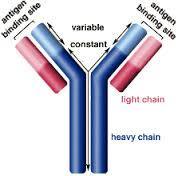
| On B cells, the receptors are called : | Immunoglobulins (Ig) or antibodies |
| Immunoglobulins (Ig) has many classes : | Examples: IgG, IgA, IgM, IgE, IgD |
| Variable region and constant region of antibodies | |
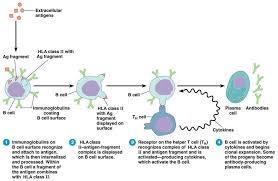
| iii) T-cell response | Antigens presented on APCs will activate T and B cells |
| For T cells, this activation stimulates their differentiation into : | - subtypes of T helper cells - memory cells - regulatory T cells -cytotoxic T cells |
| Process of T-cell activation | |
| iv) B-cell response | - sometimes can be activated without the help of T helper cells ( T-independent activation) -but most of the times, B cells requires activation by the T helper cells |
| Following activation, B cells differentiate into : | - memory B cells - regulatory B cells - plasma cells |
| Memory B cells | Store immunological memory |
| Regulatory B cells | Regulate other cells to prevent excessive inflammation and autoimmunity |
| Plasma cells | Launch billions of antibodies to attack the invaders |
| Antibodies disable the targets through: | - neutralisation - opsonisation -agglutination - antitoxin action |
| Neutralisation | block the receptor on a surface or the targets by neutralising them |
| Opsonisation | coat the targets and helping phagocytes to recognize them |
| Agglutination | link the targets with one another into large clumps, immobilizing then and enhancing their phagocytosis |
| Antitoxin action | bind to toxins produces by the targets and rendering them harmless |
Want to create your own Flashcards for free with GoConqr? Learn more.