
Flashcards
Consumer World
Cards in this deck (33)
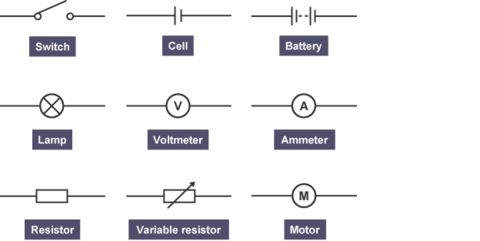
- 1Electrical circuit symbols: 1. Switch 2. Cell 3. Battery 4. Lamp 5. Voltmeter 6. Ammeter 7. Resistor 8. Variable Resistor 9. Motor 10. Fuse
- 2Difference between Series and Parallel Circuit.Series Circuit - The circuit starts with cell, going through other components but lead straight back to the cell.
Parallel Circuit - Multiple wires connected in parallel. The components on different wires keep working if a bulb stops working on a wire. - 3Voltage?Voltage is a measure of the difference in electrical energy between two parts of a circuit.
'Energy per unit Charged'
Voltage is supplied by the battery - Electromotive force voltage.
Voltage is used in components, not in wires.
Measures voltage across a component (not through).
Measured with voltmeter. (Parallel) - 4Electric Current?Current is the rate of flow of charge (usually flow of electrons).
Current is not used up.
Current through a component.
Measure in amps(amperes), A.
Measured using ammeter, connected in series, must break circuit. - 5Resistance?Resistance is measured in Ohms. It measures how much a component slows down the rate of flow.
- 6What is Ohm's Law?The current flowing through a wire is proportional to the potential difference (voltage) across it provided the temperature remain constant.
V = IR - 7V = IR What is V, R, and I?V = voltage (volts)
R = resistance (ohms)
I = Current (amps) - 8Resistance depends on:The length of the conductor - as length increases, resistance increases.
The cross Sectional area of the conductor - as area decreases, resistance increases.
The resistivity of the conductor (What it is made of) - as resistivity increases resistance increases. - 9Resistivity?Resistivity, p, is the property of a material - how hard it is for the current to pass through that material.
Resistance is related by: R = p * l/a
l = length of wire
a = cross sectional area of the wire. - 10Resistance is inversely proportional to ...Resistance is inversely proportional to the cross section area. As the area increases, the resistance decreases since the electrons can spread out more, there are less collisions.
- 11What happens if a metal gets hotter?If a metal gets hotter, the ions vibrate faster so the resistance increases. As more current passes through the bulb, it gets, hotter, so the resistance increases.
- 12What is non ohmic?A bulb is a non-ohmic conductor. Its voltage-current graph does not follow a straight line. Instead, it gives a curve with an increasing gradient. It shows that the resistance increases as the current increases.
- 13How is the voltage shared in a series circuit?In a series circuit, the voltage supplied by the battery is shared by the components.
Current is the same at any point.
Voltage splits up between each component. - 14How is the voltage shared in a Parallel circuit?In a parallel circuit, the voltage supplied is the same as the component's charge.
Current splits up down each "Strand/Path/Loop".
Voltage is the same at each "Strand/Path/Loop". - 15Non Renewable Resources?Coal, Oil and natural gas all release pollutant gases when burning.
Nuclear energy produces harmful radioactive waste. - 16Renewable Resources?Wind, Wave, Tidal, Hydroelectric, Geothermal, Solar Panel.
We may have an infinity supple of alternative resources, but each one has advantages and disadvantages. Some of them may have an negative effect on the surrounding environment. - 17What is Sankey DiagramA Sankey diagram helps to show how much energy is produced. The thickness of the arrow is shown to show the amount of energy.
- 18Formula of EfficiencyEfficiency = (Useful energy output * 100) / (Total Energy Input)
- 19What is Electricity?Electricity is the flow of electric charge - Electrons.
- 20What is Static Electricity?Static electricity results from an imbalance between negative and positive charges in objects. Electricity that collects on the surface of something and does not flow as a current and can cause a mild shock if you touch it.
- 21What are magnets?Magnet is an object that has a magnetic field around it. The force field of the magnet is concentrated at two points, North and South poles. If freely suspended, the north pole of the magnet will always suspend upwards. The magnetic field direction runs north to south.
- 22How to generate electricity using magnetic field?When we move a wire through a magnetic field, the magnetic field focus electrons in the wire to move within the wire. This creates electrical energy. voltage is the difference in electrical energy between two points. The process of moving wires in magnetic field is how most of our energy is produced. Turbines spin to either move the magnets, or move the wires around the magnets.
- 23What is a food chain?A food chain shows the flow of energy in an environment. All of energy in a food chain begins with the sun.
- 24What form of energy do plants provide to animals?Chemical Potential Energy.
- 25What do animals release?Animals release heat energy, kinetic energy and sound energy. This energy is lost from the food chain and cannot be used by predators. They can only gain chemical potential energy stored in the cells.
- 26Sun - Grass - Grasshopper - Shrew - OwlSun = Energy
Grass = Producer
Grasshopper = Primary Consumer
Shrew = Secondary Consumer
Owl = Tertiary Consumer - 27What are simple machines for?A simple machine reduces the amount of force needed to complete a task. It does this by increasing the distance that the object is moved through. A simple machine does not reduce the energy or work required.
- 28Wheel & Axle?Makes work easier by moving objects across distances. The wheel (or round end) turns with the axle (or cylindrical post) causing movement. On a wagon, for example, a container rests on top of the axle.
- 29Inclined Plane?A flat surface (or plane) that is slanted, or inclined, so it can help move objects across distances. A common inclined plane is a ramp.
- 30Wedge?Instead of using the smooth side of the inclined plane to make work easier, you can also use the pointed edges to do other kinds of work. When you use the edge to push things apart, this movable inclined plane is called a wedge. An ax blade is one example of a wedge.
- 31Lever?Any tool that pries something loose is a lever. Levers can also lift objects. A lever is an arm that “pivots” (or turns) against a fulcrum (the point or support on which a lever pivots). Think of the claw end of a hammer that you use to pry nails loose; it’s a lever. A see-saw is also a lever.
- 32Pulley?Instead of an axle, a wheel could also rotate a rope, cord, or belt. This variation of the wheel and axle is the pulley. In a pulley, a cord wraps around a wheel. As the wheel rotates, the cord moves in either direction. Attach a hook to the cord, and now you can use the wheel’s rotation to raise and lower objects, making work easier. On a flagpole, for example, a rope is attached to a pulley to raise and lower the flag more easily.
- 33Screw?When you wrap an inclined plane around a cylinder, its sharp edge becomes another simple tool: a screw. If you put a metal screw beside a ramp, it may be hard to see similarities, but a screw is actually just another kind of inclined plane. One example of how a screw helps you do work is that it can be easily turned to move itself through a solid space like a block of wood.
Information
- Description
- Science Flashcards on Consumer World, created by Sujen Phea on 22/10/2016.
- Created by
- Sujen Phea
- Views
- 0
- Rating