
Flashcards
Organic III
Cards in this deck (109)
- 1Define enthalpy change of hydrogenationWhen two atoms of hydrogen add across a double bond of one mole of an alkene
- 2What is the value for the enthalpy change of hydrogenation of cyclohexane?-120kj/mol
- 3What is the expected value for enthalpy of hydrogenation of the kekule structure for benzene?3 x -120 = -360kj/mol
- 4What is the value for the experimental enthalpy of hydrogenation for benzene?-208kj/mol
- 5Explain the difference in the theoretical and experimental values for enthalpy of hydrogenation of benzeneThe experimental value is less exothermic than the theoretical, showing that more energy is put in to break the bonds. This suggests that benzene is more stable than the kekule structure would be. This is thought to be due to a delocalised ring of electrons.
- 6Why doesn't benzene undergo addition reactions easily?The delocalised pi-bonds in benzene spread out the negative charge and make the ring very stable, so benzene is reluctant to break the ring. Benzene also has less attraction to electrophiles as the negative charge is reduced due to the ring.
- 7Give the equation and observations for when benzene completely combusts2C6H6 + 15O2 --> 12CO2 + 6H2O
Smoky flame - because of low carbon:hydrogen ratio - 8What are aromatic compounds?Compounds containing a benzene ring
- 9What reactions does benzene undergo?electrophilic substitution
- 10How does a halogen carrier work?It makes compounds stronger electrophiles by accepting a lone pair of electrons from a halogen atoms on an electrophile, which polarises the molecule and makes it more electrophilic.
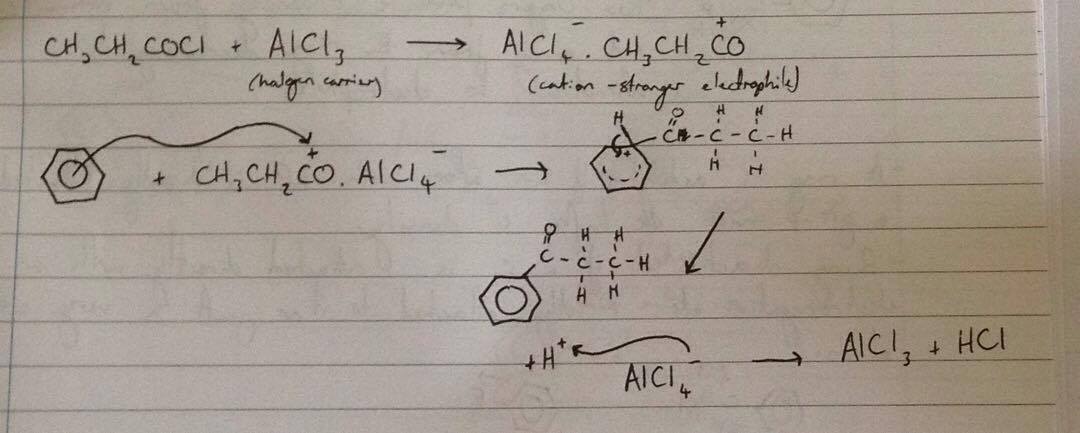
- 11Write down the mechanism for the reaction between propanoyl chloride and benzene (including formation of electrophile). What is this reaction called?Acylation (substitution by an acyl group)
- 12How would you form nitrobenzene from benzene?Warm with conc. nitric acid and conc. sulfuric acid.
- 13What is the catalyst used in a nitration reaction?Sulfuric acid - it reacts with nitric acid to form the electrophile (nitronium ion NO2^+)
- 14At what temperature does a mononitration reaction take place?Below 55 degrees
- 15Why is phenol more reactive than benzene?One of the lone pairs of electrons in a p-orbital of the oxygen atom overlaps with the delocalised pi-bonds in the benzene ring, which causes them to partially delocalise into the ring. This increases the electron density of the ring, making it more likely to be attacked by an electrophile.
- 16What is the organic product of the reaction between phenol and bromine water? Give the observations2,4,6-tribromophenol
Precipitate forms, smells of antiseptic - 17Describe how you would synthesise aspirin from salicyclic acidAdd some ethanoic anhydride and a few drops of phosphoric acid to salicyclic acid. Warm to 50 degrees and leave for 15 minutes. Then add cold water and cool on ice to allow aspirn crystals to form. Filter and recrystallise the crystals.
- 18What is an amine?An organic compound with the functional group NR2, where R is an alkyl group or a hydrogen
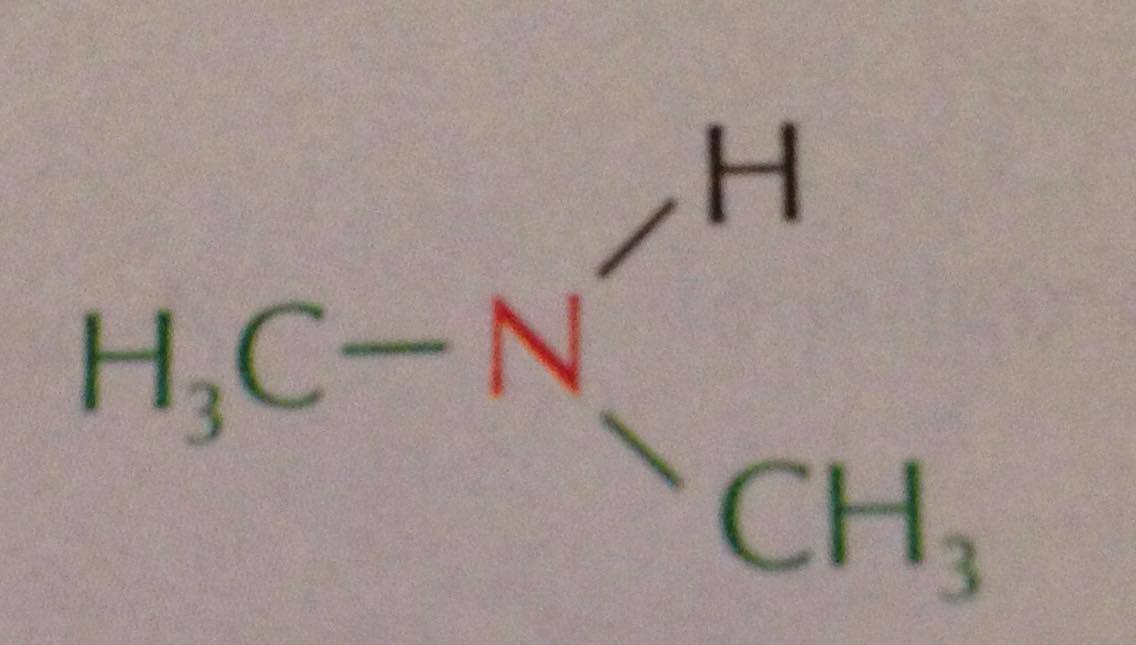
- 19Name this compoundDimethylamine
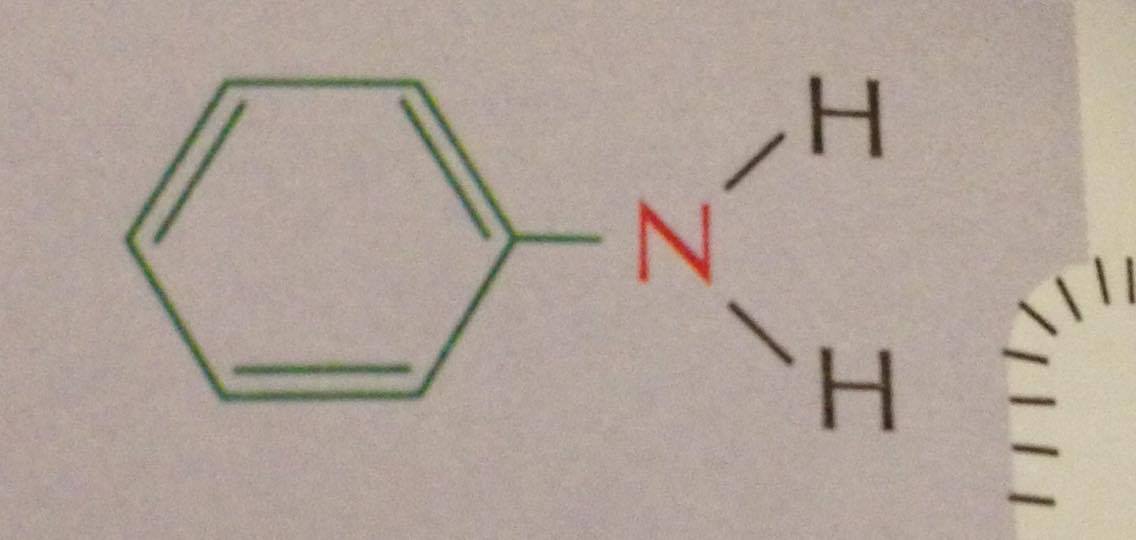
- 20Name this compoundPhenylamine
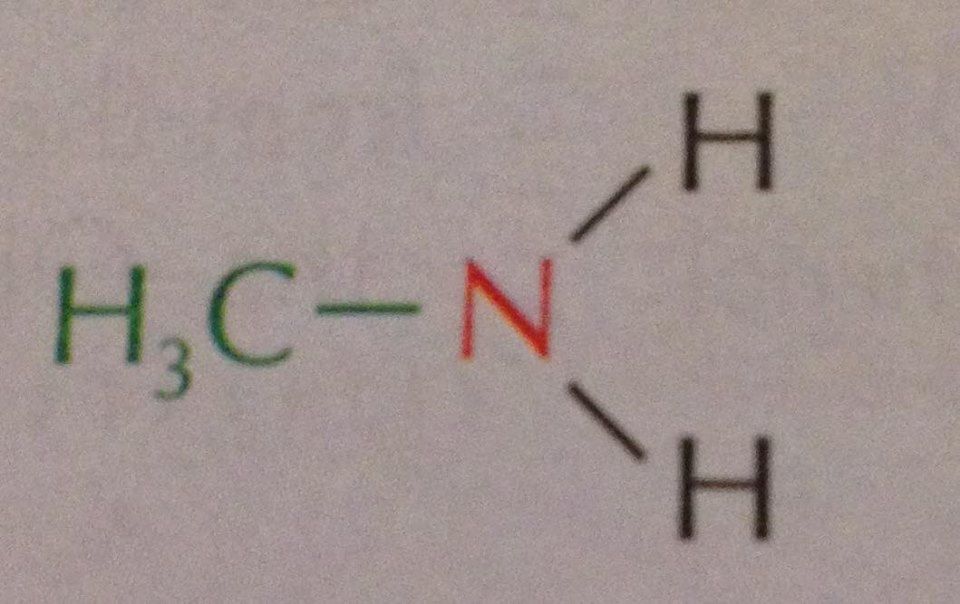
- 21Name this compoundMethylamine
- 22Name this compoundTetramethylamine ion
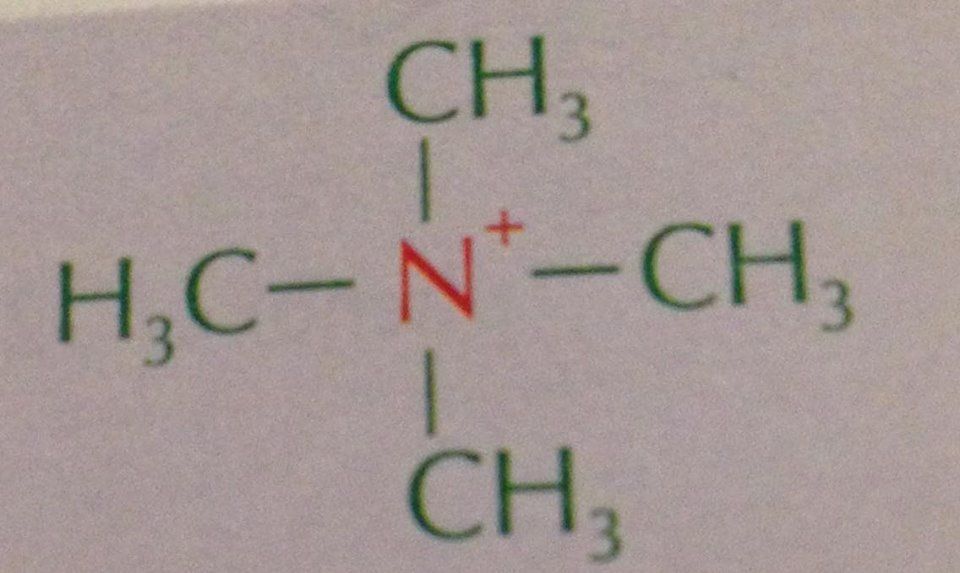
- 23Name this compoundTrimethylamine
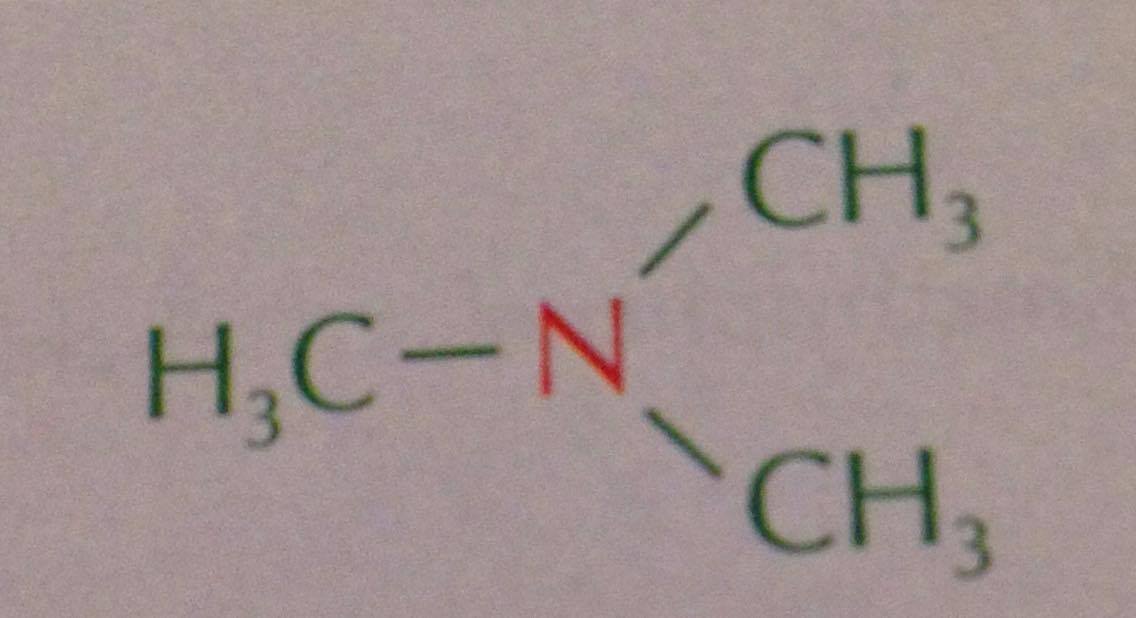
- 24What are aliphatic compounds?compounds without benzene ring structures
- 25Give the mechanism for the formation of ethylamine from 1-chloroethane
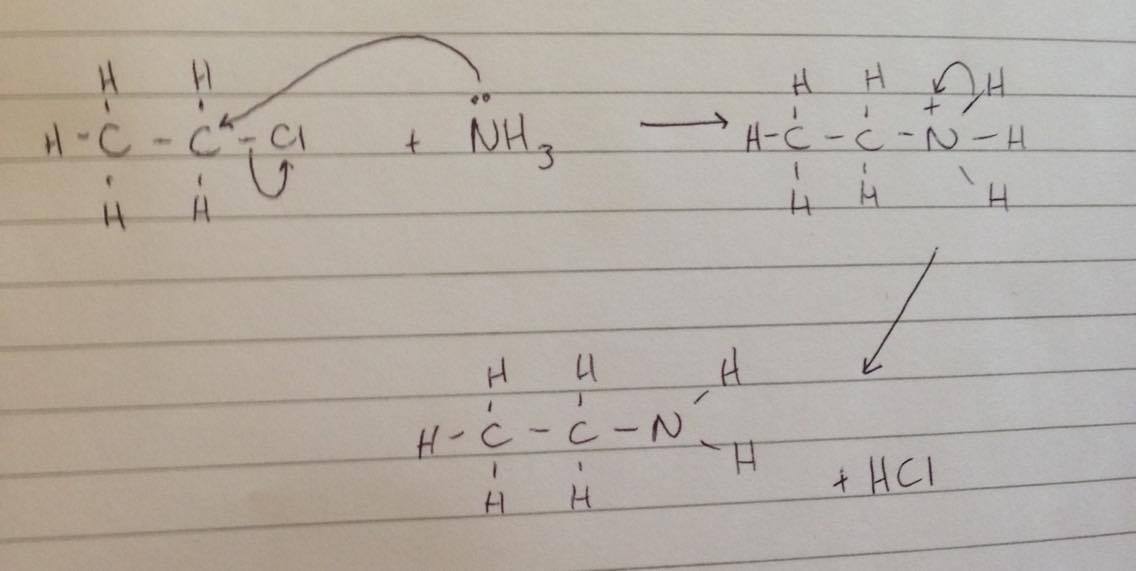
- 26Why is a mixture of primary, secondary, tertiary amines and quanternary ammonium salts formed when a primary halogenoalkane is reacted with ammonia?The nitrogen atom in the amine has a lone pair and so it undergos nucleophilic substitution reactions with other halogenoalkanes in the mixture.
- 27What are the two ways you can form a primary amine from a nitrile?Add lithium aluminium tetrahydride in dry ether, then some dilute acid
or
Use hydrogen gas at high temperature and pressure with a metal catalyst (catalytic hydrogenation) - 28How would you form an aromatic amine?Heat with an aromatic nitro compound (eg. nitrobenzene), tin and concentrated hydrochloric acid under reflux. Then add sodium hydroxide.
- 29Give the equation for the reduction of a nitrobenzene to form phenylamine
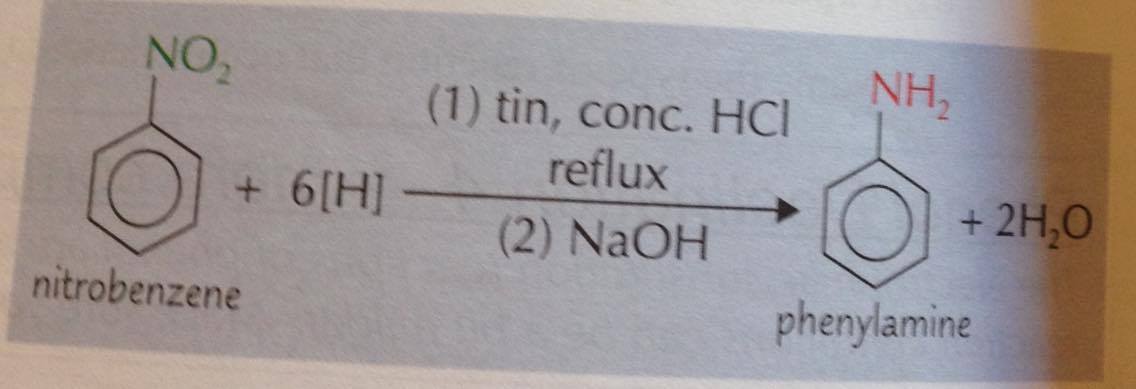
- 30How are primary aliphatic amines stronger bases than ammonia?Alkyl groups shift electron density onto the nitrogen atom, making the lone pair more available to accept protons
- 31Why are aromatic amines weak bases?The lone pair of electrons on the nitrogen overlap with the delocalised ring of electrons in the benzene, so electron density on the nitogen decreases. This makes the lone pair less available to accept protons
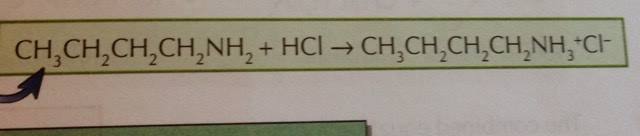
- 32Give the equation for the neutralisation of butylamine. Name the productButylammonium chloride
- 33How does solubility of amines change as you increase the carbon chain length?Solubility decreases as greater london forces form between amine molecules, which means more energy is required to overcome them to form new bonds with water
- 34Give the colour change when a small amount of butylamine is added to copper sulfate solution followed by an excess and explain why this change occurs.Blue -> Pale blue precipitate -> deep blue
When a small amount is added, the amine acts as a base and takes two H+ ions from the aqueous copper(II) complex, which forms insoluble copper hydroxide.
When an excess is added the precipitate dissolves to form a deep blue solution as butylamine molecules begin to replace the ligands, forming soluble complex ions. - 35Give the mechanism for the reaction between ethanoyl chloride and butylamine. Name the product
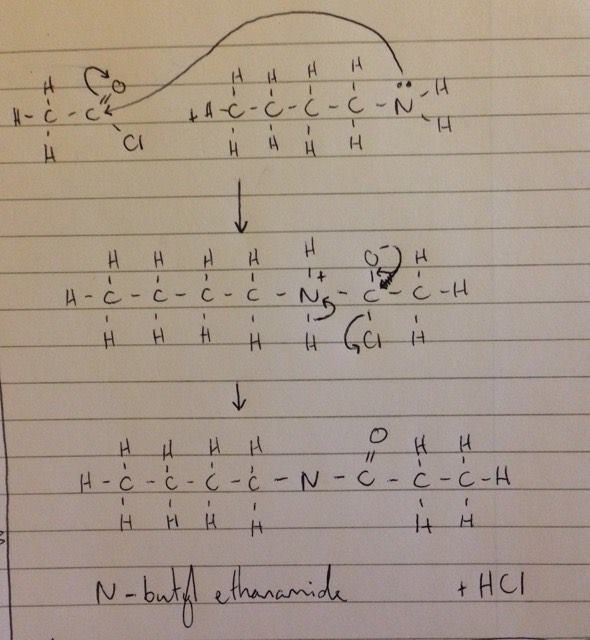
- 36What further reaction occurs after ethanoyl chloride and butylamine react?The HCl produced goes on to react with butylamine to form butylammonium chloride
- 37What are the observations for when ethanoyl chloride is added to conc. aqueous solution of an amine?Violent reaction, produces solid white product
- 38What is the functional group for an amide?-CONH2
- 39Why do amides behave differently from amines?The carbonyl group on the amide pulls electron density towards it and away from the NH2 group
- 40What is an N-substituted amide?When one of the H's on the N is substituted for an alkyl group
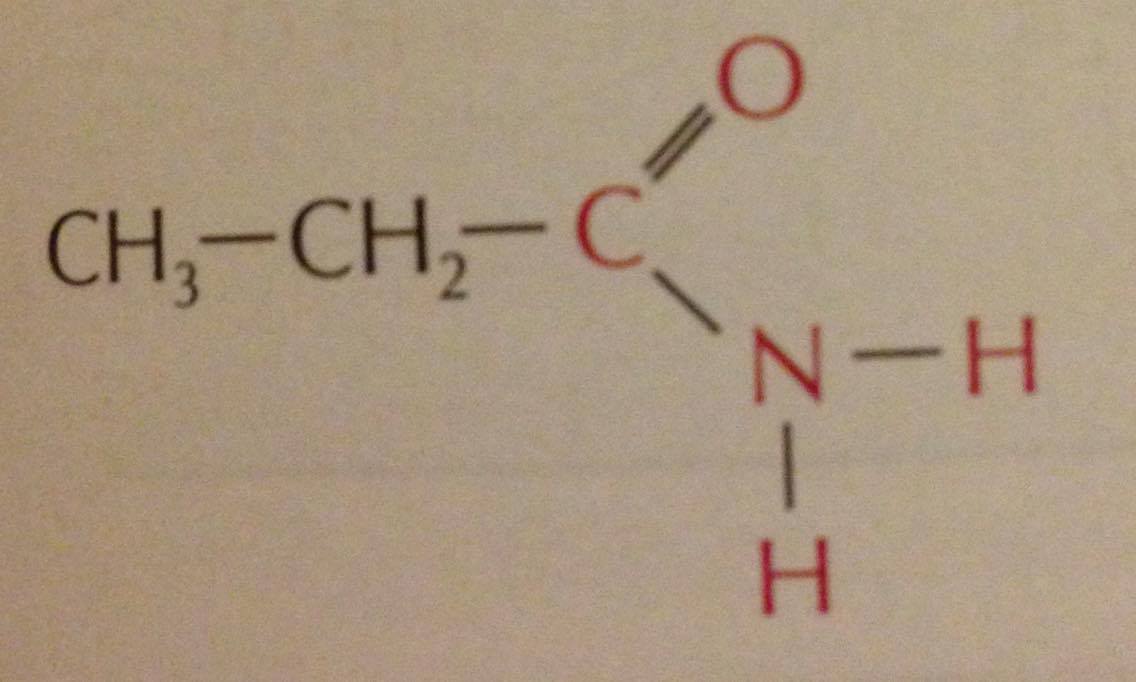
- 41Name this compoundPropanamide
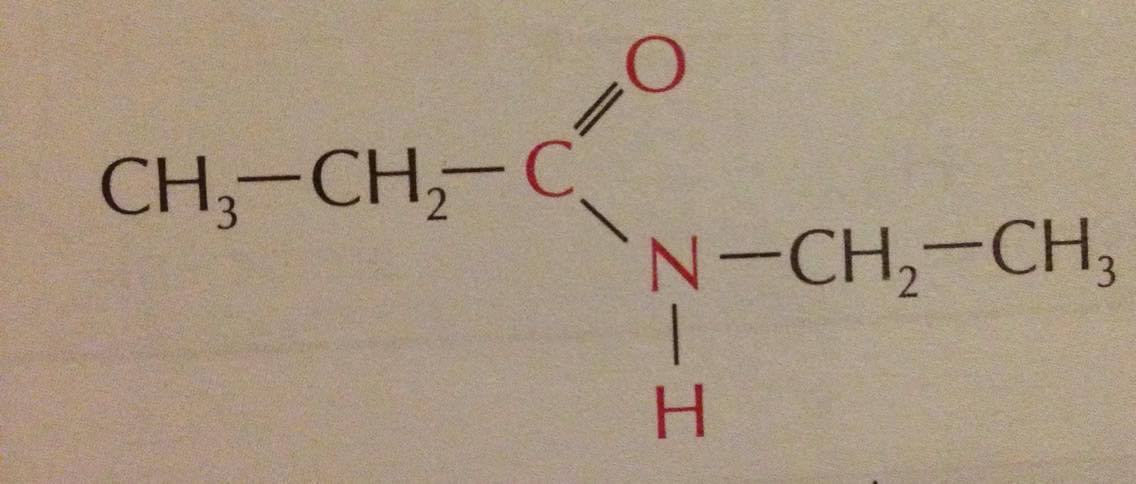
- 42Name this compoundN-ethylpropanamide
- 43How are primary amides formed?Adding concentrated ammonia to ethanoyl chloride at room temperature
- 44How are N-substituted amides formed?Adding a primary amine to ethanoyl chloride at room temperature
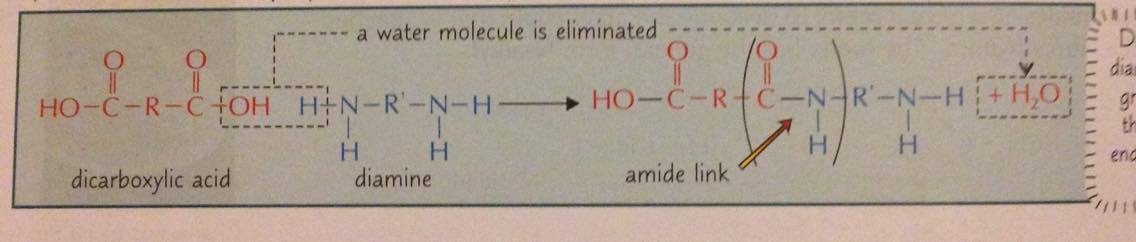
- 45What is condensation polymerisation?The joining of two different types of monomers with at least two functional groups, each functional group reacts with a group on another monomer to form a link
- 46What monomers react together to form polyamides?Dicarboxylic acids and diamines
- 47Give the equation for the formation polyamides
- 48Give the equation to show how amino acid monomers form protein chains
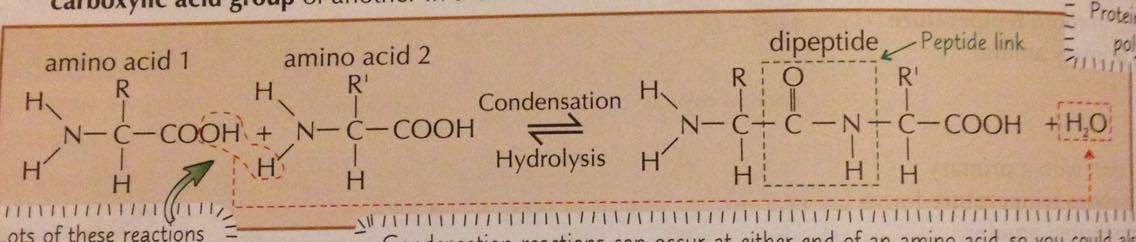
- 49How are amino acids hydrolysed?By adding hot aqueous 6M HCl, then reflux for 24 hours. This forms the ammonium salts of the amino acids, which are neutralised using a base.
- 50How are polyesters formed? Give the equation and label the ester linkCarboxyl groups react with hydroxyl groups to form ester links
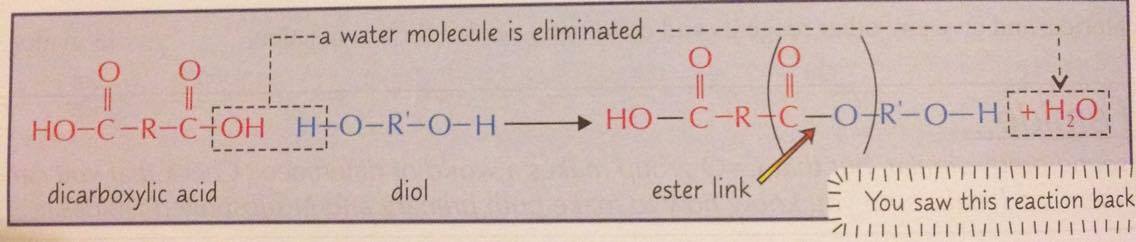
- 51Give the general structure of an amino acid
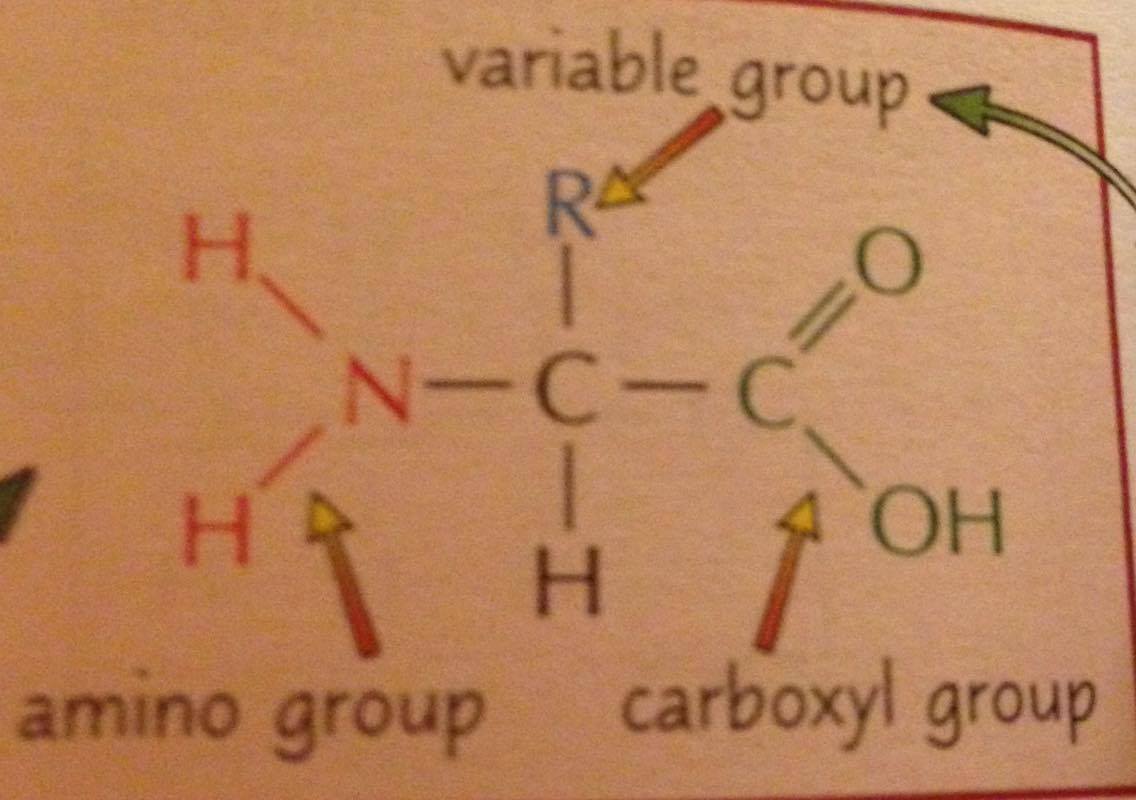
- 52What is a zwitterion?An overall neutral molecule that has both a positive and a negative charge on different parts of the molecule
- 53Under what conditions does an amino acid exist as a zwitterion?At the pH where the overall charge on the amino acid is zero (at its isoelectric point)
- 54How does the structure of amino acids change as pH increases?In acidic conditions, the NH2 group is protonated, giving the amino acid acidic properties.
At the isoelectric point, both the carboxyl group and the amino group are ionised, forming a zwitterion.
In basic conditions, the carboxyl group is deprotonted, giving the amino acid basic properties. - 55What type of amino acid is naturally occurring?2-amino acids, amino group positioned on carbon-2
- 56What amino acid is not chiral?Glycine
- 57How are grignard reagents formed?By refluxing a halogenoalkane with magnesium in dry ether
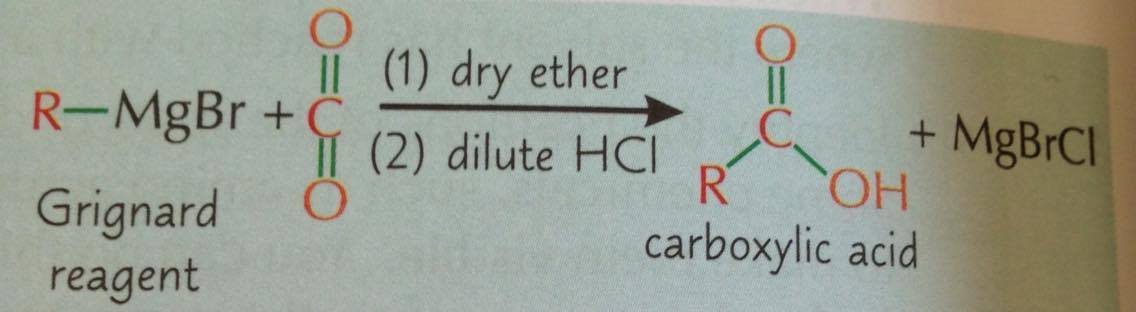
- 58Give the equation and conditions for the reaction between grignard reagent and carbon dioxideA new C-C forms between the C in the carbon dioxide and the C-Mg carbon from the grignard. One of the C=O bonds in the CO2 is broken to form a C-O-, which is then protonated by the acid to form a C-OH.
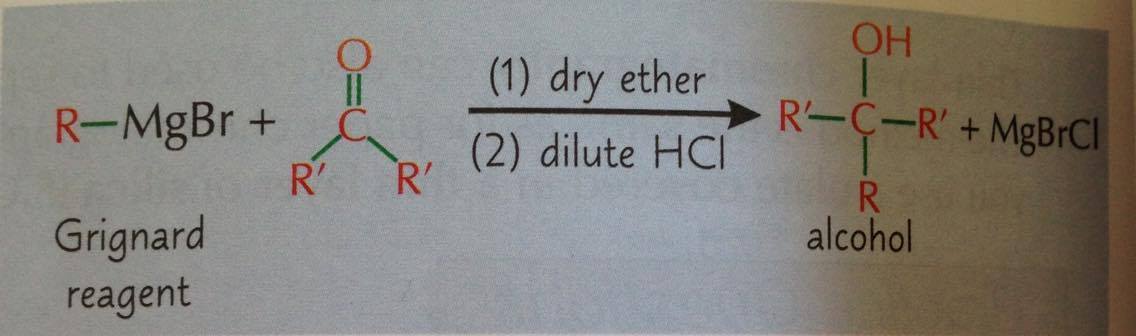
- 59How are alcohols formed from grignard reagents?An aldehyde or ketone is added - A new C-C bond forms between the C-Mg carbon and the C=O carbon, this breaks the C=O bond and when acid is added forms a C-OH group.
- 60What reactions do alkanes tend to undergo?Radical substitution
- 61What reactions do alkenes tend to undergo?Electrophilic addition
- 62What reactions do aromatic compounds tend to undergo?Electrophilic substitution
- 63What reactions do alcohols tend to undergo?Nucleophilic substitution, dehydration/elimination, esterfication, nucleophilic substitution
- 64What reactions do halogenoalkanes tend to undergo?Nucleophilic substitution, elimination
- 65What reactions do amines tend to undergo?Neutralisation, nucleophilic substitution
- 66What reactions do nitriles tend to undergo?Reduction, hydrolysis
- 67What reactions do aldehydes tend to undergo?Nucleophilic addition, reduction, oxidation
- 68What reactions do ketones tend to undergo?Nucleophilic addition, reduction
- 69What reactions do carboxylic acids tend to undergo?Neutralisation, esterfication, reduction
- 70What reactions do esters tend to undergo?Hydrolysis
- 71What reactions do acyl chlorides tend to undergo?Nucleophilic addition-elimination, condensation, friedel-crafts acylation
- 72How would you form a halogenoalkane from and alkane?X2 and UV light
- 73How would you form a halogenoalkane from an alkene?HX, room temperature
- 74How would you form an alkene from a halogenoalkane?Add KOH and ethanol and heat under reflux
- 75How would you form an alkane from an alkene?Add H2, nickel catalyst, 150degrees
- 76How would you form a dihalogenoalkane from an alkene?Add X2 at room temperature
- 77How would you form a diol from an alkene?Acidified KMnO4 at room temperature
- 78How would you form an alcohol from an alkene?Steam, H3PO4 catalyst, 300degrees, 60-70 atm
- 79How would you form an alkene from an alcohol?Conc. H3PO4, 170degrees
- 80How would you form an ester from an alcohol?Add carboxylic acid, acid catalyst, heat
or
Add an acyl chloride - 81How would you form an alcohol from an ester?Add dilute acid or alkali and reflux
- 82How would you form a bromoalkane from an alcohol?Add KBr, 50% conc. H2SO4 at room temperature
- 83How would you form a chloroalkane from an alcohol?Add PCl5 or HCl at room temperature
- 84How would you form an alcohol from a halogenoalkane?Add warm aqueous KOH and reflux
or
Add Mg, dry ether, then dilute acid - 85How would you form a primary amine from a halogenoalkane?Add excess ethanolic ammonia and heat
- 86How would you form a nitrile from a halogenoalkane?Add KCN and ethanol and reflux
- 87How would you form a carboxylic acid from a halogenoalkane?Add Mg, dry ether, CO2, then dilute acid
- 88How would you form an iodoalkane from an alcohol?Add red phosphorus, I2 (to make PI3), then reflux
- 89How would you make an aldehyde or ketone from an alcohol?Add K2Cr2O7 and sulfuric acid, distil primary for aldehydes and reflux secondary for ketones
- 90How would you form an alcohol from an aldehyde/ketone?Add LiAlH4
- 91How would you form a hydroxynitrile from an aldehyde/ketone?Add KCN and H+ or HCN, then ethanol and reflux
- 92How would you form a carboxylic acid from an alcohol?Add acidified potassium dichromate and reflux
- 93How would you form a carboxylic acid from a ketone?Add I2 and NaOH
- 94How would you form an alcohol from a carboxylic acid?Add LiAlH4
- 95How would you form a primary amine from a nitrile?Add LiAlH4, then dilute acid
or
H2, nickel or platinum catalyst and high pressure and temp - 96How would you form a carboxylic acid from a nitrile?Add dilute HCl and reflux
- 97How would you form an ester from a carboxylic acid?Add alcohol, acid catalyst and heat
- 98How would you form a carboxylic acid from an ester?Add dilute acid or alkali and reflux
- 99How would you form an ester from an acyl chloride?Add alcohol at room temperature
- 100How would you form a carboxylic acid from an acyl chloride?Add cold water
- 101How would you form an acyl chloride from a carboxylic acid?Add PCl5 at room temperature
- 102How would you form a primary amide from an acyl chloride?Add NH3 at room temperature
- 103How would you form an N-substituted amide from an acyl chloride?Add a primary amine at room temperature
- 104How would you form nitrobenzene from benzene?Add conc. nitric acid and conc. sulfuric acid below 55degrees
- 105How would you form phenylamine from nitrobenzene?Add tin, conc. HCl, reflux then add NaOH
- 106How would you form alkyl benzene from benzene?Add a halogenoalkane, AlCl3 catalyst, reflux
- 107How would you form a halobenzene from benzene?Add X2, halogen carrier at room temp
- 108How would you form phenylketone from benzene?Add an acyl chloride, AlCl3 catalyst and reflux
- 109How would you form a bromophenol from a phenol?Add bromine water
Information
- Description
- AS - Level Chemistry Flashcards on Organic III, created by Kayla Price on 20/05/2017.
- Created by
- Kayla Price
- Views
- 27
- Rating