
Flashcards
C4 Quiz
Cards in this deck (26)
- 1What is an element?A substance that cannot be broken down into anything simpler.
- 2How is spectrography used to identify elements?Element burned in a colourless flame and the light passed through a prism. Each element produces a unique line spectrum that allows it to be identified.
- 3What were the two rules by which Mendeleev constructed his periodic table?Put elements in order of relative atomic mass and put similar elements in the same column.
- 4What particles are found within an atom, where are they found, what mass do they have and what charge do they have?Proton- found in the nucleus weighing the same as a hydrogen atom with a positive charge.
Neutron- found in the nucleus weighing the same as a hydrogen atom with a neutral charge.
Electron- found in shells around nucleus, almost no mass with a negative charge. - 5Why do atoms have no overall charge? How are atoms listed in a modern periodic table?1) same number of protons as electrons, so charges balance. 2) By the number of protons they have (the proton number)
- 6What is the relative atomic mass?The sum of protons and neutrons in the nucleus.
- 7How many electrons are in the first 3 electron shells?2,8,8 (3rd shell only for the first 20 elements)
- 8What do periods show?The rows in a periodic table are called periods. From left to right across the period the number of elements in the outer shell increases from one element to the next. This is why there are only two elements in the first period.
- 9What happens to the energy level as electrons get further from the nucleus?The further it gets from the nucleus the higher the energy levels of the electron. Electrons can only have the energy corresponding to the energy level they are at, they cannot have energy between energy levels. This is why electrons stay in shells and do not fall in the nucleus.
- 10Where are metals and non-metals located on the periodic table?Metals: left Non-metals: right
- 11What can we tell from the number of electrons in the outer shell?1,2 or 3 electrons metal; non-metals have 5-7; 8 electrons inert gases.
- 12What are columns called in the periodic table and what do they show?Groups. Group number equals the number of electrons in the outer shell. All the elements in a group have similar properties.
- 13What is the name given to group 1? What are some properties of these substances?The alkali metals all have 1 electron in their outer shell. Are soft and can be cut easily. When freshly cut is shiny and silver in colour, in moist air the surface dulls rapidly. This is because the metals corrode or tarnish by reacting with the metals in the air. To slow down the reaction the metals are kept in oil and out of contact with air.
- 14What trends are there within group 1? Give an explanation for this.The alkali metals get more reactive further down the group. In addition melting point and boiling point decrease as you go down the group. In addition density also shows a trend. This is because as you go down the group the number of shells increases and the atoms get bigger. The outer electron is further and further from the nucleus, in a higher and higher energy level. This makes it easier for it to combine with other elements to form a stable compound; thus its reactivity increases.
- 15What is the general formula for alkali metals reacting with water?Alkali metal + water = hydrogen + alkali metal hydroxide.
- 16Write the general balanced equation for the reaction of alkali metals with chlorine.2 (alkali metal) (s) + Cl2 (g) = 2(alkali metal)Cl (s)
- 17What is the name given to group 7? Give 2 elements in this group.The halogens. (any two from) Fluorine, Chlorine, Bromine, Iodine and Astatine.
- 18What do the group 7 elements have in common? What trend is shown?They form diatomic molecules, meaning they have two atoms in each molecule. e.g. fluorine is F2. When they react to form molecules the -ine turns to -ide. E.g. fluorine reacts with sodium to form sodium fluoride. One trend shown is that as you go down the group the melting point increases. These similarities and trends can be explained through the electron arrangement. All halogens have seven electrons in the outer shells of their atom which is why they have similar properties. The patterns can be explained by the increasing number of shells and size of atoms down the group.
- 19What is formed when halogens react with alkali metals and other metals such as iron?Halides
- 20What is the trend of reactivity within the halogens? How can this be shown? Why is this?The halogens become less reactive down the group. This can be shown through displacement reactions where one halogen takes the place of another in its compounds. The elements further up the group are able to displace those further down the group from compounds showing they are more reactive. This is because in non-metals the smaller atoms combine most readily with other elements. Going down the halogen group the number of shells increases and the outer shell gets further from the nucleus, therefore the reactivity decreases.
- 21What is the general formula for reactions with halogens and alkali metals?2M +X2 = 2MX. When M stands for a group 1 element and X for any group 7 element.
- 22What similarities do the compounds formed of group 1 and group 7 elements have? Why is this?They are colourless, crystalline solids with high melting points and which, when melted, will conduct electricity. As an electric current is produced when charged particles, called ions, flow through a substance. Therefore all the substances must be ionic compounds as they are made of ions.
- 23Within these substances, which atoms form positive ions and which form negative ions and why?The group 1 metals form ions with a positive charge and the group 7 elements form ions with a negative charge. This is because in order for both particles to have full outer shells of electrons the alkali metals must lose an electron, and the halogens must gain an electron. As electrons carry a negative charge this results in the alkali metals forming positive ions and halogens forming negative ions.f
- 24What structure do ionic compounds have?A crystal lattice. This occurs as the ions pack together in a regular repeated pattern. For example in sodium chloride each positively charged sodium ion is surrounded by 6 negatively chlorine ions. This is turn is surrounded by 6 positively charged sodium ions. This pattern is repeated to form the cubic sodium chloride crystals.
- 25What happens when an ionic compound melts?The ions become free to move as the lattice structure is broken. This also occurs when the compound is dissolved in water. When an electric current is passed through the solution the charged ions move to the electrodes and so complete the circuit. This is why an ionic compound can only conduct electricity when it is liquid or in solution; it is only then that the ions can move.
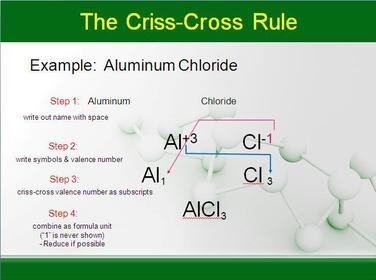
- 26How can we work out the formula of ionic compounds?
Information
- Description
- GCSE Chemistry (C4) Flashcards on C4 Quiz, created by harry.vinall on 30/05/2014.
- Created by
- harry.vinall · May 2014
- Updated
- Apr 6, 2018
- Views
- 37
- Rating