
Flowchart
Edward VI
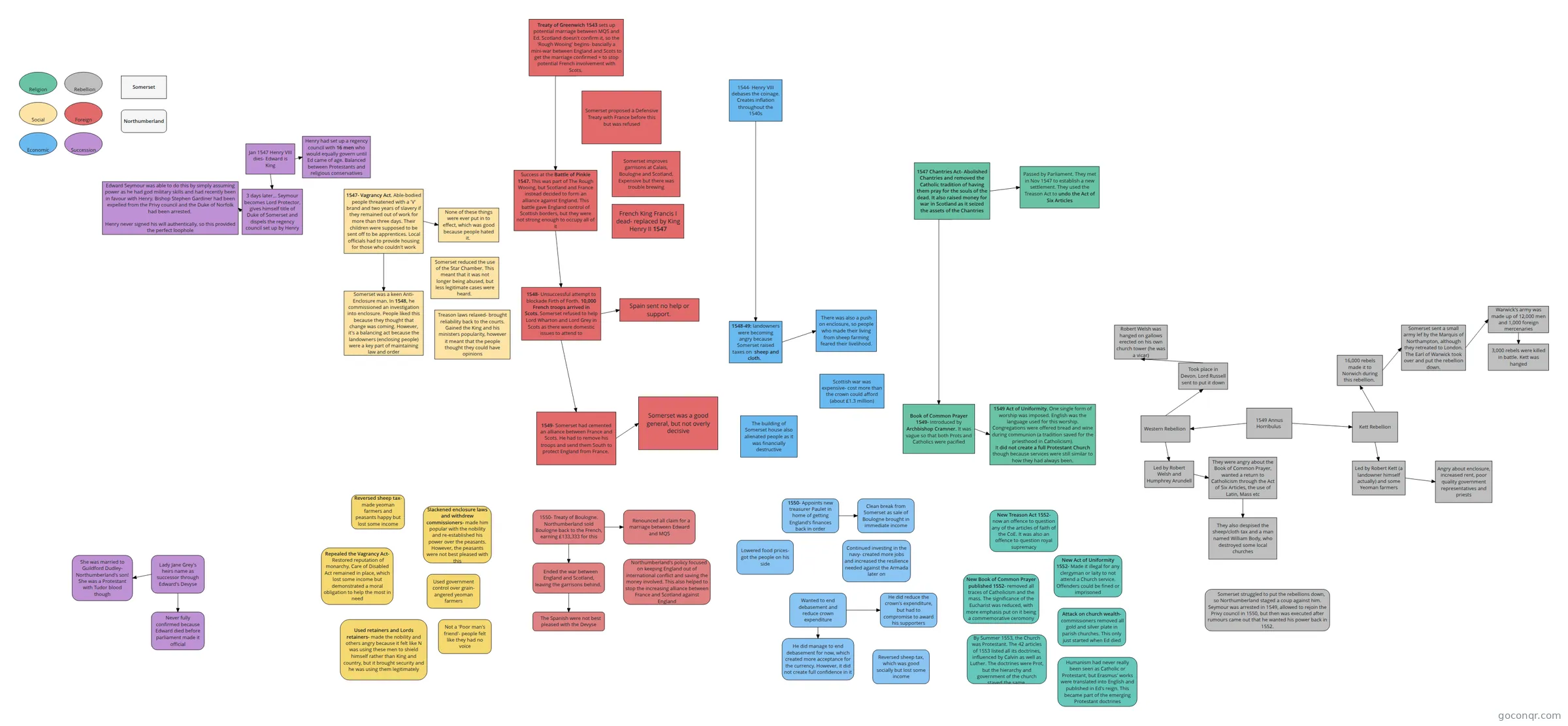
Flowchart: Edward VI reign
Flowchart content
Jan 1547 Henry VIII dies- Edward is King
3 days later... Seymour becomes Lord Protector, gives himself title of Duke of Somerset and dispels the regency council set up by Henry
Henry had set up a regency council with 16 men who would equally govern until Ed came of age. Balanced between Protestants and religious conservatives
Edward Seymour was able to do this by simply assuming power as he had god military skills and had recently been in favour with Henry. Bishop Stephen Gardiner had been expelled from the Privy council and the Duke of Norfolk had been arrested.
Henry never signed his will authentically, so this provided the perfect loophole
1547- Vagrancy Act. Able-bodied people threatened with a 'V' brand and two years of slavery if they remained out of work for more than three days. Their children were supposed to be sent off to be apprentices. Local officials had to provide housing for those who couldn't work
Social
Economic
Religion
Foreign
Rebellion
Succession
None of these things were ever put in to effect, which was good because people hated it.
Success at the Battle of Pinkie 1547. This was part of The Rough Wooing, but Scotland and France instead decided to form an alliance against England. This battle gave England control of Scottish borders, but they were not strong enough to occupy all of it
Treaty of Greenwich 1543 sets up potential marriage between MQS and Ed. Scotland doesn't confirm it, so the 'Rough Wooing' begins- bascially a mini-war between England and Scots to get the marriage confirmed + to stop potential French involvement with Scots.
1544- Henry VIII debases the coinage. Creates inflation throughout the 1540s
Somerset was a keen Anti-Enclosure man. In 1548, he commissioned an investigation into enclosure. People liked this because they thought that change was coming. However, it's a balancing act because the landowners (enclosing people) were a key part of maintaining law and order
Somerset reduced the use of the Star Chamber. This meant that it was not longer being abused, but less legitimate cases were heard.
Northumberland
Somerset
Treason laws relaxed- brought reliability back to the courts. Gained the King and his ministers popularity, however it meant that the people thought they could have opinions
1548- Unsuccessful attempt to blockade Firth of Forth. 10,000 French troops arrived in Scots. Somerset refused to help Lord Wharton and Lord Grey in Scots as there were domestic issues to attend to
Somerset proposed a Defensive Treaty with France before this but was refused
Somerset improves garrisons at Calais, Boulogne and Scotland. Expensive but there was trouble brewing
Spain sent no help or support.
1549- Somerset had cemented an alliance between France and Scots. He had to remove his troops and send them South to protect England from France.
Somerset was a good general, but not overly decisive
1548-49: landowners were becoming angry because Somerset raised taxes on sheep and cloth.
There was also a push on enclosure, so people who made their living from sheep farming feared their livelihood.
Scottish war was expensive- cost more than the crown could afford (about £1.3 million)
The building of Somerset house also alienated people as it was financially destructive
Book of Common Prayer 1549- Introduced by Archbishop Cramner. It was vague so that both Prots and Catholics were pacified
1547 Chantries Act- Abolished Chantries and removed the Catholic tradition of having them pray for the souls of the dead. It also raised money for war in Scotland as it seized the assets of the Chantries
Passed by Parliament. They met in Nov 1547 to establish a new settlement. They used the Treason Act to undo the Act of Six Articles
French King Francis I dead- replaced by King Henry II 1547
1549 Act of Uniformity. One single form of worship was imposed. English was the language used for this worship. Congregations were offered bread and wine during communion (a tradition saved for the priesthood in Catholicism).
It did not create a full Protestant Church though because services were still similar to how they had always been.
1549 Annus Horribulus
Western Rebellion
Kett Rebellion
Led by Robert Kett (a landowner himself actually) and some Yeoman farmers
Angry about enclosure, increased rent, poor quality government representatives and priests
16,000 rebels made it to Norwich during this rebellion.
Somerset sent a small army lef by the Marquis of Northampton, although they retreated to London. The Earl of Warwick took over and put the rebellion down.
Warwick's army was made up of 12,000 men and 1,000 foreign mercenaries
3,000 rebels were killed in battle. Kett was hanged
Led by Robert Welsh and Humphrey Arundell
They were angry about the Book of Common Prayer, wanted a return to Catholicism through the Act of Six Articles, the use of Latin, Mass etc
Took place in Devon. Lord Russell sent to put it down
They also despised the sheep/cloth tax and a man named William Body, who destroyed some local churches
Robert Welsh was hanged on gallows erected on his own church tower (he was a vicar)
Somerset struggled to put the rebellions down, so Northumberland staged a coup against him. Seymour was arrested in 1549, allowed to rejoin the Privy council in 1550, but then was executed after rumours came out that he wanted his power back in 1552.
1550- Treaty of Boulogne. Northumberland sold Boulogne back to the French, earning £133,333 for this
Ended the war between England and Scotland, leaving the garrisons behind.
Renounced all claim for a marriage between Edward and MQS
The Spanish were not best pleased with the Devyse
Northumberland's policy focused on keeping England out of international conflict and saving the money involved. This also helped to stop the increasing alliance between France and Scotland against England
1550- Appoints new treasurer Paulet in home of getting England's finances back in order
Lowered food prices- got the people on his side
Clean break from Somerset as sale of Boulogne brought in immediate income
Continued investing in the navy- created more jobs and increased the resilience needed against the Armada later on
Wanted to end debasement and reduce crown expenditure
He did reduce the crown's expenditure, but had to compromise to award his supporters
He did manage to end debasement for now, which created more acceptance for the currency. However, it did not create full confidence in it
Reversed sheep tax, which was good socially but lost some income
Reversed sheep tax- made yeoman farmers and peasants happy but lost some income
Slackened enclosure laws and withdrew commissioners- made him popular with the nobility and re-established his power over the peasants. However, the peasants were not best pleased with this
Repealed the Vagrancy Act- Restored reputation of monarchy. Care of Disabled Act remained in place, which lost some income but demonstrated a moral obligation to help the most in need
Used government control over grain- angered yeoman farmers
Used retainers and Lords retainers- made the nobility and others angry because it felt like N was using these men to shield himself rather than King and country, but it brought security and he was using them legitimately
Not a 'Poor man's friend'- people felt like they had no voice
New Treason Act 1552- now an offence to question any of the articles of faith of the CoE. It was also an offence to question royal supremacy
New Act of Uniformity 1552- Made it illegal for any clergyman or laity to not attend a Church service. Offenders could be fined or imprisoned
New Book of Common Prayer published 1552- removed all traces of Catholicism and the mass. The significance of the Eucharist was reduced, with more emphasis put on it being a commemorative ceromony
Lady Jane Grey's heirs name as successor through Edward's Devyse
Never fully confirmed because Edward died before parliament made it official
She was married to Guildford Dudley- Northumberland's son! She was a Protestant with Tudor blood though
Attack on church wealth- commissioners removed all gold and silver plate in parish churches. This only just started when Ed died
By Summer 1553, the Church was Protestant. The 42 articles of 1553 listed all its doctrines, influenced by Calvin as well as Luther. The doctrines were Prot, but the hierarchy and government of the church stayed the same.
Humanism had never really been seen as Catholic or Protestant, but Erasmus' works were translated into English and published in Ed's reign. This became part of the emerging Protestant doctrines
Information
- Description
- A level History (Tudors) (Edward VI) Flowchart on Edward VI, created by Lucy Voakes on 03/05/2023.
- Created by
- Lucy Voakes
- Views
- 0
- Rating