
Mind map
GRAMMAR: THE ESSENTIALS IN SCIENTIFIC WRITING
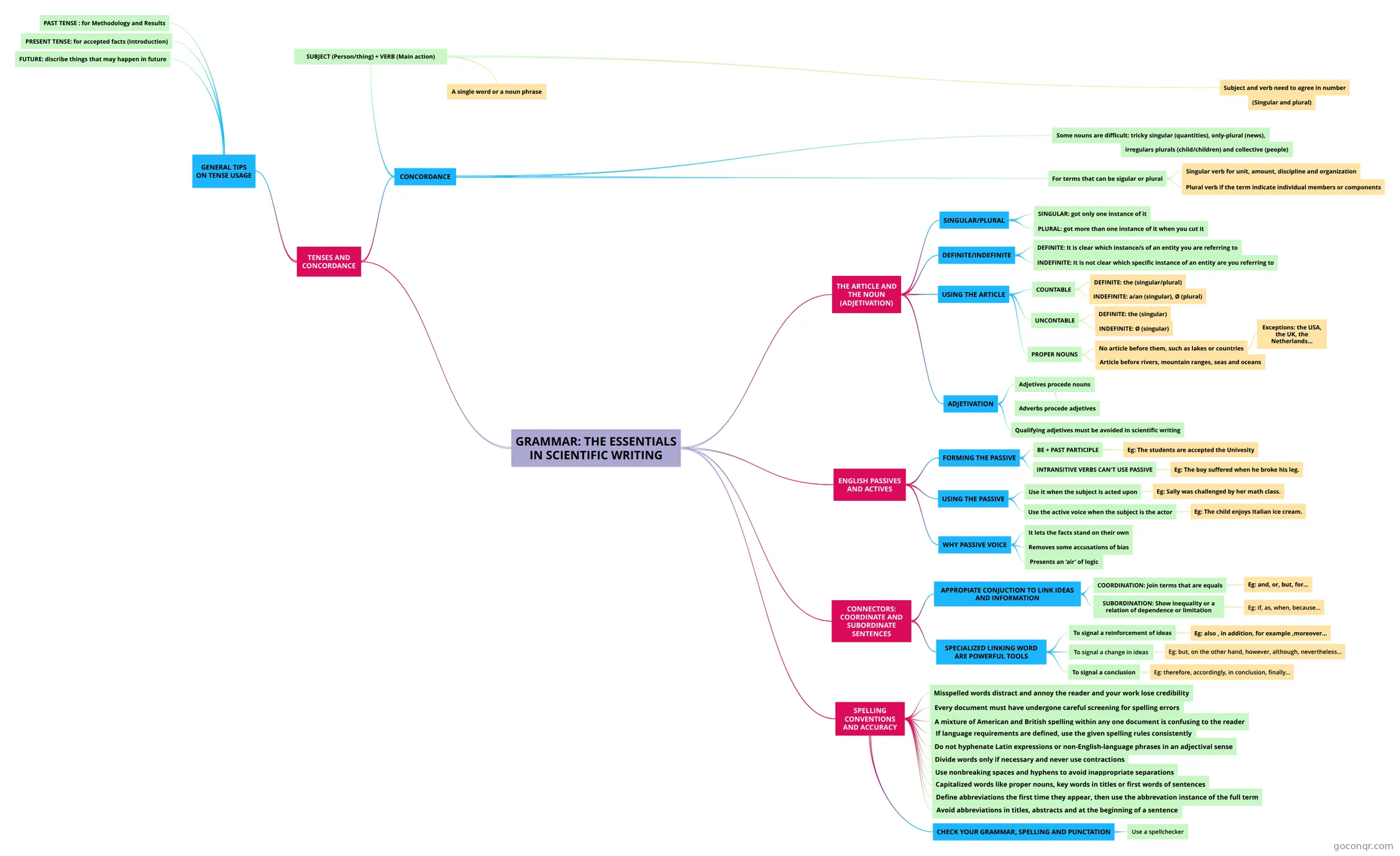
Mind map: Grammar essentials in scientific writing
Map content
GRAMMAR: THE ESSENTIALS IN SCIENTIFIC WRITING
TENSES AND CONCORDANCE
- GENERAL TIPS ON TENSE USAGE
- PAST TENSE : for Methodology and Results
- PRESENT TENSE: for accepted facts (Introduction)
- FUTURE: discribe things that may happen in future
- CONCORDANCE
- SUBJECT (Person/thing) + VERB (Main action)
- A single word or a noun phrase
- Subject and verb need to agree in number
- (Singular and plural)
- Some nouns are difficult: tricky singular (quantities), only-plural (news),
- irregulars plurals (child/children) and collective (people)
- For terms that can be sigular or plural
- Singular verb for unit, amount, discipline and organization
- Plural verb if the term indicate individual members or components
- SUBJECT (Person/thing) + VERB (Main action)
- GENERAL TIPS ON TENSE USAGE
THE ARTICLE AND THE NOUN (ADJETIVATION)
- SINGULAR/PLURAL
- SINGULAR: got only one instance of it
- PLURAL: got more than one instance of it when you cut it
- DEFINITE/INDEFINITE
- DEFINITE: It is clear which instance/s of an entity you are referring to
- INDEFINITE: It is not clear which specific instance of an entity are you referring to
- USING THE ARTICLE
- COUNTABLE
- DEFINITE: the (singular/plural)
- INDEFINITE: a/an (singular), Ø (plural)
- UNCONTABLE
- DEFINITE: the (singular)
- INDEFINITE: Ø (singular)
- PROPER NOUNS
- No article before them, such as lakes or countries
- Exceptions: the USA, the UK, the Netherlands...
- Article before rivers, mountain ranges, seas and oceans
- No article before them, such as lakes or countries
- COUNTABLE
- ADJETIVATION
- Adjetives procede nouns
- Adverbs procede adjetives
- Qualifying adjetives must be avoided in scientific writing
- Adjetives procede nouns
- SINGULAR/PLURAL
ENGLISH PASSIVES AND ACTIVES
- FORMING THE PASSIVE
- BE + PAST PARTICIPLE
- Eg: The students are accepted the Univesity
- INTRANSITIVE VERBS CAN'T USE PASSIVE
- Eg: The boy suffered when he broke his leg.
- BE + PAST PARTICIPLE
- USING THE PASSIVE
- Use it when the subject is acted upon
- Eg: Sally was challenged by her math class.
- Use the active voice when the subject is the actor
- Eg: The child enjoys Italian ice cream.
- Use it when the subject is acted upon
- WHY PASSIVE VOICE
- It lets the facts stand on their own
- Removes some accusations of bias
- Presents an ‘air’ of logic
- FORMING THE PASSIVE
CONNECTORS: COORDINATE AND SUBORDINATE SENTENCES
- APPROPIATE CONJUCTION TO LINK IDEAS AND INFORMATION
- COORDINATION: Join terms that are equals
- Eg: and, or, but, for...
- SUBORDINATION: Show inequality or a relation of dependence or limitation
- Eg: if, as, when, because...
- COORDINATION: Join terms that are equals
- SPECIALIZED LINKING WORD ARE POWERFUL TOOLS
- To signal a reinforcement of ideas
- Eg: also , in addition, for example ,moreover...
- To signal a change in ideas
- Eg: but, on the other hand, however, although, nevertheless...
- To signal a conclusion
- Eg: therefore, accordingly, in conclusion, finally...
- To signal a reinforcement of ideas
- APPROPIATE CONJUCTION TO LINK IDEAS AND INFORMATION
SPELLING CONVENTIONS AND ACCURACY
- Misspelled words distract and annoy the reader and your work lose credibility
- Every document must have undergone careful screening for spelling errors
- A mixture of American and British spelling within any one document is confusing to the reader
- If language requirements are defined, use the given spelling rules consistently
- Do not hyphenate Latin expressions or non-English-language phrases in an adjectival sense
- Divide words only if necessary and never use contractions
- Use nonbreaking spaces and hyphens to avoid inappropriate separations
- Capitalized words like proper nouns, key words in titles or first words of sentences
- Define abbreviations the first time they appear, then use the abbrevation instance of the full term
- Avoid abbreviations in titles, abstracts and at the beginning of a sentence
- CHECK YOUR GRAMMAR, SPELLING AND PUNCTATION
- Use a spellchecker
Information
- Description
- traduccion Lingüística Mind Map on GRAMMAR: THE ESSENTIALS IN SCIENTIFIC WRITING, created by Mari Paz Mena on 27/02/2019.
- Created by
- Mari Paz Mena
- Views
- 0
- History
-
- Created by Mari Paz Mena · Feb 27, 2019
- Copied by Mari Paz Mena · Feb 27, 2019
- Rating