
Mind map
Getting to Yes: Negotiating agreement without giving in
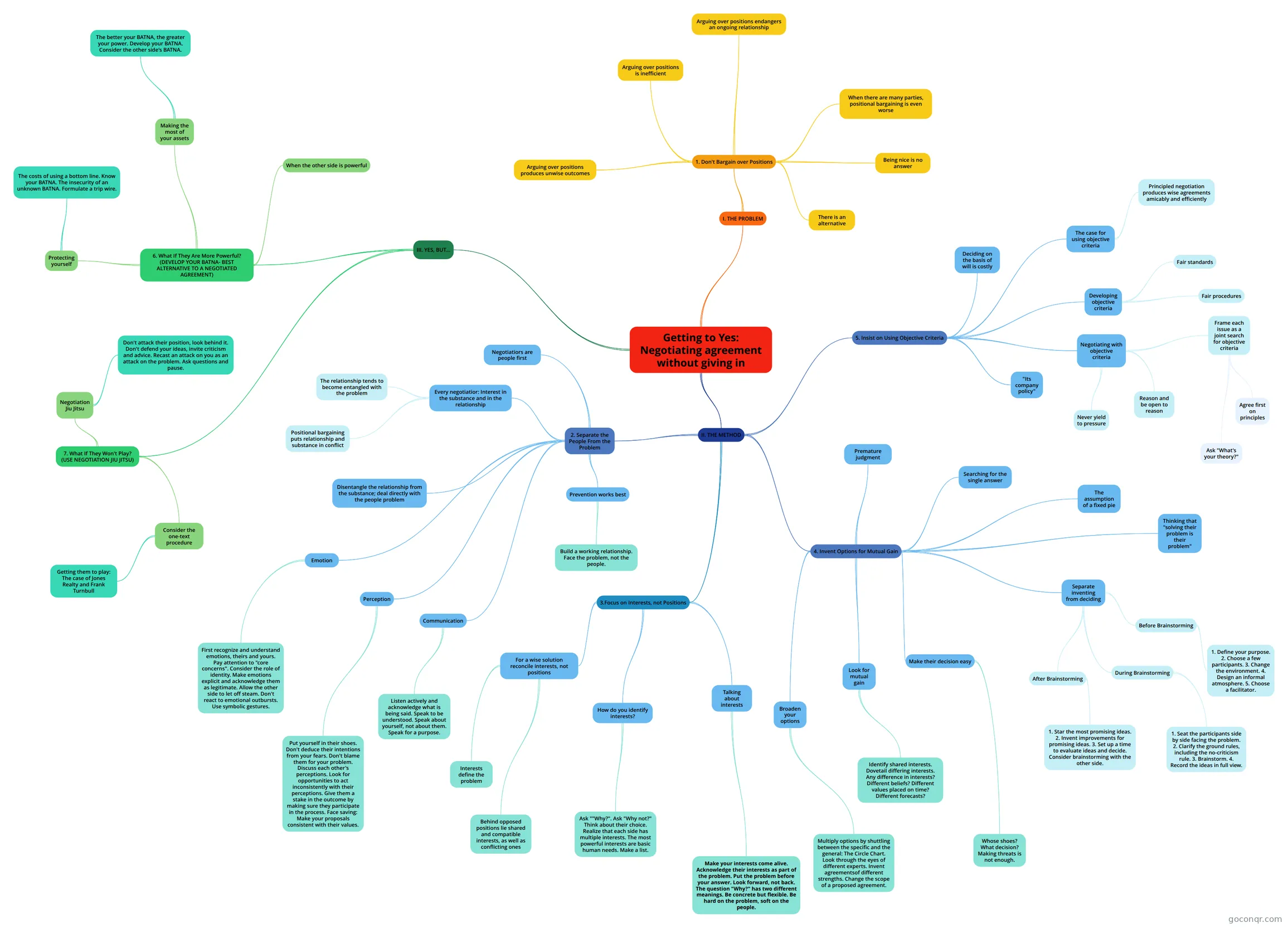
Mind map: Getting to Yes: negotiating agreement without giving in
Map content
Getting to Yes: Negotiating agreement without giving in
I. THE PROBLEM
- 1. Don't Bargain over Positions
- Arguing over positions produces unwise outcomes
- Arguing over positions is inefficient
- Arguing over positions endangers an ongoing relationship
- When there are many parties, positional bargaining is even worse
- Being nice is no answer
- There is an alternative
- 1. Don't Bargain over Positions
II. THE METHOD
- 3.Focus on Interests, not Positions
- For a wise solution reconcile interests, not positions
- Interests define the problem
- Behind opposed positions lie shared and compatible interests, as well as conflicting ones
- How do you identify interests?
- Ask ""Why?". Ask "Why not?" Think about their choice. Realize that each side has multiple interests. The most powerful interests are basic human needs. Make a list.
- Talking about interests
- Make your interests come alive. Acknowledge their interests as part of the problem. Put the problem before your answer. Look forward, not back. The question "Why?" has two different meanings. Be concrete but flexible. Be hard on the problem, soft on the people.
- For a wise solution reconcile interests, not positions
- 5. Insist on Using Objective Criteria
- The case for using objective criteria
- Principled negotiation produces wise agreements amicably and efficiently
- Developing objective criteria
- Fair standards
- Fair procedures
- Negotiating with objective criteria
- Frame each issue as a joint search for objective criteria
- Ask "What's your theory?"
- Agree first on principles
- Reason and be open to reason
- Never yield to pressure
- Frame each issue as a joint search for objective criteria
- Deciding on the basis of will is costly
- "Its company policy"
- The case for using objective criteria
- 2. Separate the People From the Problem
- Communication
- Listen actively and acknowledge what is being said. Speak to be understood. Speak about yourself, not about them. Speak for a purpose.
- Disentangle the relationship from the substance; deal directly with the people problem
- Emotion
- First recognize and understand emotions, theirs and yours. Pay attention to "core concerns". Consider the role of identity. Make emotions explicit and acknowledge them as legitimate. Allow the other side to let off steam. Don't react to emotional outbursts. Use symbolic gestures.
- Perception
- Put yourself in their shoes. Don't deduce their intentions from your fears. Don't blame them for your problem. Discuss each other's perceptions. Look for opportunities to act inconsistently with their perceptions. Give them a stake in the outcome by making sure they participate in the process. Face saving: Make your proposals consistent with their values.
- Every negotiatior: Interest in the substance and in the relationship
- The relationship tends to become entangled with the problem
- Positional bargaining puts relationship and substance in conflict
- Negotiatiors are people first
- Prevention works best
- Build a working relationship. Face the problem, not the people.
- Communication
- 4. Invent Options for Mutual Gain
- Broaden your options
- Multiply options by shuttling between the specific and the general: The Circle Chart. Look through the eyes of different experts. Invent agreementsof different strengths. Change the scope of a proposed agreement.
- Searching for the single answer
- Make their decision easy
- Whose shoes? What decision? Making threats is not enough.
- Premature judgment
- The assumption of a fixed pie
- Look for mutual gain
- Identify shared interests. Dovetail differing interests. Any difference in interests? Different beliefs? Different values placed on time? Different forecasts?
- Separate inventing from deciding
- Before Brainstorming
- 1. Define your purpose. 2. Choose a few participants. 3. Change the environment. 4. Design an informal atmosphere. 5. Choose a facilitator.
- During Brainstorming
- 1. Seat the participants side by side facing the problem. 2. Clarify the ground rules, including the no-criticism rule. 3. Brainstorm. 4. Record the ideas in full view.
- After Brainstorming
- 1. Star the most promising ideas. 2. Invent improvements for promising ideas. 3. Set up a time to evaluate ideas and decide. Consider brainstorming with the other side.
- Before Brainstorming
- Thinking that "solving their problem is their problem"
- Broaden your options
- 3.Focus on Interests, not Positions
III. YES, BUT...
- 6. What If They Are More Powerful? (DEVELOP YOUR BATNA- BEST ALTERNATIVE TO A NEGOTIATED AGREEMENT)
- Protecting yourself
- The costs of using a bottom line. Know your BATNA. The insecurity of an unknown BATNA. Formulate a trip wire.
- Making the most of your assets
- The better your BATNA, the greater your power. Develop your BATNA. Consider the other side's BATNA.
- When the other side is powerful
- Protecting yourself
- 7. What If They Won't Play? (USE NEGOTIATION JIU JITSU)
- Negotiation Jiu Jitsu
- Don't attack their position, look behind it. Don't defend your ideas, invite criticism and advice. Recast an attack on you as an attack on the problem. Ask questions and pause.
- Consider the one-text procedure
- Getting them to play: The case of Jones Realty and Frank Turnbull
- Negotiation Jiu Jitsu
- 6. What If They Are More Powerful? (DEVELOP YOUR BATNA- BEST ALTERNATIVE TO A NEGOTIATED AGREEMENT)
Information
- Description
- Expresion jurídica Derecho Mind Map on Getting to Yes: Negotiating agreement without giving in, created by emilio12av on 17/04/2016.
- Created by
- emilio12av
- Views
- 1
- Rating
More on Principled Negotiation