
Mind map
Atmospheric composition
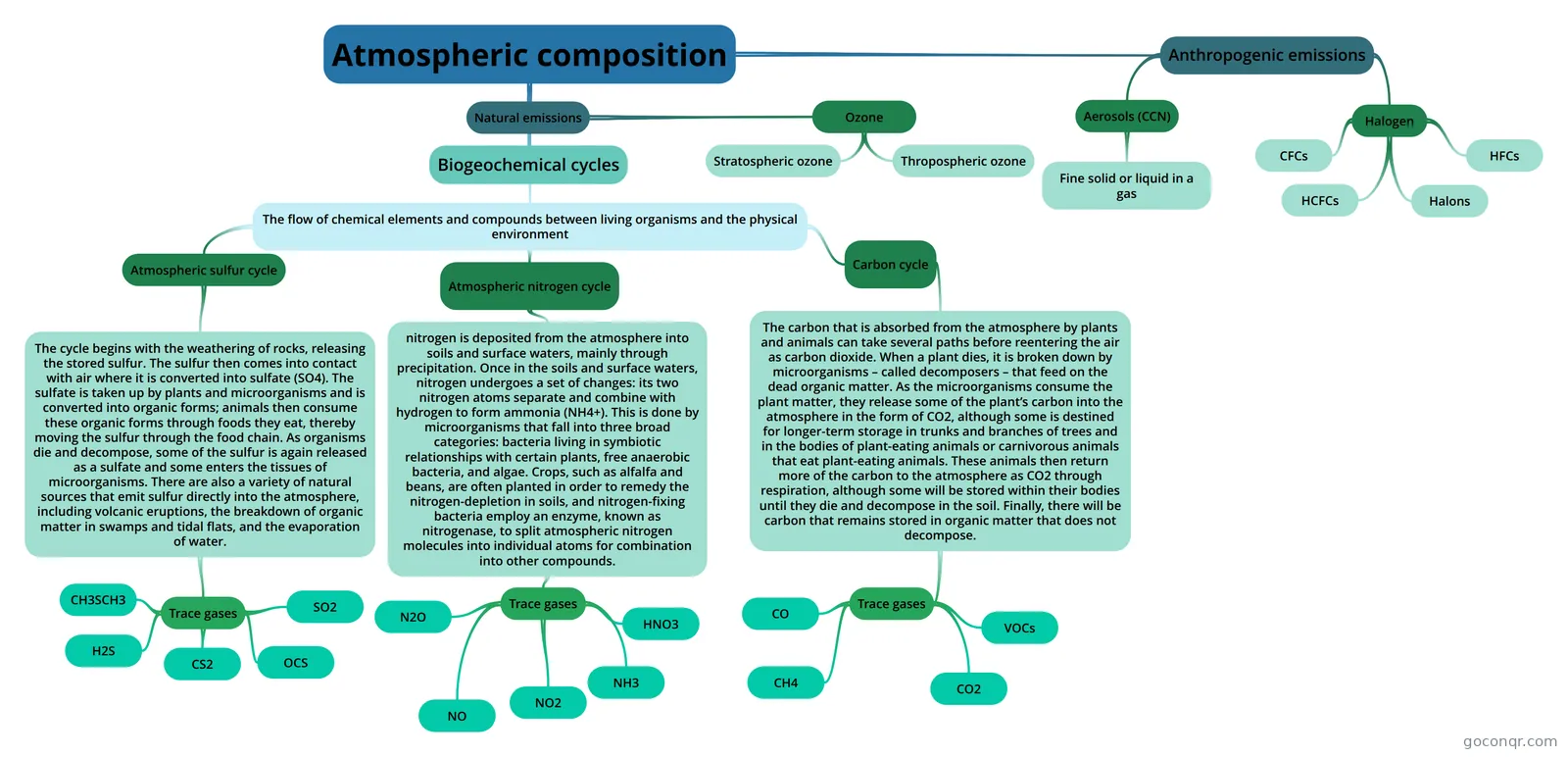
Mind map: Atmospheric composition
Map content
Atmospheric composition
The flow of chemical elements and compounds between living organisms and the physical environment
- Carbon cycle
- The carbon that is absorbed from the atmosphere by plants and animals can take several paths before reentering the air as carbon dioxide. When a plant dies, it is broken down by microorganisms – called decomposers – that feed on the dead organic matter. As the microorganisms consume the plant matter, they release some of the plant’s carbon into the atmosphere in the form of CO2, although some is destined for longer-term storage in trunks and branches of trees and in the bodies of plant-eating animals or carnivorous animals that eat plant-eating animals. These animals then return more of the carbon to the atmosphere as CO2 through respiration, although some will be stored within their bodies until they die and decompose in the soil. Finally, there will be carbon that remains stored in organic matter that does not decompose.
- Trace gases
- VOCs
- CO2
- CO
- CH4
- Trace gases
- The carbon that is absorbed from the atmosphere by plants and animals can take several paths before reentering the air as carbon dioxide. When a plant dies, it is broken down by microorganisms – called decomposers – that feed on the dead organic matter. As the microorganisms consume the plant matter, they release some of the plant’s carbon into the atmosphere in the form of CO2, although some is destined for longer-term storage in trunks and branches of trees and in the bodies of plant-eating animals or carnivorous animals that eat plant-eating animals. These animals then return more of the carbon to the atmosphere as CO2 through respiration, although some will be stored within their bodies until they die and decompose in the soil. Finally, there will be carbon that remains stored in organic matter that does not decompose.
- Atmospheric nitrogen cycle
- nitrogen is deposited from the atmosphere into soils and surface waters, mainly through precipitation. Once in the soils and surface waters, nitrogen undergoes a set of changes: its two nitrogen atoms separate and combine with hydrogen to form ammonia (NH4+). This is done by microorganisms that fall into three broad categories: bacteria living in symbiotic relationships with certain plants, free anaerobic bacteria, and algae. Crops, such as alfalfa and beans, are often planted in order to remedy the nitrogen-depletion in soils, and nitrogen-fixing bacteria employ an enzyme, known as nitrogenase, to split atmospheric nitrogen molecules into individual atoms for combination into other compounds.
- Trace gases
- NH3
- HNO3
- NO2
- NO
- N2O
- Trace gases
- nitrogen is deposited from the atmosphere into soils and surface waters, mainly through precipitation. Once in the soils and surface waters, nitrogen undergoes a set of changes: its two nitrogen atoms separate and combine with hydrogen to form ammonia (NH4+). This is done by microorganisms that fall into three broad categories: bacteria living in symbiotic relationships with certain plants, free anaerobic bacteria, and algae. Crops, such as alfalfa and beans, are often planted in order to remedy the nitrogen-depletion in soils, and nitrogen-fixing bacteria employ an enzyme, known as nitrogenase, to split atmospheric nitrogen molecules into individual atoms for combination into other compounds.
- Atmospheric sulfur cycle
- The cycle begins with the weathering of rocks, releasing the stored sulfur. The sulfur then comes into contact with air where it is converted into sulfate (SO4). The sulfate is taken up by plants and microorganisms and is converted into organic forms; animals then consume these organic forms through foods they eat, thereby moving the sulfur through the food chain. As organisms die and decompose, some of the sulfur is again released as a sulfate and some enters the tissues of microorganisms. There are also a variety of natural sources that emit sulfur directly into the atmosphere, including volcanic eruptions, the breakdown of organic matter in swamps and tidal flats, and the evaporation of water.
- Trace gases
- SO2
- OCS
- CS2
- CH3SCH3
- H2S
- Trace gases
- The cycle begins with the weathering of rocks, releasing the stored sulfur. The sulfur then comes into contact with air where it is converted into sulfate (SO4). The sulfate is taken up by plants and microorganisms and is converted into organic forms; animals then consume these organic forms through foods they eat, thereby moving the sulfur through the food chain. As organisms die and decompose, some of the sulfur is again released as a sulfate and some enters the tissues of microorganisms. There are also a variety of natural sources that emit sulfur directly into the atmosphere, including volcanic eruptions, the breakdown of organic matter in swamps and tidal flats, and the evaporation of water.
- Carbon cycle
Natural emissions
- Ozone
- Stratospheric ozone
- Thropospheric ozone
- Ozone
Anthropogenic emissions
- Halogen
- CFCs
- HCFCs
- HFCs
- Halons
- Aerosols (CCN)
- Fine solid or liquid in a gas
- Halogen
Biogeochemical cycles
Information
- Description
- Ingeniería Mind Map on Atmospheric composition, created by Carlos Alemán Mendoza on 23/01/2017.
- Created by
- Carlos Alemán Mendoza
- Views
- 51
- Tags
- Rating