
Biogeochemical Cycles
598 resources created by 514 users
This Biogeochemical Cycles page on GoConqr gathers community-made mind maps, quizzes, flashcards, flowcharts and notes on the nitrogen, carbon, water and phosphorus cycles. It's built for school students, primary pupils and teachers after ready-made material, with revision that suits GCSE Biology, A-level Biology and IB. There are over 500 resources here, including over 300 mind maps, more than 30 quizzes and over 100 flashcards, all made by over 400 contributors. Pick a cycle, try a quiz, then make your own maps.
Top Biogeochemical Cycles resources
-
35 questionsWater, Carbon, Nitrogen and Nitrogen Cycle Name three important needs for water.
-
Mind map The 4 Cycles of Life Loading...
-
Mind map The Phosphorus Cycle 10 Ideas of the Importance of the Phosphorus Cycle in Nature.
-
5 cardsNitrogen cycle flash cards Describe the process of ammonification -
-
10 cardsOCR A2 Biology: The Nitrogen Cycle Why do plants and animals need Nitrogen?
-
Flowchart The Water Cycle Detailed description of the water cycle
-
Mind map Nitrogen Cycle Nitrogen Cycle Mindmap
-
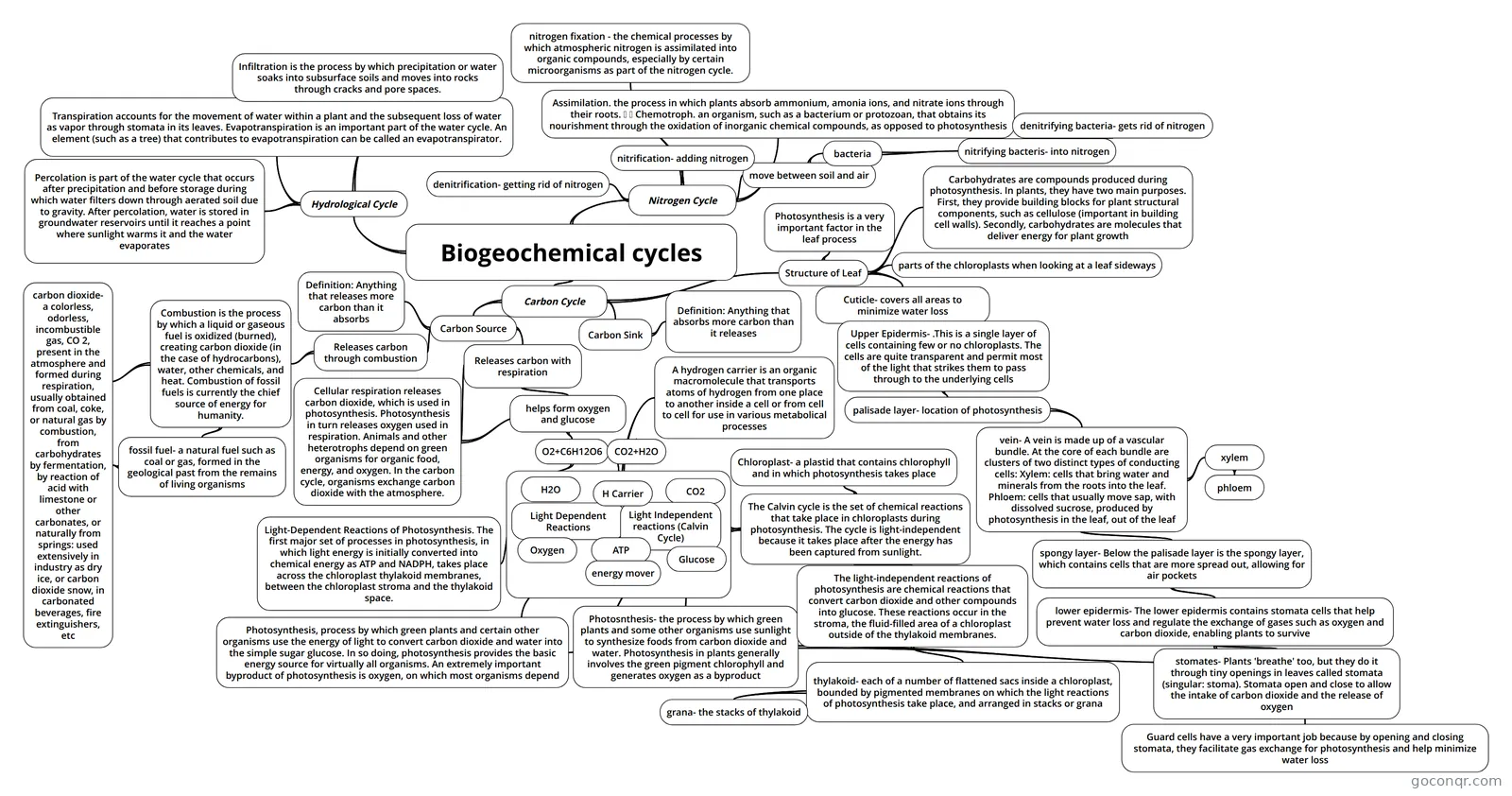 Mind map Biogeochemical cycles the biogeochemical cycles- mainly the carbon cycle. everything else is incomplete
Quizzes
See all 51 quizzes-
35 questionsWater, Carbon, Nitrogen and Nitrogen Cycle Name three important needs for water.
-
12 questions8th Grade Water Cycle Quiz Where does the energy that powers the water cycle come from?
-
3 questionsnitrogen cycle bacteria What are Nitrifying Bacteria?
-
3 questionsapes: nitrogen cycle @jesus please let me pass this quiz thanks
-
3 questionsThe Water Cycle Quiz What is the collection step in the water cycle?
-
33 questionsWater and the Biosphere Cycles
-
20 questionsBIOL1103 Unit 5 Exam Where do plants get the sugar to run and build their bodies?
-
12 questionsThe Water Cycle most of the water on earth is saline, meaning salty and it can't be consumed by humans. of the world's fres...
Mind maps
See all 363 mind maps-
The 4 Cycles of Life Loading...
-
The Phosphorus Cycle 10 Ideas of the Importance of the Phosphorus Cycle in Nature.
-
Nitrogen Cycle Nitrogen Cycle Mindmap
-
Biogeochemical cycles the biogeochemical cycles- mainly the carbon cycle. everything else is incomplete
-
WATER CYCLE ES GRANDE CON MUCHOS COLORES I MUCHAS FIGURITAS
-
Cycles of Matter Hey, this are te Nitrogen, Ogygen and Carbon Cycle.
-
Nitrogen Cycle
-
Water Cycle Yuh
Flashcards
See all 114 flashcards-
5 cardsNitrogen cycle flash cards Describe the process of ammonification -
-
10 cardsOCR A2 Biology: The Nitrogen Cycle Why do plants and animals need Nitrogen?
-
17 cardsThe Water Cycle Keywords
-
3 cardsWater Cycle The water cycle
-
32 cardsNutrient cycles What is a saprobiont?
-
36 cards5B: Nutrient Cycles WHAT IS A NATURAL ECOSYSTEM?
-
21 cards13.5 Environmental issues concerning use of nitrogen-containing fertilisers What are the detrimental effects of using nitrogen-containing fertilisers?
-
47 cardsNitrogen Cycle What % is Nitrogen in the air?
Flowcharts
See all 38 flowcharts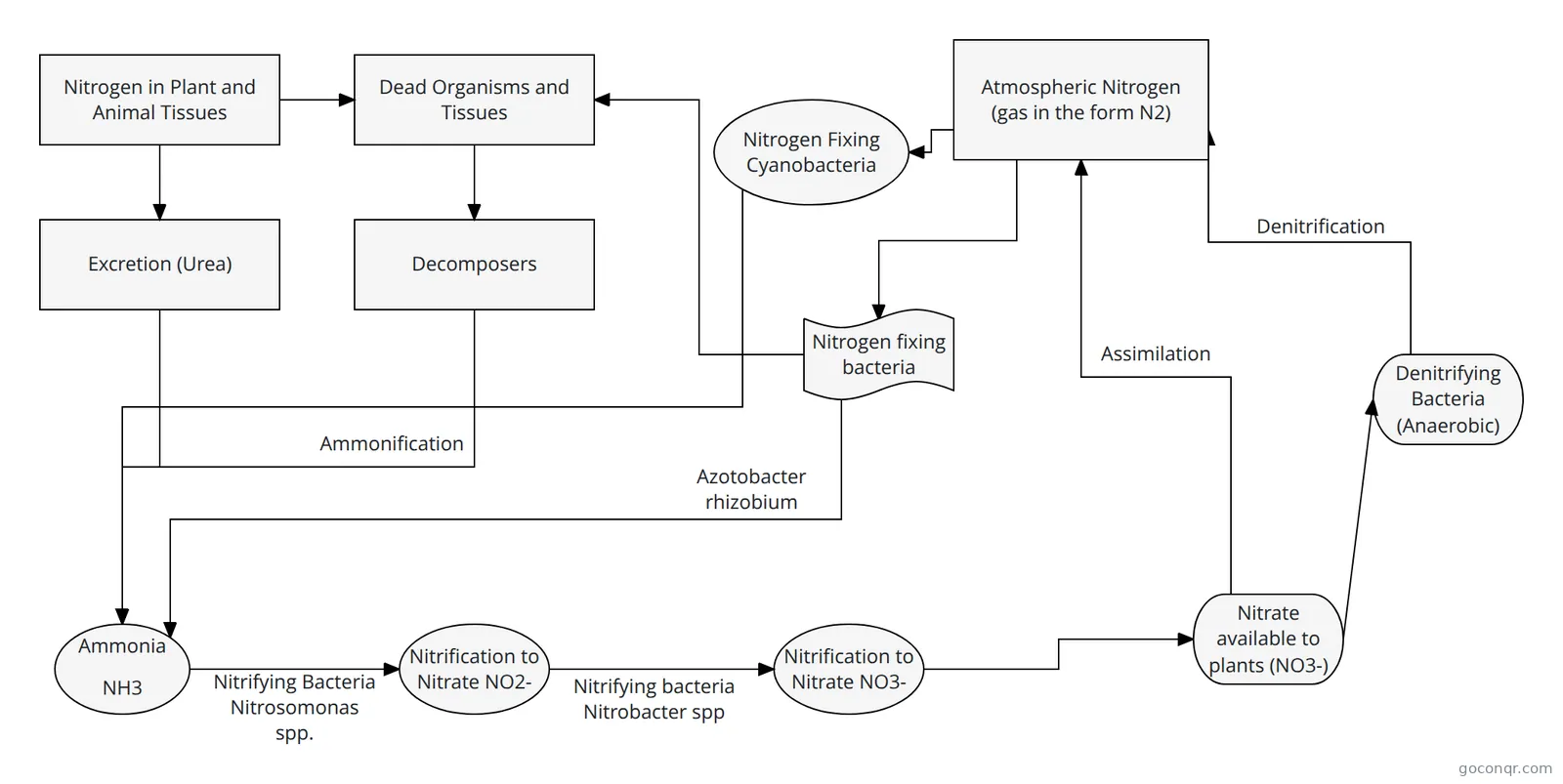
Notes
See all 21 notes-
Biogeochemical Cycles The Biogeochemical Cycles Human Impact on the Carbon Cycle Photosynthesis: Deforestation - less carbon from the atmosphere into biomass. Afforestation - more carbon from the atmosphere into biomass. Marine pollution w...
-
Untitled While the air we breathe is rich in nitrogen gas (N2) and is the major component in air at 78%, this nitrogen is unavailable to us since nitrogen gas is very inert chemically. We want to briefly discuss how nitrogen g...
-
Nitrogen Cycle Nitrogen CycleAmmonification:Saprobiotic microorganisms feed on urea found from the ammonium containing compounds.They release NH3 as they do so, then it is converted to NH4+ in ammonification in the soil.Nitrificatio...
-
The Nitrogen Cycle Revision The Nitrogen Cycle Revision Nitrogen is a vital element for all living things. It is needed to make proteins. Proteins themselves are needed as raw materials for the building of new cells and repairing the old cells.&...
-
Cycles Carbon Dioxide - Oxygen When carbon is inside an animal it is part of the biosphere but when it is outside the animal it is part of the atmosphere Carbon is not always in the form of carbon dioxide Cellular respiratio...
-
Nitrogen Cycle 1. NITROGEN FIXATION Nitrogen gas (in atmosphere) is converted into ammonia by bacteria called Rhizobium. Ammonia is then used by plants. Rhizobium found inside root nodules of leguminous plants (e.g. peas, beans and ...
-
Nitrogen Fixation, nitrification and denitrification Nitrogen fixation Impossible for plants to use nitrogen gas directly because it is very unreactive. Instead they need a supply of fixed nitrogen such as ammonium ions or nitrate ions. Can occur when lightning strikes ...
-
The nitrogen cycle - created from Mind Map Nitrogen fixation Ammonification/decomposition Nitrification
Slides
See all 11 slidesTopics in Biogeochemical Cycles
More Biology and natural sciences topics
About Biogeochemical Cycles
GoConqr OriginalWhat this page covers
The page is mostly about the nitrogen cycle and the water cycle, with plenty on the carbon cycle and the phosphorus cycle too. The mind map Nitrogen Cycle starts with nitrogen gas in the atmosphere and explains why nitrogen is needed to make proteins. It goes on to show how plants take it from the soil and animals get it by eating plants. It also covers nitrogen fixation.
The mind map The Phosphorus Cycle follows phosphates from rocks into soil and water, then into plants. A flowchart called The Water Cycle walks through evaporation and condensation step by step, moving water from the hydrosphere to the atmosphere.
Where to start
If you want the big picture first, open the mind map Biogeochemical cycles. It links the carbon cycle, the hydrological cycle and the nitrogen cycle, and it defines carbon sources and carbon sinks. Then pick one cycle and stay with it for a session.
- Read a mind map or flowchart to see the whole cycle.
- Go through a flashcard deck to learn the key terms.
- Finish with a quiz to see what stuck.
Using maps, flashcards and quizzes together
For the nitrogen cycle, the flashcard deck Nitrogen cycle flash cards asks you to describe ammonification, nitrification and nitrogen fixation by free-living and mutualistic bacteria. Another deck is aimed at OCR A2 Biology and asks what denitrification is. After the cards, test yourself with the quiz Water, Carbon, Nitrogen and Nitrogen Cycle. It asks about macronutrients, the share of nitrogen in the air and why phosphorus matters as a biological molecule.
Younger learners can use the water cycle quizzes, such as the one written for eighth graders. It asks where the energy for the cycle comes from and what evaporation is. Teachers can set a quiz, or project a flowchart or slide set for a class discussion.
Where it fits
This unit sits in the Ecology and the Environment strand of Biology and natural sciences. Some resources also look at how people affect the carbon, nitrogen and phosphorus cycles, including the use of fertilisers. Exam-minded students will find material that mentions GCSE Biology, A-level Biology and IB.
Ready to begin? Choose a cycle that you find tricky and open the first map or deck that catches your eye.
Frequently asked questions
Which resource should I open first?
Start with the mind map Biogeochemical cycles for an overview of the carbon, hydrological and nitrogen cycles. If you already know which cycle you need, open the Nitrogen Cycle mind map or the flowchart The Water Cycle. Then move on to flashcards and a quiz on the same cycle.
What do the mind maps on this page cover?
There are over 300 mind maps. Most deal with the nitrogen cycle and the water cycle, and others cover the carbon cycle, the phosphorus cycle, nutrient cycles and recycling. Some also ask how humans affect the carbon, nitrogen and phosphorus cycles, so they work for both overview and detail.
Are the resources free to use?
Yes. Every resource listed here is free to open, study and take, and you do not need an account. They were made by GoConqr users, not by GoConqr itself, so style and depth vary from one resource to the next.
Which levels and exams do the resources suit?
Most are aimed at secondary students, with a good number for primary pupils. The resources mention GCSE Biology, A-level Biology and IB. Younger learners can try the simple water cycle quizzes, while older students can use the detailed nitrogen cycle flashcards.
Can I make my own quizzes or flashcards?
Yes. A free GoConqr account saves your quiz scores and lets you make your own quizzes, mind maps, flashcards and notes. Teachers might build a short quiz on the carbon cycle, and students could turn a favourite mind map into a flashcard deck.
What if I cannot find the topic I need?
Try a nearby cycle or a broader resource first. The notes called Biogeochemical Cycles and the mind map Nutrient Cycles cover several cycles at once. If the gap remains, you can build your own map or flashcards for it.