
Mind map
Physics y10 autumn
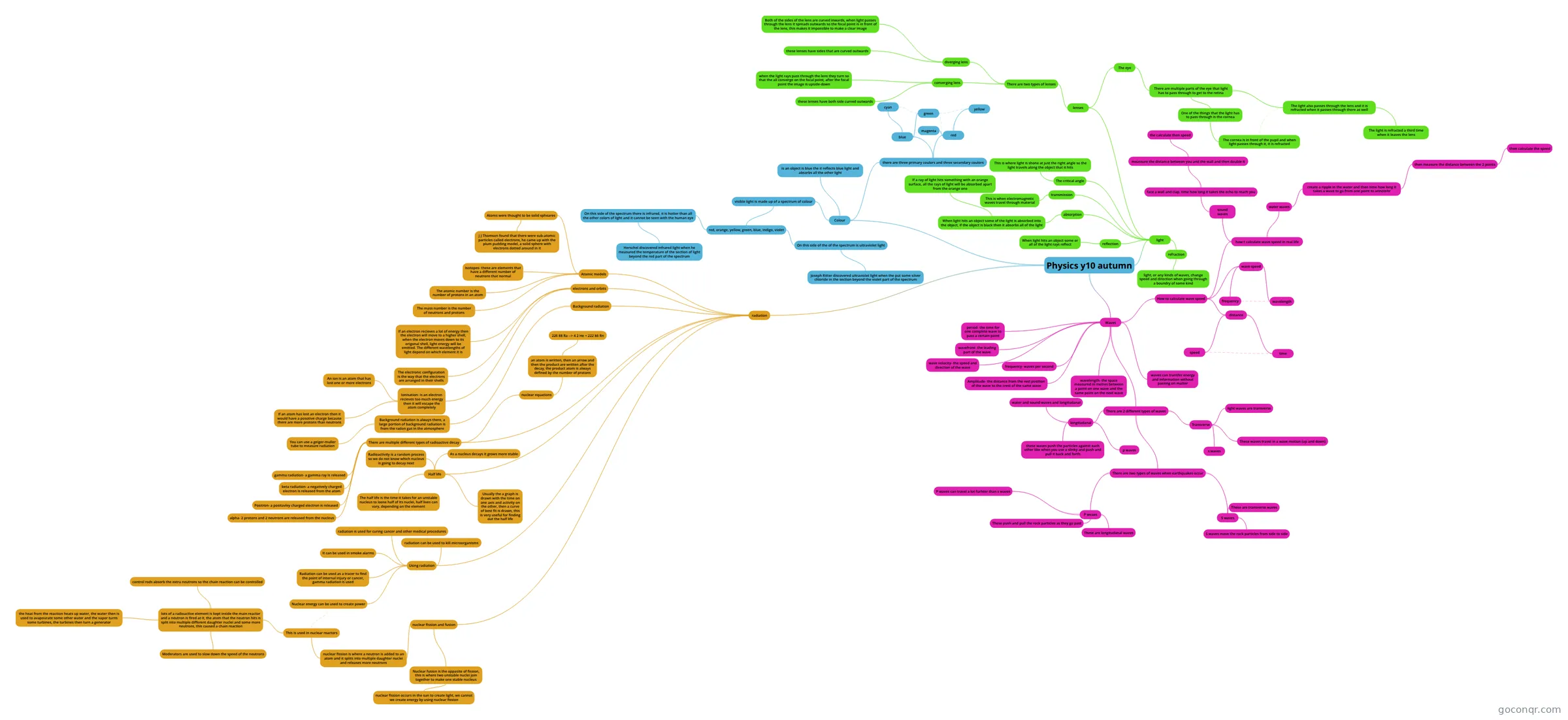
Mind map: Physics waves, light and radiation
Map content
Physics y10 autumn
Waves
- waves can transfer energy and information without passing on matter
- frequency- waves per second
- wavelength- the space measured in metres between a point on one wave and the same point on the next wave
- wavefront- the leading part of the wave
- period- the time for one complete wave to pass a certain point
- Amplitude- the distance from the rest position of the wave to the crest of the same wave
- wave velocity- the speed and direction of the wave
- There are 2 different types of waves
- longitudanal
- these waves push the particles against each other like when you use a slinky and push and pull it back and forth
- water and sound waves and longitudanal
- p waves
- Transverse
- These waves travel in a wave motion (up and down)
- light waves are transverse
- s waves
- There are two types of waves when earthquakes occur
- P wvaes
- These push and pull the rock particles as they go past
- These are longitudanal waves
- P waves can travel a lot furhter than s waves
- S waves
- S waves move the rock particles from side to side
- These are transverse waves
- P wvaes
- longitudanal
- How to calculate wave speed
- distance
- speed
- time
- wave speed
- frequency
- wavelength
- how t calculate wave speed in real life
- sound waves
- face a wall and clap, time how long it takes the echo to reach you
- meassure the distance between you and the wall and then double it
- the calculate then speed
- meassure the distance between you and the wall and then double it
- face a wall and clap, time how long it takes the echo to reach you
- water waves
- create a ripple in the water and then time how long it takes a wave to go from one point to annotehr
- then measure the distance between the 2 points
- then calculate the speed
- then measure the distance between the 2 points
- create a ripple in the water and then time how long it takes a wave to go from one point to annotehr
- sound waves
- distance
light
- reflection
- When light hits an object some or all of the light rays reflect
- refraction
- light, or any kinds of waves, change speed and direction when going through a boundry of some kind
- transmission
- This is when electromagnetic waves travel through material
- absorption
- When light hits an object some of the light is absorbed into the object, if the object is black then it absorbs all of the light
- If a ray of light hits something with an orange surface, all the rays of light will be absorbed apart from the orange one
- When light hits an object some of the light is absorbed into the object, if the object is black then it absorbs all of the light
- The critical angle
- This is where light is shone at just the right angle so the light travels along the object that it hits
- lenses
- There are two types of lenses
- converging lens
- these lenses have both side curved outwards
- when the light rays pass through the lens they turn so that the all converge on the focal point, after the focal point the image is upside-down
- diverging lens
- these lenses have sides that are curved outwards
- Both of the sides of the lens are curved inwards, when light passes through the lens it spreads outwards so the focal point is in front of the lens, this makes it impossible to make a clear image
- converging lens
- The eye
- There are multiple parts of the eye that light has to pass through to get to the retina
- One of the things that the light has to pass through is the cornea
- The cornea is in front of the pupil and when light passes through it, it is refracted
- The light also passes through the lens and it is refracted when it passes through there as well
- The light is refracted a third time when it leaves the lens
- One of the things that the light has to pass through is the cornea
- There are multiple parts of the eye that light has to pass through to get to the retina
- There are two types of lenses
- reflection
Colour
- is an object is blue the it reflects blue light and absorbs all the other light
- there are three primary coulors and three secondary coulors
- blue
- green
- cyan
- red
- yellow
- magenta
- blue
- visible light is made up of a spectrum of colour
- red, orange, yellow, green, blue, indigo, violet
- On this side of the spectrum there is infrared, it is hotter than all the other colors of light and it cannot be seen with the human eye
- Herschel discovered infrared light when he measured the temperature of the section of light beyond the red part of the spectrum
- On this side of the of the spectrum is ultraviolet light
- Joseph Ritter discovered ultraviolet light when the put some silver chloride in the section beyond the violet part of the spectrum
- On this side of the spectrum there is infrared, it is hotter than all the other colors of light and it cannot be seen with the human eye
- red, orange, yellow, green, blue, indigo, violet
radiation
- Atomic models
- Atoms were thought to be solid spheares
- J J Thomson found that there were sub-atomic particles called electrons, he came up with the plum pudding model, a solid sphere with electrons dotted around in it
- Isotopes- these are elements that have a different number of neutrons that normal
- The atomic number is the number of protons in an atom
- The mass number is the number of neutrons and protons
- Atoms were thought to be solid spheares
- electrons and orbits
- The electronic configuration is the way that the electrons are arranged in their shells
- If an electron recieves a lot of energy then the electron will move to a higher shell, when the electron moves down to its origonal shell, light energy will be emitted. The different wavelengths of light depend on which element it is
- Ionisation- is an electron recieves too much energy then it will escape the atom completely
- An ion is an atom that has lost one or more electrons
- If an atom has lost an electron then it would have a posotive charge because there are more protons than neutrons
- Background radiation
- Background radiation is always there, a large portion of background radiation is from the radon gas in the atmosphere
- You can use a geiger-muller tube to measure radiation
- Background radiation is always there, a large portion of background radiation is from the radon gas in the atmosphere
- There are multiple different types of radioactive decay
- gamma radiation- a gamma ray is released
- beta radiation- a negatively charged electron is released from the atom
- Positron- a positavley charged electron is released
- alpha- 2 protons and 2 neutrons are released from the nucleus
- nuclear equations
- an atom is written, then an arrow and then the product are written after the decay, the product atom is always defined by the number of protons
- 226 88 Ra --> 4 2 He + 222 86 Rn
- an atom is written, then an arrow and then the product are written after the decay, the product atom is always defined by the number of protons
- Half life
- As a nucleus decays it grows more stable
- Radioactivity is a random process so we do not know which nucleus is going to decay next
- The half life is the time it takes for an unstable nucleus to loose half of its nuclei, half lives can vary, depending on the element
- Usually the a graph is drawn with the time on one axis and activity on the other, then a curve of best fit is drawn, this is very useful for finding out the half life
- Using radiation
- radiation can be used to kill microorganisms
- radiation is used for curing cancer and other medical procedures
- It can be used in smoke alarms
- Radiation can be used as a tracer to find the point of internal injury or cancer, gamma radiation is used
- Nuclear energy can be used to create power
- nuclear fission and fusion
- nuclear fission is where a neutron is added to an atom and it splits into multiple daughter nuclei and releases more neutrons
- This is used in nuclear reactors
- lots of a radioactive element is kept inside the main reactor and a neutron is fired at it, the atom that the neutron hits is split into multiple different daughter nuclei and some more neutrons, this caused a chain reaction
- Moderators are used to slow down the speed of the neutrons
- control rods absorb the extra neutrons so the chain reaction can be controlled
- the heat from the reaction heats up water, the water then is used to avapourate some other water and the vapor turns some turbines, the turbines then turn a generator
- lots of a radioactive element is kept inside the main reactor and a neutron is fired at it, the atom that the neutron hits is split into multiple different daughter nuclei and some more neutrons, this caused a chain reaction
- This is used in nuclear reactors
- Nuclear fusion is the oppasite of fission, this is where two unstable nuclei join together to make one stable nucleus
- nuclear fission occurs in the sun to create light, we cannot we create energy by using nuclear fission
- nuclear fission is where a neutron is added to an atom and it splits into multiple daughter nuclei and releases more neutrons
- Atomic models
Information
- Description
- GCSE (physics) Mind Map on Physics y10 autumn, created by robert england on 22/10/2017.
- Created by
- robert england
- Views
- 12
- Rating