
Mind map
Maths
Map content
Maths
Angles
- Sum of interior angles = 180(n-2)
- 11 sides = 180(n-2)... 180(11-2) = 1620*
- Number of sides = sum of interior angles / 180
- 1980 / 180 = 11 + 2 = 13 sides
- Angles In Parallel Lines
- Alternate = Z
- The same
- Co - interior = C
- Add to 180*
- Corresponding = F
- The same
- Angles on a straight line
- Add to 180*
- Vertically opposite = X
- The same
- Alternate = Z
- Angles in polygons
- Triangle = 180*
- Hexagon = 720*
- Quadrilateral = 360*
- Heptagon = 900*
- Nonagon = 1260*
- Heptagon = 900*
- Pentagon = 540*
- Octagon = 1080*
- Triangle = 180*
- Sum of interior angles = 180(n-2)
Bearings
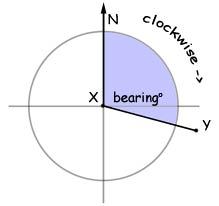
- 1) Bearings are a measure of direction taken from the North
- 2) Bearings are always measured in a clockwise direction
- 3) Bearings are always written in 3 figures e.g. 079*
Inequalities
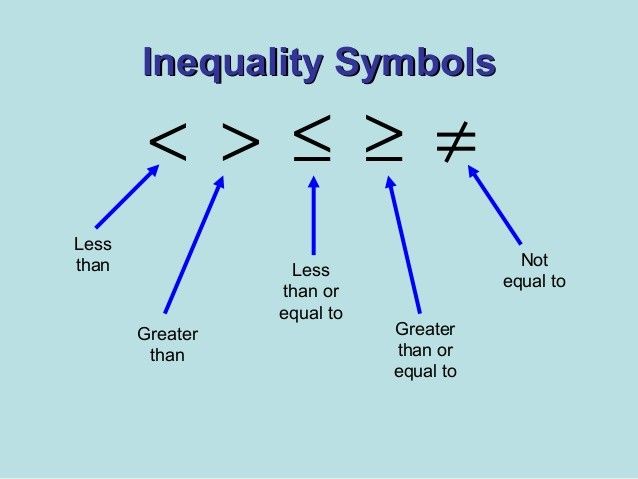
- There are 5 inequality symbols
- Some problems don't have specific answers. Inequalities give a range of possible numbers, but you have to give the whole range of answers by using the inequality signs e.g. x < 3
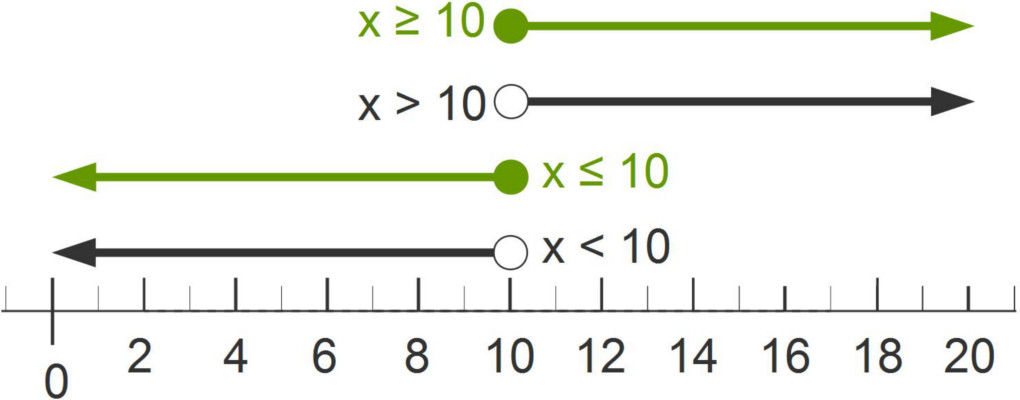
- Filled in dots represent greater than and less than
- Not filled in dots represent greater thank or equal to and less than or equal to
- Solving inequalities = 4x + 1 > 11... 4x +1 = 11... 4x = 10... x = 2.5... >2.5
- 3>1 ... 2<7 ... 33>25 ... 110<567
Negative Numbers
- Ordering from S - L -5, -2, 0, 1, 3, 4, 7.
- -4 + 6 = 2
- -4 + -7 = -11
- 6 - - 7 = 13
Prime Factors
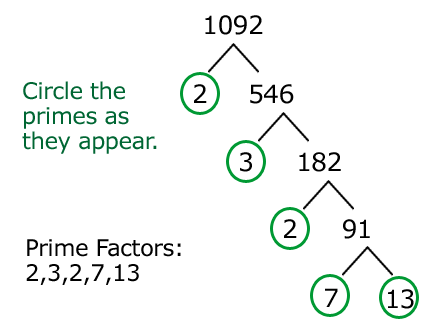
- Prime factor trees are used to find the LCM and HCF of 2 numbers
- Prime numbers = 2, 3, 5, 7, 11, 13, 17, 19, 23, 29 etc.
HCF And LCM
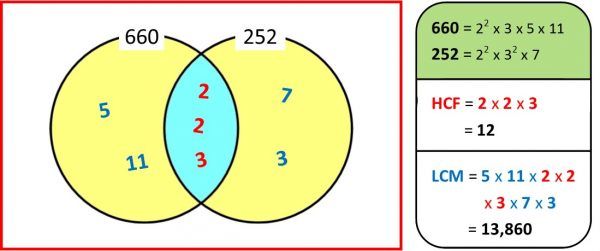
- To find the Highest Common Factor and Lowest Common Multiple you can use a venn diagram
- Example = LCM and HCF of 660 and 252
- Do the prime factor trees of both numbers and write them out the long way
- If there is a 2 for example in both of the lists, then put it in the middle. Same with the other numbers the re-occur in both lists
- Place the rest in the corresponding circle.
- To find the HCF you multiply all the numbers in the middle.
- To find the LCM you multiply the numbers in one circle by the number fromthe outside of the other circle, 5x11x252
Fractions
- Top heavy fractions are fractions where the denominator is smaller than the numerator. We solve this problem by changing them into mixed numbers
- To find a mixed number we divide the numerator by the denominator and write the remainder over the previous denominator.
- E.g. 22/3 = 7 and 1/3
- To find a mixed number we divide the numerator by the denominator and write the remainder over the previous denominator.
- Top heavy fractions are fractions where the denominator is smaller than the numerator. We solve this problem by changing them into mixed numbers
Multiplying and Dividing Decimals
- Dividing
- Using short division will come in handy ( bus stop method)
- Multiplying
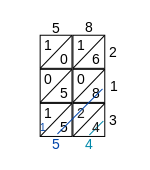
- To multiply decimals, count how many numbers there are after the decimal point and remember it
- Take out the decimal point(s) and use the Chinese method to solve it
- Once you have gotten your answer, put the decimal point back where it should be.
- Dividing
Recurring Decimals
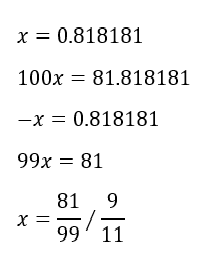
- First, change the decimal into a whole number by multiplying it by 10,100,1000 etc.
- When you have a whole number, and the digits after the decimal are the same as x, then you can take x away from the largest number.
- Write the whole number as a fraction over the total and simplify it
- When you have a whole number, and the digits after the decimal are the same as x, then you can take x away from the largest number.
- First, change the decimal into a whole number by multiplying it by 10,100,1000 etc.
Images and files in the map
Information
- Description
- Year 9 Maths Mind Map on Maths, created by Karina Terlecka on 30/10/2017.
- Created by
- Karina Terlecka
- Views
- 9
- Rating