
Mind map
Unit 1 - Medical Negligence
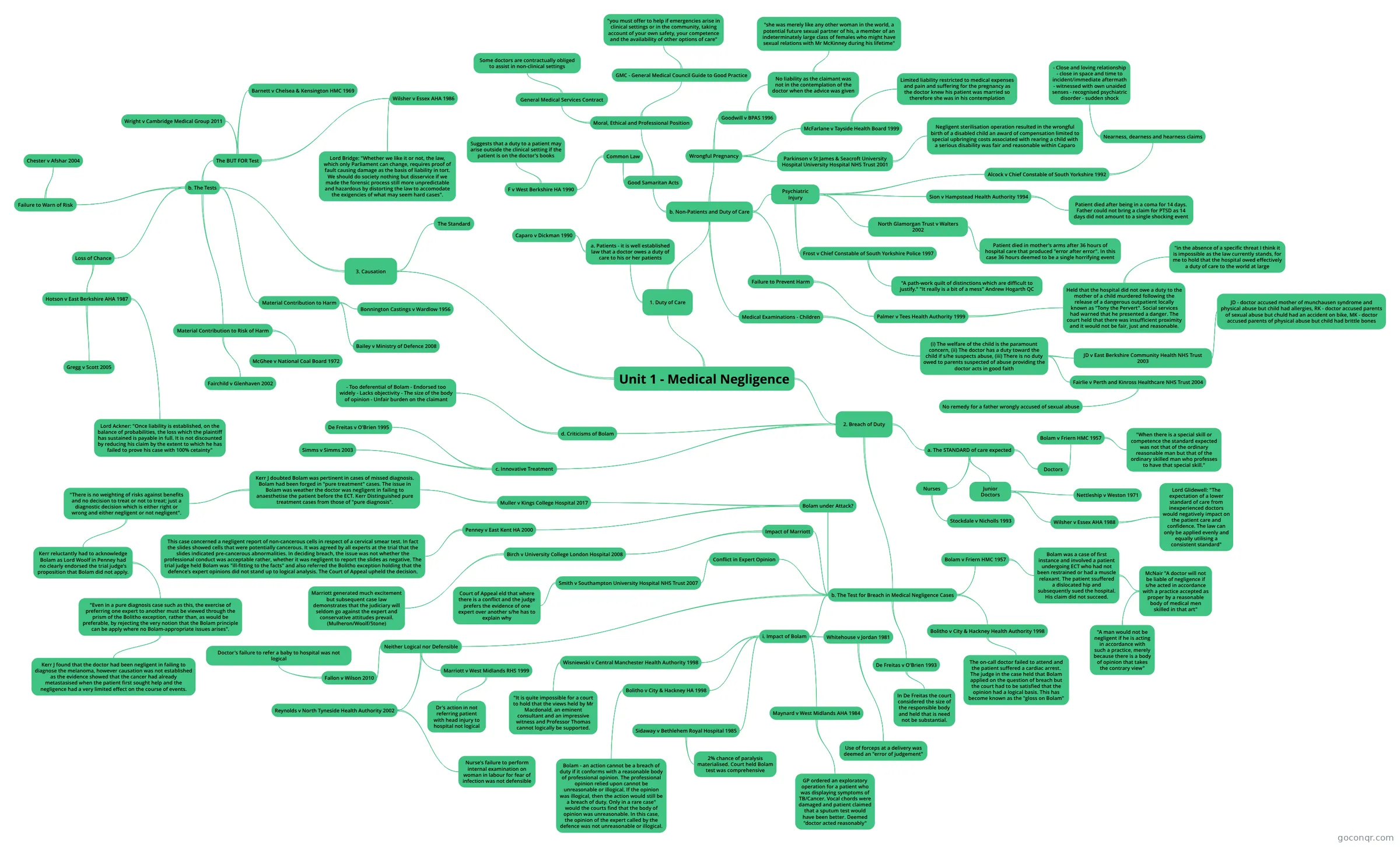
Mind map: medical negligence
Map content
Unit 1 - Medical Negligence
1. Duty of Care
- a. Patients - it is well established law that a doctor owes a duty of care to his or her patients
- Caparo v Dickman 1990
- b. Non-Patients and Duty of Care
- Good Samaritan Acts
- Common Law
- F v West Berkshire HA 1990
- Suggests that a duty to a patient may arise outside the clinical setting if the patient is on the doctor's books
- F v West Berkshire HA 1990
- Moral, Ethical and Professional Position
- General Medical Services Contract
- Some doctors are contractually obliged to assist in non-clinical settings
- GMC - General Medical Council Guide to Good Practice
- "you must offer to help if emergencies arise in clinical settings or in the community, taking account of your own safety, your competence and the availability of other options of care"
- General Medical Services Contract
- Common Law
- Wrongful Pregnancy
- Goodwill v BPAS 1996
- No liability as the claimant was not in the contemplation of the doctor when the advice was given
- "she was merely like any other woman in the world, a potential future sexual partner of his, a member of an indeterminately large class of females who might have sexual relations with Mr McKinney during his lifetime"
- No liability as the claimant was not in the contemplation of the doctor when the advice was given
- McFarlane v Tayside Health Board 1999
- Limited liability restricted to medical expenses and pain and suffering for the pregnancy as the doctor knew his patient was married so therefore she was in his contemplation
- Parkinson v St James & Seacroft University Hospital University Hospital NHS Trust 2001
- Negligent sterilisation operation resulted in the wrongful birth of a disabled child an award of compensation limited to special upbringing costs associated with rearing a child with a serious disability was fair and reasonable within Caparo
- Goodwill v BPAS 1996
- Psychiatric Injury
- Alcock v Chief Constable of South Yorkshire 1992
- Nearness, dearness and hearness claims
- - Close and loving relationship - close in space and time to incident/immediate aftermath - witnessed with own unaided senses - recognised psychiatric disorder - sudden shock
- Nearness, dearness and hearness claims
- Sion v Hampstead Health Authority 1994
- Patient died after being in a coma for 14 days. Father could not bring a claim for PTSD as 14 days did not amount to a single shocking event
- North Glamorgan Trust v Walters 2002
- Patient died in mother's arms after 36 hours of hospital care that produced "error after error". In this case 36 hours deemed to be a single horrifying event
- Frost v Chief Constable of South Yorkshire Police 1997
- "A path-work quilt of distinctions which are difficult to justify." "It really is a bit of a mess" Andrew Hogarth QC
- Alcock v Chief Constable of South Yorkshire 1992
- Failure to Prevent Harm
- Palmer v Tees Health Authority 1999
- Held that the hospital did not owe a duty to the mother of a child murdered following the release of a dangerous outpatient locally known as "Tony the Pervert". Social services had warned that he presented a danger. The court held that there was insufficient proximity and it would not be fair, just and reasonable.
- "in the absence of a specific threat I think it is impossible as the law currently stands, for me to hold that the hospital owed effectively a duty of care to the world at large
- Held that the hospital did not owe a duty to the mother of a child murdered following the release of a dangerous outpatient locally known as "Tony the Pervert". Social services had warned that he presented a danger. The court held that there was insufficient proximity and it would not be fair, just and reasonable.
- Palmer v Tees Health Authority 1999
- Medical Examinations - Children
- (i) The welfare of the child is the paramount concern, (ii) The doctor has a duty toward the child if s/he suspects abuse, (iii) There is no duty owed to parents suspected of abuse providing the doctor acts in good faith
- JD v East Berkshire Community Health NHS Trust 2003
- JD - doctor accused mother of munchausen syndrome and physical abuse but child had allergies, RK - doctor accused parents of sexual abuse but chuld had an accident on bike, MK - doctor accused parents of physical abuse but child had brittle bones
- Fairlie v Perth and Kinross Healthcare NHS Trust 2004
- No remedy for a father wrongly accused of sexual abuse
- JD v East Berkshire Community Health NHS Trust 2003
- (i) The welfare of the child is the paramount concern, (ii) The doctor has a duty toward the child if s/he suspects abuse, (iii) There is no duty owed to parents suspected of abuse providing the doctor acts in good faith
- Good Samaritan Acts
- a. Patients - it is well established law that a doctor owes a duty of care to his or her patients
2. Breach of Duty
- a. The STANDARD of care expected
- Doctors
- Bolam v Friern HMC 1957
- "When there is a special skill or competence the standard expected was not that of the ordinary reasonable man but that of the ordinary skilled man who professes to have that special skill."
- Bolam v Friern HMC 1957
- Junior Doctors
- Nettleship v Weston 1971
- Wilsher v Essex AHA 1988
- Lord Glidewell: "The expectation of a lower standard of care from inexperienced doctors would negatively impact on the patient care and confidence. The law can only be applied evenly and equally utilising a consistent standard"
- Nurses
- Stockdale v Nicholls 1993
- Doctors
- b. The Test for Breach in Medical Negligence Cases
- Bolam v Friern HMC 1957
- Bolam was a case of first instance and involved a patient undergoing ECT who had not been restrained or had a muscle relaxant. The patient ssuffered a dislocated hip and subsequently sued the hospital. His claim did not succeed.
- McNair "A doctor will not be liable of negligence if s/he acted in accordance with a practice accepted as proper by a reasonable body of medical men skilled in that art"
- "A man would not be negligent if he is acting in accordance with such a practice, merely because there is a body of opinion that takes the contrary view"
- McNair "A doctor will not be liable of negligence if s/he acted in accordance with a practice accepted as proper by a reasonable body of medical men skilled in that art"
- Bolam was a case of first instance and involved a patient undergoing ECT who had not been restrained or had a muscle relaxant. The patient ssuffered a dislocated hip and subsequently sued the hospital. His claim did not succeed.
- Bolitho v City & Hackney Health Authority 1998
- The on-call doctor failed to attend and the patient suffered a cardiac arrest. The judge in the case held that Bolam applied on the question of breach but the court had to be satisfied that the opinion had a logical basis. This has become known as the "gloss on Bolam"
- De Freitas v O'Brien 1993
- In De Freitas the court considered the size of the responsible body and held that is need not be substantial.
- i. Impact of Bolam
- Whitehouse v Jordan 1981
- Use of forceps at a delivery was deemed an "error of judgement"
- Maynard v West Midlands AHA 1984
- GP ordered an exploratory operation for a patient who was displaying symptoms of TB/Cancer. Vocal chords were damaged and patient claimed that a sputum test would have been better. Deemed "doctor acted reasonably"
- Sidaway v Bethlehem Royal Hospital 1985
- 2% chance of paralysis materialised. Court held Bolam test was comprehensive
- Bolitho v City & Hackney HA 1998
- Bolam - an action cannot be a breach of duty if it conforms with a reasonable body of professional opinion. The professional opinion relied upon cannot be unreasonable or illogical. If the opinion was illogical, then the action would still be a breach of duty. Only in a rare case" would the courts find that the body of opinion was unreasonable. In this case, the opinion of the expert called by the defence was not unreasonable or illogical.
- Wisniewski v Central Manchester Health Authority 1998
- "It is quite impossible for a court to hold that the views held by Mr Macdonald, an eminent consultant and an impressive witness and Professor Thomas cannot logically be supported.
- Whitehouse v Jordan 1981
- Neither Logical nor Defensible
- Marriott v West Midlands RHS 1999
- Dr's action in not referring patient with head injury to hospital not logical
- Reynolds v North Tyneside Health Authority 2002
- Nurse's failure to perform internal examination on woman in labour for fear of infection was not defensible
- Fallon v Wilson 2010
- Doctor's failure to refer a baby to hospital was not logical
- Marriott v West Midlands RHS 1999
- Conflict in Expert Opinion
- Smith v Southampton University Hospital NHS Trust 2007
- Court of Appeal eld that where there is a conflict and the judge prefers the evidence of one expert over another s/he has to explain why
- Smith v Southampton University Hospital NHS Trust 2007
- Impact of Marriott
- Birch v University College London Hospital 2008
- Marriott generated much excitement but subsequent case law demonstrates that the judiciary will seldom go against the expert and conservative attitudes prevail. (Mulheron/Woolf/Stone)
- Birch v University College London Hospital 2008
- Bolam under Attack?
- Penney v East Kent HA 2000
- This case concerned a negligent report of non-cancerous cells in respect of a cervical smear test. In fact the slides showed cells that were potentially cancerous. It was agreed by all experts at the trial that the slides indicated pre-cancerous abnormalities. In deciding breach, the issue was not whether the professional conduct was acceptable rather, whether it was negligent to report the slides as negative. The trial judge held Bolam was "ill-fitting to the facts" and also referred the Bolitho exception holding that the defence's expert opinions did not stand up to logical analysis. The Court of Appeal upheld the decision.
- Muller v Kings College Hospital 2017
- Kerr J doubted Bolam was pertinent in cases of missed diagnosis. Bolam had been forged in "pure treatment" cases. The issue in Bolam was weather the doctor was negligent in failing to anaesthetise the patient before the ECT. Kerr Distinguished pure treatment cases from those of "pure diagnosis".
- "There is no weighting of risks against benefits and no decision to treat or not to treat; just a diagnostic decision which is either right or wrong and either negligent or not negligent".
- Kerr reluctantly had to acknowledge Bolam as Lord Woolf in Penney had no clearly endorsed the trial judge's proposition that Bolam did not apply.
- "Even in a pure diagnosis case such as this, the exercise of preferring one expert to another must be viewed through the prism of the Bolitho exception, rather than, as would be preferable, by rejecting the very notion that the Bolam principle can be apply where no Bolam-appropriate issues arises".
- Kerr J found that the doctor had been negligent in failing to diagnose the melanoma, however causation was not established as the evidence showed that the cancer had already metastasised when the patient first sought help and the negligence had a very limited effect on the course of events.
- "Even in a pure diagnosis case such as this, the exercise of preferring one expert to another must be viewed through the prism of the Bolitho exception, rather than, as would be preferable, by rejecting the very notion that the Bolam principle can be apply where no Bolam-appropriate issues arises".
- Kerr reluctantly had to acknowledge Bolam as Lord Woolf in Penney had no clearly endorsed the trial judge's proposition that Bolam did not apply.
- "There is no weighting of risks against benefits and no decision to treat or not to treat; just a diagnostic decision which is either right or wrong and either negligent or not negligent".
- Kerr J doubted Bolam was pertinent in cases of missed diagnosis. Bolam had been forged in "pure treatment" cases. The issue in Bolam was weather the doctor was negligent in failing to anaesthetise the patient before the ECT. Kerr Distinguished pure treatment cases from those of "pure diagnosis".
- Penney v East Kent HA 2000
- Bolam v Friern HMC 1957
- c. Innovative Treatment
- De Freitas v O'Brien 1995
- Simms v Simms 2003
- d. Criticisms of Bolam
- - Too deferential of Bolam - Endorsed too widely - Lacks objectivity - The size of the body of opinion - Unfair burden on the claimant
- a. The STANDARD of care expected
3. Causation
- The Standard
- b. The Tests
- The BUT FOR Test
- Barnett v Chelsea & Kensington HMC 1969
- Wilsher v Essex AHA 1986
- Lord Bridge: "Whether we like it or not, the law, which only Parliament can change, requires proof of fault causing damage as the basis of liability in tort. We should do society nothing but disservice if we made the forensic process still more unpredictable and hazardous by distorting the law to accomodate the exigencies of what may seem hard cases".
- Wright v Cambridge Medical Group 2011
- Material Contribution to Harm
- Bonnington Castings v Wardlow 1956
- Bailey v Ministry of Defence 2008
- Material Contribution to Risk of Harm
- McGhee v National Coal Board 1972
- Fairchild v Glenhaven 2002
- Loss of Chance
- Hotson v East Berkshire AHA 1987
- Lord Ackner: "Once liability is established, on the balance of probabilities, the loss which the plaintiff has sustained is payable in full. It is not discounted by reducing his claim by the extent to which he has failed to prove his case with 100% cetainty"
- Gregg v Scott 2005
- Hotson v East Berkshire AHA 1987
- Failure to Warn of Risk
- Chester v Afshar 2004
- The BUT FOR Test
Information
- Description
- Law Mind Map on Unit 1 - Medical Negligence, created by Emil Way on 16/12/2017.
- Created by
- Emil Way
- Views
- 5
- Rating