
Mind map
1. Philosophical Language and Thought
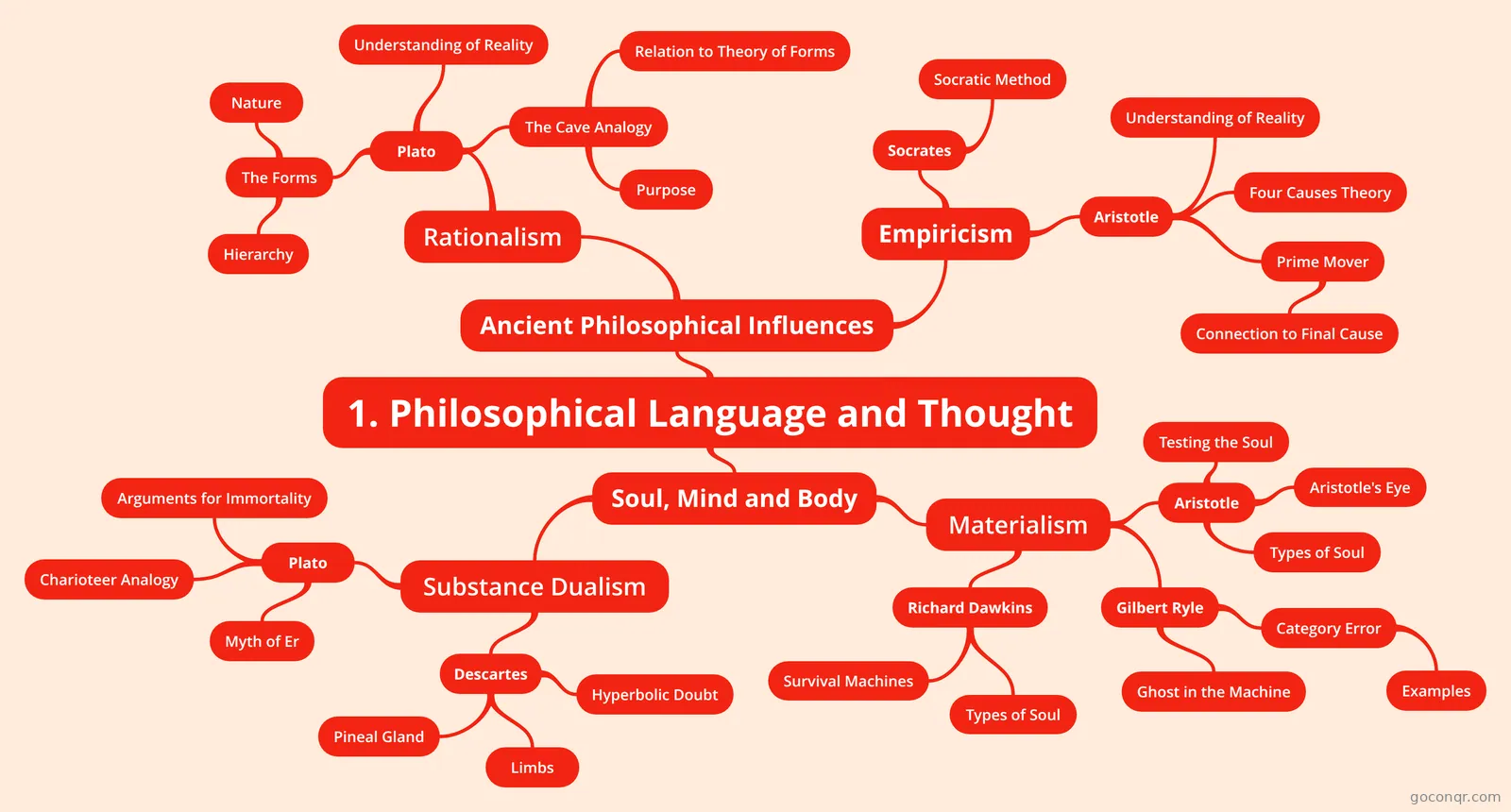
Mind map: Philosophical language and thought
Map content
1. Philosophical Language and Thought
Ancient Philosophical Influences
- Rationalism
- Believing knowledge can be reached through reason rather than sense experience
- Plato
- Ancient Greek rationalist
- Understanding of Reality
- The Visible World Illusion: Refers to illusory objects which comprise a world of appearances Belief: Assumptions which are formulated surrounding those objects of illusion The Intelligible Realm Reasoning: Refers to the thought process used to gain knowledge Understanding: Knowledge which is achieved as a result of right reason
- The Forms
- Nature
- Eternal representations of objects which possess a certain common feature For example, all chairs are different, but we call them chairs because they carry 'chairness'
- Hierarchy
- 1. The Form of the Good: That which allows all Forms and Particulars to be realised; this has been compared to the Sun 2. The Form of Abstract Concepts: Forms of concepts, such as love and justice3. The Form of Visible Objects: Forms of objects of illusion4. Particulars: Objects of illusion
- Nature
- The Cave Analogy
- Republic VII Socrates asks Glaucon to imagine a cave of prisoners, who have been chained to the floor by their legs and necks since birth Illusion - They can only see a wall in front of them, onto which shadows are cast due to people travelling along a walkway behind which is a fire Belief - One day, a prisoner is released, though find difficulty in accepting that their shadow reality was not actually reality Reasoning - They climb a steep and rugged ascent towards sunlight, symbolic of the effort of reasoning Understanding - Achieved when the prisoner has reached sunlight
- Purpose
- As an homage to Socrates and his life, and to illustrate Plato's Divided Line
- Relation to Theory of Forms
- The Sun and objects outside the Cave represent the Forms The Cave and its objects represents the illusory 'Particulars'
- Empiricism
- Believing knowledge can be reached through sense experience rather than reason
- Socrates
- Ancient Greek empiricist He criticises Plato's Form of the Good for having no worldly application, as he has not ascribed goodness to any worldly property; we therefore have no reason to believe it exists
- Socratic Method
- Identifying a concept, such as justice, and then trying to work out what we mean by it This was intended to illustrate how we are epistemologically limited
- Aristotle
- Ancient Greek empiricist
- Understanding of Reality
- There are two states of being - potentiality and actuality An object has potentiality if it has a possibility to become something else, whilst actuality refers to when that object fulfills its potentiality
- Four Causes Theory
- Something can be understood so long as its Four Causes are known An object is 'good' if it fulfills its telos, e.g. a knife able to cut is 'good' Material - That from which something is made, e.g. wood Formal - What shape that material takes, e.g. four legs with a top Efficient - How something came to be, e.g. a carpenter's effort Final - What said object's telos is, e.g. to dine at
- Prime Mover
- That which sits behind any chain of movement, and is itself unmoved What we see taking place is a Final Cause, which is rooted in the Prime Mover It must be actual, as it cannot have potential The Prime Mover must also be immaterial (and composed of pure thought), or it would be subject to change
- Connection to Final Cause
- Where there is a chain of events, Aristotle believed there to be a Final Cause, with the ultimate cause being the Prime Mover
- Rationalism
Soul, Mind and Body
- Substance Dualism
- States that mind and body exist as distinct substances
- Descartes
- Hyperbolic Doubt
- Descartes argued that the soul/mind and body were distinct through using 'hyperbolic doubt' He questioned whether he could be certain of mathematical equations, whether he could be dreaming, and whether a demon could be manipulating his senses He eventually reached the First Certainty: cogito ergo sum - 'I think, therefore I am'
- Limbs
- Descartes reasoned that soul/mind and body must be distinct, because nothing would be taken from his mind if something we taken from his body
- Pineal Gland
- Descartes tries to solve the soul/mind-body problem through pointing to the pineal gland as the point of interaction between the two This was because everything else in the brain was 'double,' e.g. the eyes, hemispheres...
- Hyperbolic Doubt
- Plato
- Argues that souls only animate bodies temporarily, and are then released to contemplate the Form of the Good They must exist necessarily, as it would be contradictory for a soul to die
- Arguments for Immortality
- Phaedo 1. Argument from Opposites - Every quality exists because it has an opposite; when something is not big it is small, so something that it not dead must be alive 2. Argument from Knowledge - Through questioning, Meno's slave boy is able to solve a geometry puzzle, suggesting he had attained knowledge before birth 3. Argument from Affinity - When our body dies, our soul will continue to live due to its immateriality
- Charioteer Analogy
- Phaedrus Two winged horses, appetite and emotion, pull a chariot which is controlled by a charioteer of reason Plato demonstrated how philosophers are 'wise' because they allow reason to guide them rather than appetite or emotion
- Myth of Er
- Republic X An old Greek legend which tells of a man called Er who died in battle, whose body showed no signs of decomposition when collected ten days later Two days after this, Er's body came to life on a funeral pyre, and he was able to tell everyone of his experiences in the afterlife
- Materialism
- States that mind and consciousness can be fully explained through material interactions, such as biochemical processes It therefore rejects the soul as a spiritual substance
- Aristotle
- Testing the Soul
- De Anima Concluded that a continuous 'psyche' is what connects the newborn, child, and the adult
- Types of Soul
- Aristotle argues that the type of soul a being possesses is related to its Four Causes: - Vegetative: Held by plants, animals, and humans, as all of these have potential to take in and grow from nutrition - Perceptive: Held by animals and humans, as these use their sense to interpret and react to the world - Intellectual: Held by humans only, as only these can reason and distinguish right from wrong
- Aristotle's Eye
- If an eye were an animal, its soul would be its capacity to see If the eye had no soul, it would be nothing but a lump of matter Likewise, a human without a soul would be nothing without matter
- Testing the Soul
- Gilbert Ryle
- Category Error
- The Concept of Mind (1949) Distinguishing between soul/mind and body is a mistake in language, as it treats these as part of the same logical category
- Examples
- Somebody watching a cricket match may observe all the players and their tactics, but then ask where the team spirit is, as if it were something to be found
- Ghost in the Machine
- Ryle criticises substance dualism for suggesting that an immaterial mind controlling a material body would be like a 'ghost in the machine'
- Category Error
- Richard Dawkins
- Survival Machines
- The Selfish Gene (1976) Dawkins describes human bodies as 'survival machines,' the genes of which have been blindly programmed to preserve the genes
- Types of Soul
- Is Science Killing the Soul? (1999) Dawkins pulls two definitions of the soul from the Oxford English DictionarySoul One: Sees the soul as distinct, able to know God, and survive death; Dawkins says science has already killed this soul or is doing so Soul Two: Refers to someone's personality and individuality, and their ability to make choices; Dawkins says science gives rise to this type of soul, if anything
- Survival Machines
- Substance Dualism
Information
- Description
- A level Religious Studies (Revision) Mind Map on 1. Philosophical Language and Thought, created by Jordan Best on 18/12/2017.
- Created by
- Jordan Best
- Views
- 2
- Rating