
Mind map
4. Mahayana Buddhism
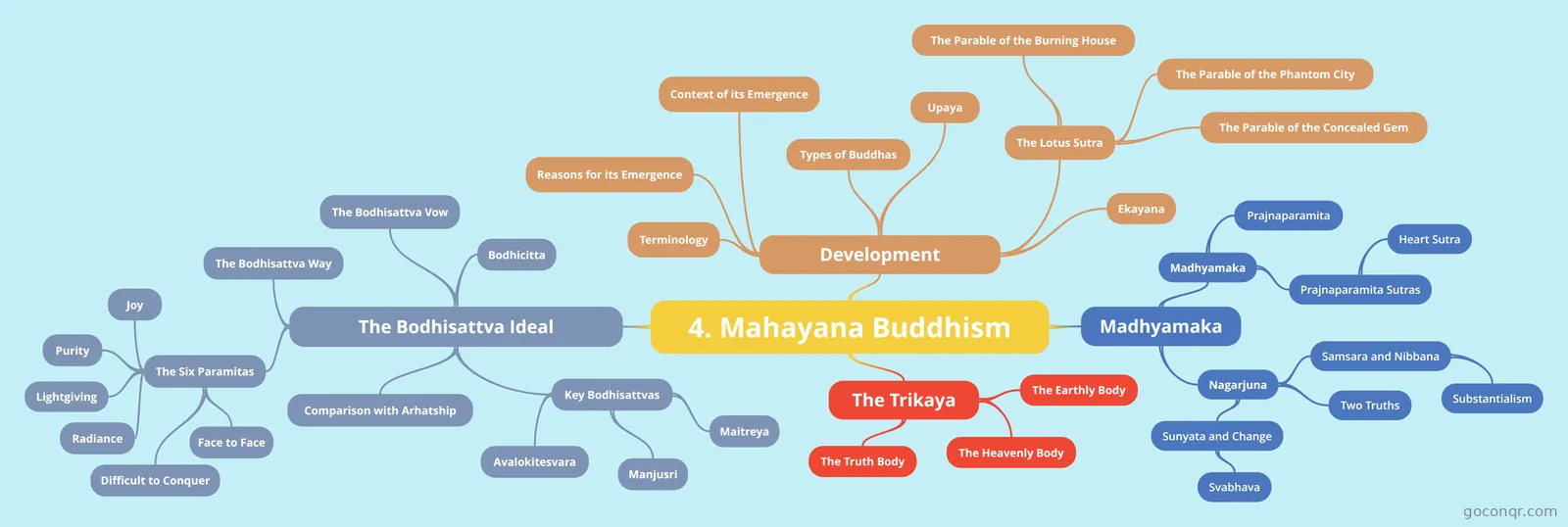
Mind map: Mahayana Buddhism
Map content
4. Mahayana Buddhism
- 1. Mahayana Buddhists accept one or multiple scriptures as the Buddha's word, such as the Pali Canon 2. Mahayana's goal is to become a bodhisattva, teaching others how to attain enlightenment before achieving it themselves 3. It is therefore possible that help can be gained from bodhisattvas further advanced on this path, such as Avalokitesvara and Manjusri 4. As well as this world-system, with its three realms of sense desire, form, and formlessness, there are other world-systems in which Buddhas such as Amitabha and Akshobya dwell 5. According to some Mahayana texts, Shakyamuni Buddha is available in a heavenly or spiritual form, like other buddhas and bodhisattvas 6. For some Mahayana Buddhists, 'buddha' also refers to the ultimate reality underlying the whole universe, everywhere and in everyone 7. Mahayana Buddhism developed several different philosophical approaches, such as the schools of Madhyamaka and the Yogacara, and also the concept of tathagatagarbha 8. Although Mahayana is thought of as more lay-oriented than Theravada, the monastic sangha remains central in most forms of Mahayana Buddhism 9. Mahayana monks still follow the Vinaya, though are likely to adapt it to suit the situation 10. Mahayana is characterised by its diversity, in that it is a label for a variety of teachings and practice; this is one reason why it is considered the 'great vehicle;
Development
- Mahayana Buddhism emerged between 150 BCE and 100 CE, when various groups began calling themselves Mahayana
- Terminology
- Mahayana Buddhists refer to Theravada Buddhism as Hinayana (the Lesser Vehicle), and Mahayana as the Great Vehicle
- Reasons for its Emergence
- Some Buddhists had reflected on what it meant to be a follower of the Buddha, suggesting that the Buddha had aimed at achieving a state which would enable him to promote the welfare of others, not just personal fulfilment This would mark the emergence of the bodhisattva ideal
- Context of its Emergence
- Four councils were conducted during the 400 years following the Buddha's death, culminating in the eventual division of Buddhism into Hinayana and Mahayana around the 1st Century CE
- Upaya
- Mahayana term translated as 'skilful means' or 'expedient means' whereby a voluntary action is driven by incomplete reasoning about its direction, e.g. telling lies to achieve a greater good It means using methods which are not permissible in traditional Buddhist teachings to help others attain nibbana - these teachings are only provisional For example, teaching a child to read by handing them Shakespeare will put them off, so one would give them other books to encourage them
- Types of Buddhas
- In order of preference: Bodhisattva: An 'awakened one' who has reached buddhahood and teaches others the path to the cessation of dukkha, and has reached nibbana through following the bodhisattva path Arhat: 'One who is worthy', or 'a perfected person' who has attained nibbana through the Hinayana way Pratyekabuddha: Literally 'a lone Buddha', or one who has become awakened by their own effort, without having heard the Buddha's teachings and do not themselves teach
- The Lotus Sutra
- Mahayana text which uses the Buddha as a mouthpiece, despite him having died some time beforehand This technique grants the writer(s) ultimate authority over Buddhism
- The Parable of the Burning House
- Found in Chapter 3 One day, a fire broke out in the house of a wealthy man who had many children He southed for his children to flee, though they were too absorbed in thier games Knowing they were fond of interesting toys, he called out that there were carts outside being pulled by all sorts of animals, and they rushed out of the house Here, the father is the Buddha, the children are beings trapped in samsara, and the house is the world burning with old age, sickness, and death This demonstrates skilful means, and the father is justified in his actions because there is no right or wrong way of achieving enlightenment His carts represent different paths to nibbana, where the ox cart represents the true path to nibbana (buddhahood)
- The Parable of the Phantom City
- Found in Chapter 7 Some people are being led by a guide through a wilderness to a place where, they are told, they will find great treasure They begin to become weary and wish to turn back, though the guide tells them there is a city ahead where they can rest They enter the city, and when they feel better, it vanishes; he explains that he created it to satisfy their needs, and now that it has done so, he has made it disappear Here, the guide is the Buddha, the group are disciples, the magic city is Buddhism, and the treasure if the buddha nature
- The Parable of the Concealed Gem
- A poor man visits a rich friend and passes out after drinking; the rich man sews a priceless gem into the lining of his friend's clothes before leaving on business When he comes to as a vagrant, he is unaware of the treasure he has received Later, he meets the rich man again, who shows him where the gem is hidden, and the poor man realises his wealth Here, the rich man is the Buddha, the poor man is a sattva, and the jewel is the truth about the buddha nature
- Ekayana
- 'One path' or 'one vehicle' Buddhas are rare amongst Theravada, with many enlightened beings having become arhats Mahayana states that everyone can and will eventually become buddhas, though they can only achieve this through folliwing the bodhisattva path
The Bodhisattva Ideal
- Mahayana emphasises the bodhisattva ideal, rather than arhatship
- The Bodhisattva Vow
- Summated as: "May I attain Buddhahood for the benefit of all sentient beings" It is a publicly announced vow which is preferably spoken in the presence of a buddha
- The Bodhisattva Way
- Mahayana's bodhisattva path seeks to benefit others by teaching them the path to the cessation of dukkha Samyaksambuddhahood is characterised by teaching the dharma to others following their own awakening 1. Dana: generosity, giving of oneself 2. Sila: virtue, morality 3. Ksantu: patience, tolerance 4. Virya: energy, diligence 5. Jhana: one-pointed concentration 6. Prajna: wisdom, insight This contrasts with the goal of the Hinayana path, where the goal is to achieve arhatship
- The Six Paramitas
- Practicing each of the six paramitas is thought to contribute to the perfection of a bodhisattva's qualities There are a total of ten in the Ten Stages Sutra, in which upaya is the seventh
- Joy
- Joy Stems from the confidence of knowing your goal in life
- Purity
- Pure Because the bodhisattva pays attention to perfecting morality, and preaches to others what they practice
- Lightgiving
- Lightgiving As the mind is cleared through study and meditation; the bodhisattva is devoted to working for the good of others
- Radiance
- Radiant With the energy of the perfection of vigour; the bodhisattva enthusiastically practices all 37 principles conducive to enlightenment
- Difficult to Conquer
- Difficult to conquer As the bodhisattva is really progressing and it would be difficult to stop them now
- Face to Face
- Face-to-face Because the bodhisattva comes face-to-face with the truth
- Comparison with Arhatship
- Theravada Buddhism culminates in arhatship, whilst Mahayana Buddhism culminates in reaching buddhahood; an ideal in which a bodhisattva withholds their nibbana and decides to teach the dharma to others Theravada Buddhists typically reach enlightenment and experience nibbana, though do not return to share their teachings with others
- Key Bodhisattvas
- Avalokitesvara
- Embodies the karuna (compassion and sympathy) of all buddhas, i.e. those who have attained buddhahood They are usually pictured with thousands of arms, ready to help everyone at once
- Manjusri
- Symbolises the embodiment of prajna (transcendent wisdom)
- Maitreya
- Will supposedly appear on Earth in the future, achieve complete enlightenment, and teach the pure dharma to others There will therefore come a time where Gautama's teachings will phase of out existence, and that this bodhisattva will revive those teachings
- Avalokitesvara
- Bodhicitta
- Bodhicitta is the 'thought of enlightenment' which inspires one to save others who are trapped in samsara, which represents a commitment to encouraging all beings to achieve enlightenment From bodhicitta and an understanding of shunyata (emptiness) arises karuna (compassion) for the suffering of others and a determination to free others
The Trikaya
- Mahayana Buddhists believe that a Buddha (an awakened bodhisattva) has three forms On the level of ultimate truth, only the Dharmakaya is real The Truth and Heavenly Bodies could be criticised for deification, and treating Shakyamuni as a deity rather than a historical figure
- The Truth Body
- Dharmakaya, Wisdom That which ultimately makes a buddha a buddha - understandings of teachings such as the universal truth and shunyata According to Mahayana, enlightenment knows no limits or boundaries
- The Heavenly Body
- Sambhogakaya, Compassion Refers to the wonderful, heavenly buddhas described in the Mahayana sutras Those buddhas form the focus of devotion towards supporting others in Mahayana Buddhism
- The Earthly Body
- Nirmanakaya, Transformation Refers to the buddha manifested in a material form, such as Gautama In Mahayana, Siddhartha's life story was acted out for the benefit of all earthly beings by an emanation of Shakyamuni Buddha Transformation bodies may take the form of earthly buddhas, but can take the form of any being which will be of help to living beings, e.g. animals, gods, or teachings from other religions
Madhyamaka
- Translated as 'The Middle Position' Nagarjuna's school claims that to say we cannot accept eternalism nor annihilationism means that it is because of inherent emptiness that things are able to change
- Madhyamaka
- Prajnaparamita
- Refers to the perfection of wisdom, which sees: - Extinction of the Triple Fires - Understanding that perfection itself is empty - Understanding that the bodhisattva seeks to work for the benefit of all beings
- Prajnaparamita Sutras
- Body of sutras associated with Nagarjuna's philosophy, such as sunyata, scepticism, and madhyamaka It is important to Mahayana Buddhism due to its emphasis on the bodhisattva ideal and compassionTo accept that things such as a bodhisattva, being, or the perfection of wisdom do not hold independent existence is to be perfect
- Heart Sutra
- Everything is empty of independent existence - All things are interconnected and dependent on other things for their existence Even the core Buddhist teachings are not really true - They are only intended to encourage one to follow the Buddhist path They are all upaya - For example, describing enlightenment as spiritual liberation to convince lay people To gain perfect understanding, we must must 'go beyond' and stop thinking dualistically- This relates to adopting a 'Middle Way' approach, and treating prajnaparamita as the end goal rather than nibbana, which is upaya
- Prajnaparamita
- Nagarjuna
- 2nd Century Buddhist philosopher who sought to defend Buddhism from philosophical ideas shared by Brahminism by reinterpreting the Buddha's word He supposed discovered the Prajnaparamita Sutras in an underwater serpent kingdom, which had been guarded since the Buddha’s time He was thereafter known as Nagarjuna, the ‘noble serpent’ Nagarjuna attempted to deconstruct all thought which analysed the world in terms of fixed essences, such as the 'atman' through taking an opponent's idea and applying reductio ad absurdium For example, suggesting that empty things DO exist suggest they exist independently, while suggesting that empty things do NOT exist suggests they do not exist at all
- Sunyata and Change
- Development of anatta which relates to non-origination, voidness, and lack of self Nagarjuna concludes that objects can only logically or empirically change if they had no fixed essence Otherwise, tanha could not arise from ignorance, and enlightenment and punabbhava could not occur
- Svabhava
- Refers to existence which is not dependent on anything else However, Nagarjuna suggests that since we do not observe non-dependent things, all things can only be empty of independent existence
- Two Truths
- According the Nagarjuna, those who do not understand the distinction between the two truths do not understand the Buddha's word Ultimate Truth: Describes ultimate reality as sunyata, and empty of concrete and inherent characteristics Without understanding this, liberation and prajnaparamita cannot be achieved Conventional Truth: Describes our daily experiences of a concrete world, in which we can learn the Ultimate Truth It could relate to Wittgenstein's language games
- Samsara and Nibbana
- Samsara is dependent upon nibbana for its existence, and therefore identities are not distinct Nibbana does not exist unconditionally, which opposes Nagasena's explanation of nibbana as unconditioned
- Substantialism
- Much like the Buddha taught anatta, Nagarjuna suggests there cannot be a substantialist stance to samsara and nibbana
Information
- Description
- A level Religious Studies (Revision) Mind Map on 4. Mahayana Buddhism, created by Jordan Best on 05/01/2018.
- Created by
- Jordan Best
- Views
- 3
- History
-
- Created by Jordan Best · Dec 18, 2017
- Copied by Jordan Best · Dec 22, 2017
- Copied by Jordan Best · Jan 5, 2018
- Rating