
Mind map
The Alternative Vote
Map content
The Alternative Vote
What is it?
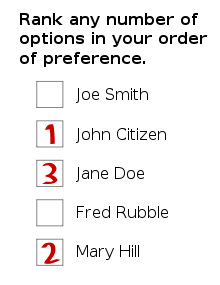
- The AV is a preferential system where the voter has the chance to rank the candidates in order of preference. The voter puts a '1' by their first choice and a '2' by their second choice, and so on, until they no longer wish to express any further preferences of run out of candidates
- Candidates are elected outright if they gain more than half of the first preference votes. If not, the candidate who lost (the one with the least first preferences) is eliminated and their votes are redistributed according to the second (or next available) preference marked on the ballot paper. This process continues until one candidate has half the number of votes and is elected
- Used in: Fiji, Papua New Guinea, Australia
- In the UK-wide referendum in 2011 the British public were asked if they wanted to replace FPTP with the Alternative Voting system for electing members of parliament. The referendum produced a definitive no vote against AV
Advantages
- All MPs would have the support of a majority of their voters. Following the 2010 General Election, two thirds of MPs elected lacked majority support, the highest figure in British political history
- It can't be right or fair that with the current system MPs can get elected on fewer than three out of ten votes. The AV raises the bar. All MPs would have to aim to get more than 50% of the vote, and so will have to work harder to win- and keep- our support. They'll have to speak to more voters and reach out to the wider community. That's bad news for complacent MPs- and extremists
- It retains the same constituencies, meaning no need to redraw boundaries, and no overt erosion of the constituency-MP link
- It penalises extremist parties, who are unlikely to gain many second-preference votes
- It encourages candidates to chase second- and third- preferences, which lessens the need for negative campaigning (one doesn't want to alienate the supporters of another candidate whose second preferences one wants) and rewards broad-church policies
- It reduces the need for tactical voting. Electors can vote for their first-choice candidate without fear of wasting their vote
- It reduces the number of "safe seats" where the election result is a forgone conclusion
- When politics was a two-horse race in the 1950s the old system worked. But as voters have embraced more parties it's easier for MPs to get in with a handful of votes. AV keeps what is best about our current system- the link between an MP serving their local constituency- and improves on it. Your ballot paper is unchanged, hung parliaments are no more likely, but every MP will have to do more to secure majority support
Disadvantages
- AV is not proportional representation and in certain electoral conditions, such as landslides, can produce a more disproportional result than FPTP
- It undermines the fundamental principle of one person one vote because some voters can have more than one vote
- David Cameron wrote in the campaign: 'The first is its simplicity. It's so simple that it can be summed up in one sentence: the candidate who gets the most votes wins. Just compare that to AV: a confusing mess of preferences, probabilities and permutations'
- In close three-way races the "compromise" candidate could be defeated in the first round even though they may be more broadly acceptable to the electorate than the top two candidates
- Lower preferences can potentially throw up a "lowest common denominator" winner without much positive support of their own
- It is fundamentally illogical and unfair that second preferences are worth as much as first preferences when they are redistributed
- A voting system which allows voters to rank candidates is prone to so-called 'Donkey voting', where voters vote for candidates in the order they appear on the ballot
- AV is only used by three countries in the world and even they don't like it. In Australia, AV hasn't made their MPs work any harder, got rid of 'safe' seats, or stopped negative campaigning. By contrast, FPTP voting system has been copied around the globe. It is used by 2.4 billion people, making it the most widely used system in the world
- It was comprehensively rejected by the British people in a referendum in May 2011 (the turnout was 41%. No to AV was 67.9% and yes to AV was 32.1%)
Images and files in the map
Information
- Description
- AS level Politics Mind Map on The Alternative Vote, created by Lily Duffy on 27/01/2018.
- Created by
- Lily Duffy
- Views
- 0
- Rating