
Mind map
Rocks and Resources
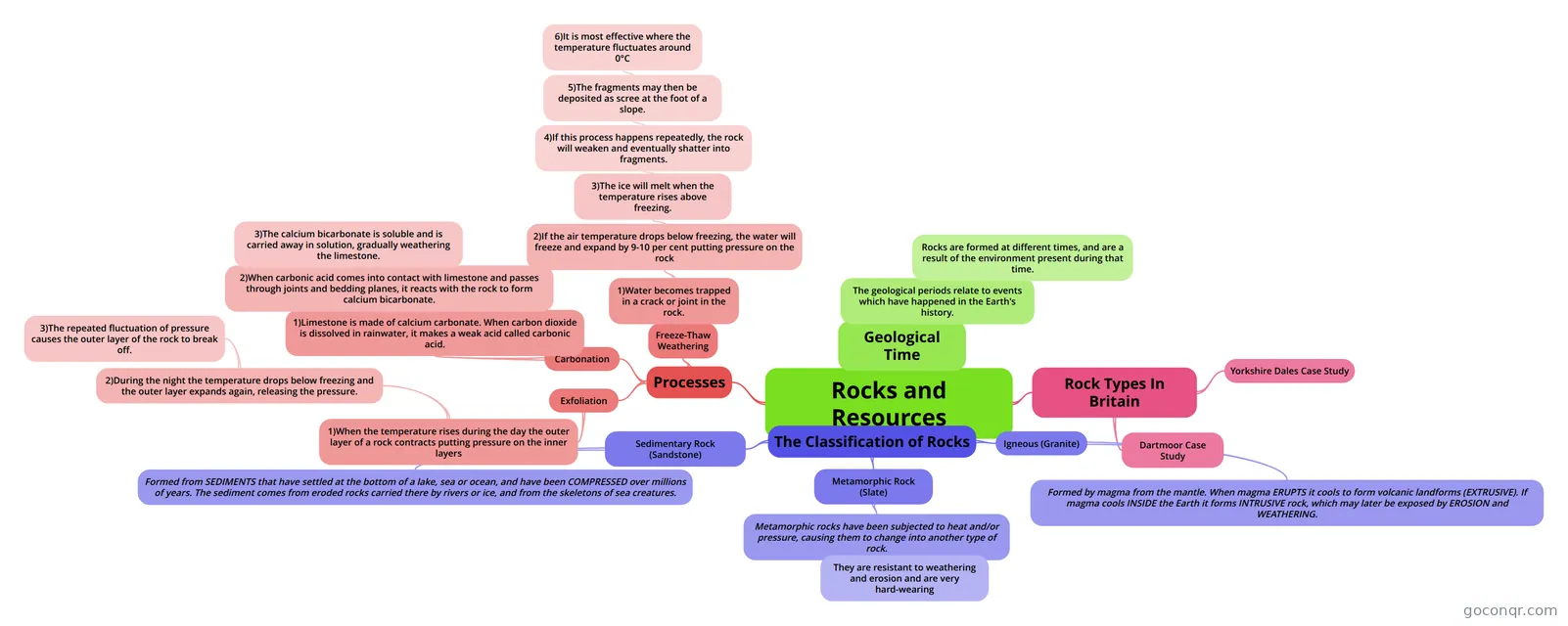
Mind map: rocks and resources
Map content
Rocks and Resources
Geological Time
- The geological periods relate to events which have happened in the Earth's history.
- Rocks are formed at different times, and are a result of the environment present during that time.
- The geological periods relate to events which have happened in the Earth's history.
The Classification of Rocks
- Igneous (Granite)
- Formed by magma from the mantle. When magma ERUPTS it cools to form volcanic landforms (EXTRUSIVE). If magma cools INSIDE the Earth it forms INTRUSIVE rock, which may later be exposed by EROSION and WEATHERING.
- Metamorphic Rock (Slate)
- Metamorphic rocks have been subjected to heat and/or pressure, causing them to change into another type of rock.
- They are resistant to weathering and erosion and are very hard-wearing
- Metamorphic rocks have been subjected to heat and/or pressure, causing them to change into another type of rock.
- Sedimentary Rock (Sandstone)
- Formed from SEDIMENTS that have settled at the bottom of a lake, sea or ocean, and have been COMPRESSED over millions of years. The sediment comes from eroded rocks carried there by rivers or ice, and from the skeletons of sea creatures.
- Igneous (Granite)
Processes
- Freeze-Thaw Weathering
- 1)Water becomes trapped in a crack or joint in the rock.
- 2)If the air temperature drops below freezing, the water will freeze and expand by 9-10 per cent putting pressure on the rock
- 3)The ice will melt when the temperature rises above freezing.
- 4)If this process happens repeatedly, the rock will weaken and eventually shatter into fragments.
- 5)The fragments may then be deposited as scree at the foot of a slope.
- 6)It is most effective where the temperature fluctuates around 0°C
- 5)The fragments may then be deposited as scree at the foot of a slope.
- 4)If this process happens repeatedly, the rock will weaken and eventually shatter into fragments.
- 3)The ice will melt when the temperature rises above freezing.
- 2)If the air temperature drops below freezing, the water will freeze and expand by 9-10 per cent putting pressure on the rock
- 1)Water becomes trapped in a crack or joint in the rock.
- Carbonation
- 1)Limestone is made of calcium carbonate. When carbon dioxide is dissolved in rainwater, it makes a weak acid called carbonic acid.
- 2)When carbonic acid comes into contact with limestone and passes through joints and bedding planes, it reacts with the rock to form calcium bicarbonate.
- 3)The calcium bicarbonate is soluble and is carried away in solution, gradually weathering the limestone.
- 2)When carbonic acid comes into contact with limestone and passes through joints and bedding planes, it reacts with the rock to form calcium bicarbonate.
- 1)Limestone is made of calcium carbonate. When carbon dioxide is dissolved in rainwater, it makes a weak acid called carbonic acid.
- Exfoliation
- 1)When the temperature rises during the day the outer layer of a rock contracts putting pressure on the inner layers
- 2)During the night the temperature drops below freezing and the outer layer expands again, releasing the pressure.
- 3)The repeated fluctuation of pressure causes the outer layer of the rock to break off.
- 2)During the night the temperature drops below freezing and the outer layer expands again, releasing the pressure.
- 1)When the temperature rises during the day the outer layer of a rock contracts putting pressure on the inner layers
- Freeze-Thaw Weathering
Rock Types In Britain
- Dartmoor Case Study
- Yorkshire Dales Case Study
Information
- Description
- Geography (Rocks) Mind Map on Rocks and Resources, created by rowanne2 on 28/08/2014.
- Created by
- rowanne2
- Views
- 15
- Rating
More on Weathering and Erosion