
Mind map
Computer Architecture
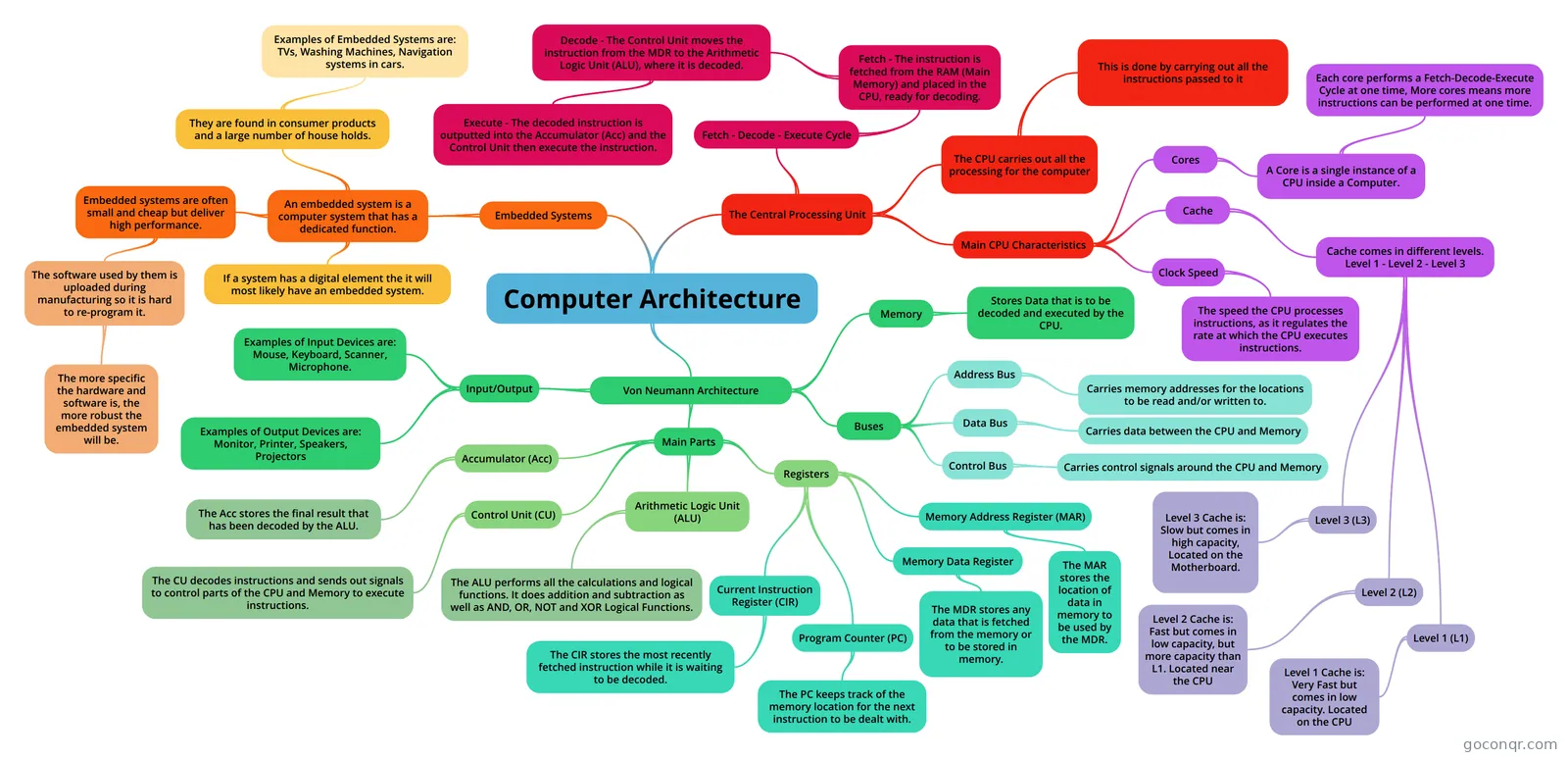
Mind map: Computer Architecture
Map content
Computer Architecture
Von Neumann Architecture
- Main Parts
- Control Unit (CU)
- The CU decodes instructions and sends out signals to control parts of the CPU and Memory to execute instructions.
- Arithmetic Logic Unit (ALU)
- The ALU performs all the calculations and logical functions. It does addition and subtraction as well as AND, OR, NOT and XOR Logical Functions.
- Registers
- Memory Address Register (MAR)
- The MAR stores the location of data in memory to be used by the MDR.
- Memory Data Register
- The MDR stores any data that is fetched from the memory or to be stored in memory.
- Program Counter (PC)
- The PC keeps track of the memory location for the next instruction to be dealt with.
- Current Instruction Register (CIR)
- The CIR stores the most recently fetched instruction while it is waiting to be decoded.
- Memory Address Register (MAR)
- Accumulator (Acc)
- The Acc stores the final result that has been decoded by the ALU.
- Control Unit (CU)
- Input/Output
- Examples of Input Devices are: Mouse, Keyboard, Scanner, Microphone.
- Examples of Output Devices are: Monitor, Printer, Speakers, Projectors
- Memory
- Stores Data that is to be decoded and executed by the CPU.
- Buses
- Address Bus
- Carries memory addresses for the locations to be read and/or written to.
- Data Bus
- Carries data between the CPU and Memory
- Control Bus
- Carries control signals around the CPU and Memory
- Address Bus
- Main Parts
The Central Processing Unit
- The CPU carries out all the processing for the computer
- This is done by carrying out all the instructions passed to it
- Fetch - Decode - Execute Cycle
- Fetch - The instruction is fetched from the RAM (Main Memory) and placed in the CPU, ready for decoding.
- Decode - The Control Unit moves the instruction from the MDR to the Arithmetic Logic Unit (ALU), where it is decoded.
- Execute - The decoded instruction is outputted into the Accumulator (Acc) and the Control Unit then execute the instruction.
- Decode - The Control Unit moves the instruction from the MDR to the Arithmetic Logic Unit (ALU), where it is decoded.
- Fetch - The instruction is fetched from the RAM (Main Memory) and placed in the CPU, ready for decoding.
- Main CPU Characteristics
- Cores
- A Core is a single instance of a CPU inside a Computer.
- Each core performs a Fetch-Decode-Execute Cycle at one time, More cores means more instructions can be performed at one time.
- A Core is a single instance of a CPU inside a Computer.
- Cache
- Cache comes in different levels. Level 1 - Level 2 - Level 3
- Level 1 (L1)
- Level 1 Cache is: Very Fast but comes in low capacity. Located on the CPU
- Level 2 (L2)
- Level 2 Cache is: Fast but comes in low capacity, but more capacity than L1. Located near the CPU
- Level 3 (L3)
- Level 3 Cache is: Slow but comes in high capacity, Located on the Motherboard.
- Level 1 (L1)
- Cache comes in different levels. Level 1 - Level 2 - Level 3
- Clock Speed
- The speed the CPU processes instructions, as it regulates the rate at which the CPU executes instructions.
- Cores
- The CPU carries out all the processing for the computer
Embedded Systems
- An embedded system is a computer system that has a dedicated function.
- If a system has a digital element the it will most likely have an embedded system.
- They are found in consumer products and a large number of house holds.
- Examples of Embedded Systems are: TVs, Washing Machines, Navigation systems in cars.
- Embedded systems are often small and cheap but deliver high performance.
- The software used by them is uploaded during manufacturing so it is hard to re-program it.
- The more specific the hardware and software is, the more robust the embedded system will be.
- The software used by them is uploaded during manufacturing so it is hard to re-program it.
- An embedded system is a computer system that has a dedicated function.
Information
- Description
- GCSE Computer Science (Computer Architecture) Mind Map on Computer Architecture, created by John Craik on 01/02/2018.
- Created by
- John Craik
- Views
- 2
- Rating
More on Von Neumann and Harvard architectures