
Mind map
1.2- Atomic Structure & The Periodic Table
Map content
1.2- Atomic Structure & The Periodic Table
Atoms and Istotopes
- Atomic Structure
- Elements are made up of atoms, and all the atoms of an element are of the same type. Every atom is made up of smaller particles called protons, neutrons and electrons. These are referred to as fundamental particles, and their numbers vary in atoms of different elements.
- Every atom contains a positively charged central region called the nucleus. This is surrounded by electrons, which are negatively charged. The atom has no overall charge because the positive and negative charges balance each other out.
- The nucleus makes up nearly all of the mass of the atom, and has to types of particle in it: protons (positive) and neutrons (no charge). The mass of a neutron is the same as a proton (1) and each electron has a negative charge. The mass of an electron is so small it is considered negligible or 1/2000
- Atomic Number: the number of PROTONS in the nucleus. The number of ELECTRONS is equal to the number of PROTONS. Found at the BOTTOM.
- Mass number: total number of nucleons (PROTONS AND NEUTRONS) in the nucleus. Found at the TOP.
- Isotopes
- Different elements have different atomic (PROTON) numbers, no two elements have the same number of protons. In all elements the atomic number (PROTONS) stays the same. However the number of NEUTRONS in the nucleus isn't fixed. Some atoms of the sam element have different numbers of neutrons, which gives them different MASS NUMBERS. These are called isotopes.
- When isotopes have more neutrons than protons, they are unstable and are likely to decay, and are radio active. The more the number of neutrons differs from the stable form, the more unstable and radio active it becomes
- Working out the Ar (Relative Atomic Mass)
- The average mass number for all the isotopes, taking into account their frequency.
- Electrons and Electron Shells
- The electrons in an atom are in different electron shells around the nucleus. These are some times called orbits. Each shell can only contain a certain number of electrons:
- Shell 1: 2 electrons
- Shell 2: 8 electrons
- Shell 3: 8 electrons
- Shell 4: 2 electrons
- Work out the atomic structure from the atomic number.
- The electrons in an atom are in different electron shells around the nucleus. These are some times called orbits. Each shell can only contain a certain number of electrons:
- Atomic Structure
Electronic Structure and the Periodic Table
- Electronic Structure
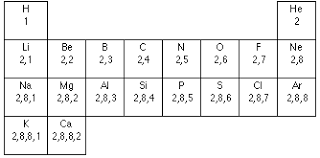
- These are the electronic structures for the first 20 elements:
- Periodic Table
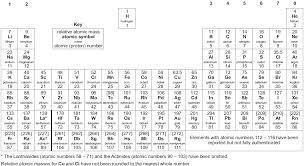
- The periodic table helps you to predict the properties of elements, and are arranged in order of their atomic numbers. Each column is called a group, the number of each group signifies the number of electrons in the outermost shell. The horizontal rows are called periods, can the period number tells you how many electron shells the element has. Hydrogen has unusual properties, so it doesn't have a group. In between groups 2 and 3 are the transition metals, with properties similar to metals and non-metals.
- You can work out the electronic structure of any element from the information given to you in the periodic table (period numbers and group numbers)
- Electronic Structure
Group 1 and Group 7
- Group 1
- Lithium
- A soft, silvery metal. It is the lightest of all metals and the least dense solid element. It is the least reactive alkali metal, but still has to be kept in mineral oil.
- Sodium
- A soft, silvery-white metal. Not found naturally because it is so reactive. Stored under mineral water to stop it from reacting with air.
- Potassium
- Soft, silvery-grey metal. More reactive as you go down the group, so is stored under mineral oil, and even reacts with the small amounts of air in the oil.
- Rubidium
- Soft, silvery and highly reactive. Bursts into flame on contact with air.
- Caesium
- Kept under oil and can only be handed in an inert atmosphere. Explodes violently on contact with water.
- Francium
- Extremely reactive and unstable. Found naturally in uranium minerals, only about 30g in existence on Earth at any one time.
- Properties
- React with oxygen to form oxides
- React with water to form hydroxides and hydrogen gas
- React with chlorine and bromine to form chlorides and bromides.
- The reactivity of alkali metals decreases down the group, so the reactions get more vigorous as you move from lithium to potassium.
- Reaction Equations
- Oxygen:
- 4Li (s) + O2 (g) ----> 2Li2O (s)
- Water:
- 2Li (s)+ 2H2O (l)----> 2LiOH (aq) + H2 (g)
- Halogen:
- 2Li (s)+ Cl2 (g) ---> 2LiCl (s)
- Oxygen:
- Flame Tests
- Lithium burns crimson red
- Sodium burns orange-yellow
- Potassium burns lilac
- Lithium
- Group 7 (Halogens)
- Flourine
- A pale yellow gas at room temperature. Highly toxic (0.1% is lethal) and explosive. Fluorine does have some functions in the human body- teeth.
- Chlorine
- A greenish- yellow gas. Very reactive and toxic. Due to this, it is most commonly found in salts (chlorides). It is used in bleach and to manufacture PVC, also disinfecting drinking water and swimming pools.
- Bromine
- A reddish-brownish liquid at room temperature. Highly reactive and toxic
- Iodine
- Reactive so is found in salts, iodides. It is toxic in its elemental form, but is used in the body in small quantities to help with the function of the thyroid gland. Used in antiseptics, disinfectants, dyes and printing inks
- Astatine
- One of the rarest elements on Earth. Highly radioactive and breaks down immediately so know one knows what it looks like.
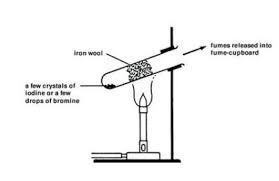
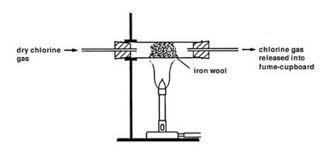
- Reactions with iron
- When fluorine comes into contact with iron wool, the below reaction/equation takes place. The iron wool bursts into flames without needing to be heated
- 2Fe(s) + 3F2 ----> 2FeF3
- Chlorine: the iron glows brightly and a blackish-brown deposit of iron(III) chloride is found in the tube.
- Bromine: The iron glows slightly and a brown residue is formed/left behind. (iron(III) bromide)
- Iodine: strong heating is required before any reaction occurs
- When fluorine comes into contact with iron wool, the below reaction/equation takes place. The iron wool bursts into flames without needing to be heated
- Flourine
- Group 1
Displacement Reactions
- A more reactive halogen can displace a less reactive halogen from a solutions of its salts. This is referred to as a displacement reaction.
- Chlorine, the second most reactive halogen, will displace bromine and iodine from solutions of bromides and iodides.
- Cl2 + 2NaBr ----> Br2 + NaCl
- Chlorine displaces bromine and iodine, but bromine displaces iodine but is displaced by chlorine. Iodine does not displace anything.
Tests for Halogens
- Halides are identified by a silver nitrate precipitation reaction. The halogen ions bond with the silver ions to form insoluble precipitates. The different colours can be used to identify halogens.
- Add diluted nitric acid to the test solution in a volume equal to the test solution. Then, add a few drops of silver nitrate solution. Observe the colours of the precipitates.
- White ---> chloride
- Pale yellow ----> bromide
- Yellow ----> iodide
- Halides are identified by a silver nitrate precipitation reaction. The halogen ions bond with the silver ions to form insoluble precipitates. The different colours can be used to identify halogens.
Group 0
- They have full outer shells so are very unreactive, they do not form compound in nature.
- Helium: lighter than air so is used in balloons and air ships. Liquid helium is used to cool the superconducting magnets in MRI scanners.
- Neon: most commonly used in neon lights. Neon produces an orange-red glow when sealed in a tube with a high potential applied to electrodes at both ends.
- Argon: produces a blue light, and is a good insulator so is used in double-glazing.
Images and files in the map
Information
- Description
- Year 10 Chemistry (Atomic Structure and the Periodic Table) Mind Map on 1.2- Atomic Structure & The Periodic Table, created by marnie cockrill on 04/06/2018.
- Created by
- marnie cockrill
- Views
- 0
- Rating