
Mind map
Classical Conditioning
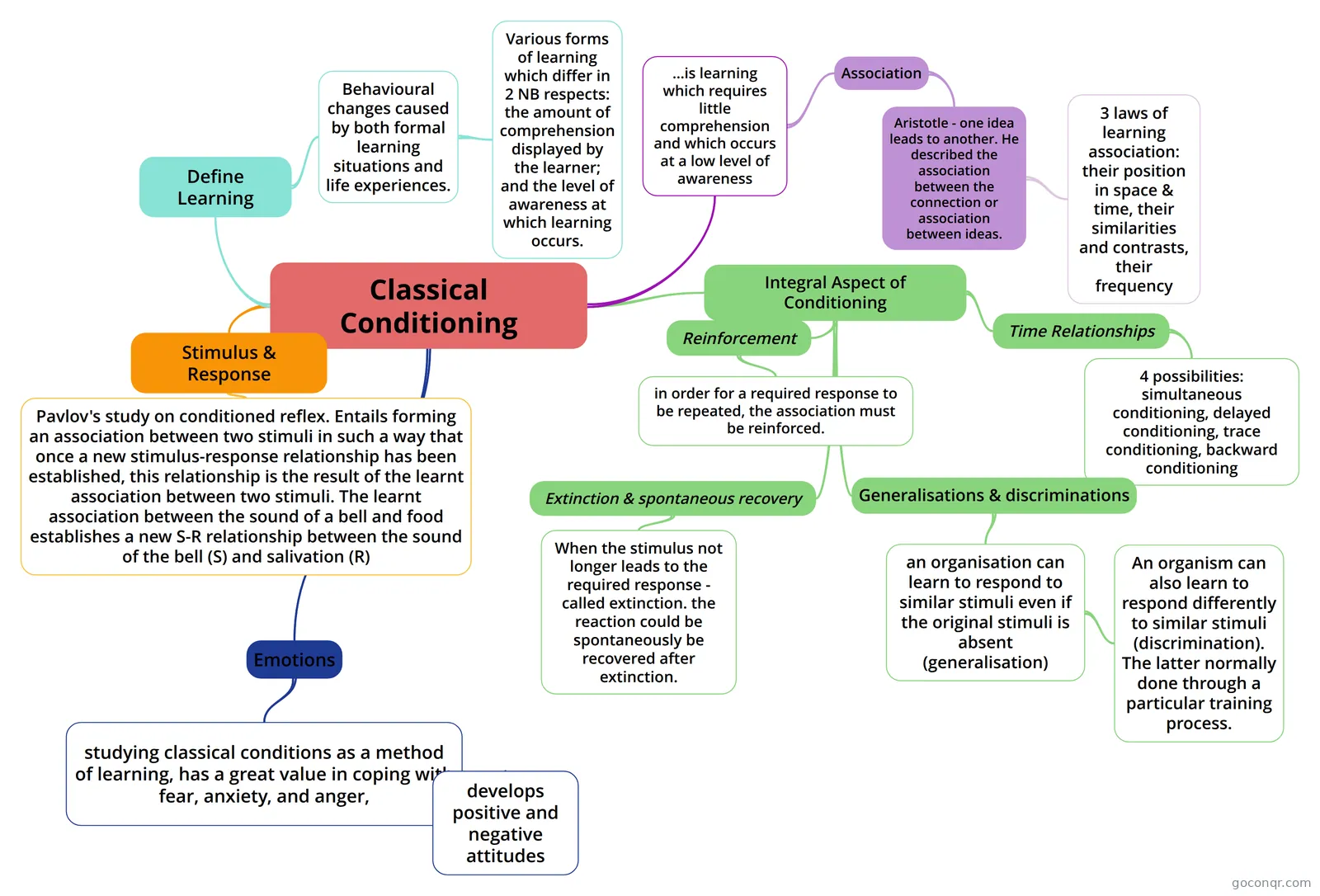
Mind map: Classical conditioning
Map content
Classical Conditioning
Define Learning
- Behavioural changes caused by both formal learning situations and life experiences.
- Various forms of learning which differ in 2 NB respects: the amount of comprehension displayed by the learner; and the level of awareness at which learning occurs.
- Behavioural changes caused by both formal learning situations and life experiences.
...is learning which requires little comprehension and which occurs at a low level of awareness
- Association
- Aristotle - one idea leads to another. He described the association between the connection or association between ideas.
- 3 laws of learning association: their position in space & time, their similarities and contrasts, their frequency
- Aristotle - one idea leads to another. He described the association between the connection or association between ideas.
- Association
Stimulus & Response
- Pavlov's study on conditioned reflex. Entails forming an association between two stimuli in such a way that once a new stimulus-response relationship has been established, this relationship is the result of the learnt association between two stimuli. The learnt association between the sound of a bell and food establishes a new S-R relationship between the sound of the bell (S) and salivation (R)
Integral Aspect of Conditioning
- Reinforcement
- in order for a required response to be repeated, the association must be reinforced.
- Time Relationships
- 4 possibilities: simultaneous conditioning, delayed conditioning, trace conditioning, backward conditioning
- Extinction & spontaneous recovery
- When the stimulus not longer leads to the required response - called extinction. the reaction could be spontaneously be recovered after extinction.
- Generalisations & discriminations
- an organisation can learn to respond to similar stimuli even if the original stimuli is absent (generalisation)
- An organism can also learn to respond differently to similar stimuli (discrimination). The latter normally done through a particular training process.
- an organisation can learn to respond to similar stimuli even if the original stimuli is absent (generalisation)
- Reinforcement
Emotions
- studying classical conditions as a method of learning, has a great value in coping with fear, anxiety, and anger,
- develops positive and negative attitudes
- studying classical conditions as a method of learning, has a great value in coping with fear, anxiety, and anger,
Information
- Description
- post grad Education Mind Map on Classical Conditioning, created by avril9249 on 05/10/2014.
- Created by
- avril9249
- Views
- 16
- Rating
More on Classical conditioning