
Mind map
External
Map content
External
Political
- Brexit: EU trade agreements with the UK are under threat now that the UK has voted to leave the EU. Changes in these agreements may mean implementation of tariffs on certain goods, meaning higher costs for Tesco's products imported from EU countries. Changes in these agreements will have to be taken into account through the SCM. JIT systems may be slowed down due to delays with goods at new customs checks.
- Recycling regulations
- 5p plastic bags: In 2015 it became UK law that retailers with over 250 employees must charge 5p for each single-use plastic bag, with a long-term goal of eliminating the use of plastic bags. By now charging money for a product that was previously free, this law could encourage suppliers of plastic bags to charge more because their product has now been given a higher selling price. Tesco would now benefit by discontinuing single-use plastic bags and offering alternatives such as bags for life.
- Changes of government will come with changes in policies and goals for the UK's economy, environment, and ethical responsibilities. Retailers like Tesco may be faced with new tax plans and be set goals by the new government and possibly face financial penalties if these are not met.
Environmental
- Costs for affects on environment: To encourage companies to become more energy efficient and do less damage to the environment, any company operating in the UK must pay certain taxes, these include: CCL and landfill tax. These taxes will increase Tesco's costs and decrease profit margins. Tesco would need to become more environmentally friendly to lower their costs otherwise these costs will be pushed on to the customer through increased prices. Increased prices would cause an inward movement of demand and create a new-point of equilibrium
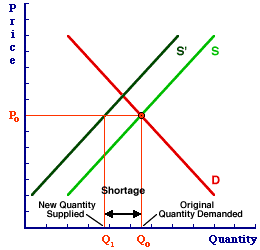
- Natural disasters can cause major disruptions in the supply chain, this would cause an inward shift of supply. This could cost large sums of money through loss of sales and slow down the supply chain, creating a shortage (Figure 3); unless alternative methods are found quickly.
- Figure 3. Shortage
- Bad weather conditions in the UK like snow will slow down supply of stores, this would cause significant losses in revenue.
Social
- Sources of food (treatment of animals): Changes in social attitudes have meant that people care more about the treatment of the livestock that they later consume. This has caused customers to demand products that give assurances no cruelty takes place within the process of getting their product from farm to fork. This has given rise to vegan options and companies who's niche is their assurance for zero cruelty to livestock. This demand has lead Tesco to provide more vegan options and other no cruelty substitutes/ alternatives. This is evident through Tesco's supply of brands such as Happy Egg Co. And Quorn.
- New customer interest in a healthy lifestyle: With the rising popularity of a 'vegan trend' Tesco and other competitors will need to expand their product range to include products that will suit the wants of these customers. However, this is an expensive market segment to enter as the COP for vegan products are higher than alternatives. However, expansion into a new market segment will incur the risk of not producing enough revenue to create profit or meet their break-even point, in which case. an expansion would be more detrimental to the company.
Technological
- Data protection (Hacks): Companies have moral and legal obligations, such as the GDPR, to ensure that the data shared with the company by customers are protected and not shared without the consent of the customer. When customer information is mishandled or ill-protected, it can have legal and financial consequences: 'Tesco Bank has been fined £16.4m by the UK financial regulator for failings surrounding a cyber-attack on its customers in November 2016.' BBC (2018). A breach like this one will not only result in a large fine, but Tesco will now face the task of regaining customer's trust. Tesco will also have to invest into security systems to safeguard customers' information, this will increase Tesco's fixed costs and will result in less money being invested in other areas of the company.
Economical
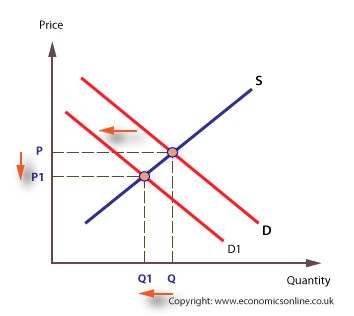
- In the event of a recession, unemployment levels will rise. This increase in unemployment levels will decrease the amount of disposable income of the overall population. With a lower overall disposable income level, the demand for luxury products will take an inward shift (Figure 1). An inward shift of demand creates a surplus and lower Tesco's ROI. To cut their losses, Tesco could lower the prices of their luxury goods to return to equilibrium, however, this would decrease Tesco's profit margins. Alternatively, Tesco could create incentives for customers to buy luxury goods by lowering prices of complementary goods or creating deals such as 'half price batteries when you buy a pair of headphones'. However, lower levels of disposable income can give Tesco an opportunity to push sales of inferior goods on to their customers, such as Tesco brand products.
- Figure 1. Inward shift of demand
- Exchange rates: Changes in exhange rates will effect the price at which good that are imported are bought. A weaker pound will mean that the cost of Tesco's imported goods will rise. Alternatively, a stronger pound in comparisson tho the Euro or dollar will decrease the cost for imported goods for Tesco. These external factors are helped using trading blocs such as the EU. However, post-Brexit Tesco may suffer if no new trading agreements are made between the UK and the EU.
- In the event of a recession, unemployment levels will rise. This increase in unemployment levels will decrease the amount of disposable income of the overall population. With a lower overall disposable income level, the demand for luxury products will take an inward shift (Figure 1). An inward shift of demand creates a surplus and lower Tesco's ROI. To cut their losses, Tesco could lower the prices of their luxury goods to return to equilibrium, however, this would decrease Tesco's profit margins. Alternatively, Tesco could create incentives for customers to buy luxury goods by lowering prices of complementary goods or creating deals such as 'half price batteries when you buy a pair of headphones'. However, lower levels of disposable income can give Tesco an opportunity to push sales of inferior goods on to their customers, such as Tesco brand products.
Market
- Competition
- A new entrance in the market: Using Porter's five forces model (p.4) the threat of a new entrance into the market is identified as low. However, should a well-established international supermarket chain enter the UK market the lure of a new choice may attract customers away from Tesco and depend on the pricing strategy.
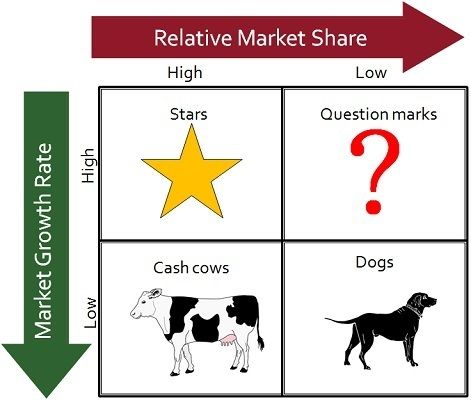
- Using the Boston Matrix (Figure 2), Tesco can be classed as a cash cow in the market. Tesco has a high market share at "27.4%" Statistica (2018). However, this has been slowly decreasing as stars such as budget retailers Aldi and LIDL have increased their market shares.
- Competition
Figure2
Images and files in the map
Information
- Description
- A level Business Studies Mind Map on External, created by Noah Shillabeer on 04/10/2018.
- Created by
- Noah Shillabeer
- Views
- 4
- Rating