
Mind map
Atomic structure
Map content
Atomic structure
Fundamental particles
- protons
- relative mass: 1 relative charge: +1
- neutrons
- relative mass: 1 relative charge: 0
- in nucleus
- electrons
- relative mass: 0 relative charge: -1
- move around nucleus in orbitals
- development over time
- Geiger–Marsden/Rutherford
- Niels Bohr
- sub-shells
- protons
Mass number and isotopes
- mass number (A): total number of protons and neutrons
- atomic number (Z): number of protons
- same for same element
- isotope: same number of protons different number of neutrons
- same configuration of electrons so same chemical properties
- different physical properties
- abundance
- relative atomic mass (Ar)
- relative molecular mass (Mr)
- time of flight (TOF) mass spectrometer
- 1. vacuum
- stops collision with air molecules
- 2. ionisation
- electrospray
- sample dissolved in volatile solvent
- injected through hypodermic needle giving a fine mist
- tip of needle has high voltage
- gains a proton (H+) as it leaves the needle
- tip of needle has high voltage
- injected through hypodermic needle giving a fine mist
- sample dissolved in volatile solvent
- electron impact
- high energy electrons
- from electron gun
- fired at sample
- knocks off one electron
- fired at sample
- from electron gun
- fragmentation
- high energy electrons
- possibility of 2+ ions
- electrospray
- 3. acceleration
- positive ions are strongly attracted to the negative plate
- all have the same KE
- KE = 1/2 mv^2
- 4. ion drift
- flight tube
- lighter ions drift faster
- t = d/v
- 5. detection
- lighter ions will arrive first
- flight times are recorded
- positive ions gain e- from detector, generates a current
- current proportional to number of ions arriving
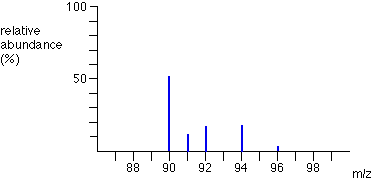
- mass spectrum
- plots abundance against m/z ratio
- assume charge is +1 so m/z = mass/1
- if charge is +2 m/z = mass/2
- could cause small peak
- Σ (% abundance x m/z) / 100 = Ar
- if relative abundances used (instead of %), divide by sum of relative abundances
- may be different from periodic table
- different abundances of isotopes
- diatomic elements
- different combinations eg. Cl35 and Cl37
- molecular sample
- molecular ion (M+) peak
- heaviest m/z value
- organic sample
- fragmentation
- molecular ion (M+) peak
- plots abundance against m/z ratio
- 1. vacuum
Electron configuration
- electrons have fixed energies
- move around nucleus in certain regions called shells
- further away form nucleus, the higher its energy, larger the principle quantum number
- divided into sub-shells that have slightly different energies
- have different numbers of orbitals
- holds 2 electrons
- electrons fill singly before they start sharing
- s = 1 orbital
- p = 3
- d = 5
- f = 7
- 4s sub-shell has lower energy than 3d so 4s fills up first
- electronic configuration determines chemical properties
- groups 1 and 2 (s block)
- easily loses s block electrons
- form + ions
- easily loses s block electrons
- groups 5, 6 and 7 (p block)
- gain electrons
- form - ions
- gain electrons
- want noble gas configuration
- groups 4, 5, 6, 7 (p block)
- share electrons when forming covalent bonds
- d block
- lose s and d electrons
- form + ions
- lose s and d electrons
- groups 1 and 2 (s block)
- have different numbers of orbitals
- move around nucleus in certain regions called shells
- Cr and Cu
- donate a 4s electron to the 3d sub-shell
- full/half full d sub-shell is more stable than a partially filled d sub-shell
- donate a 4s electron to the 3d sub-shell
- transition metals
- when becoming ions, lose 4s electrons before 3d electrons
- ionisation energies
- first ionisation energy: the energy required to remove one mole of electrons from one mole of gaseous atoms to provide one mole of gaseous +1 ions
- O(g) > O+(g) + e-
- endothermic
- lower ionisation energy = easier to ionise
- factors affecting
- nuclear charge
- more protons means more + nucleus, stronger electrostatic attraction, harder to remove electrons
- distance from nucleus
- the closer an electron to the nucleus, the stronger the attraction
- shielding
- as shielding increases, the attraction between the outer electron and the nucleus weakens
- paired or unpaired
- paired electrons are removed more easily due to repulsion
- nuclear charge
- trends
- 1st IEs decrease down a group
- group 2
- shielding increases
- distance from nucleus increases
- generally, 1st IEs increase across a period
- number of protons increases
- nuclear charge increases
- period 3
- number of protons increases
- drop between groups 2 and 3
- increased distance between sub-shells
- evidence for sub-shells
- increased distance between sub-shells
- drop between groups 5 and 6
- paired electron in orbital easier to remove due to repulsion
- generally, 1st IEs stays the same in a transition series
- electron always removed from s block first
- 1st IEs decrease down a group
- successive ionisation energies
- X^n-1+(g) > X^n+ + e-
- IE increases each time e- is removed, stronger attraction between e- and more + nucleus
- big jumps happen when new shell is broken into, electron being removed from shell closer to nucleus
- used to predict electronic structure
- first ionisation energy: the energy required to remove one mole of electrons from one mole of gaseous atoms to provide one mole of gaseous +1 ions
- electrons have fixed energies
Images and files in the map
Information
- Description
- A level Chemistry (A1.0 Atomic structure) Mind Map on Atomic structure, created by maariah hanjra on 18/12/2018.
- Created by
- maariah hanjra
- Views
- 0
- Rating