
Mind map
Rates Of Reaction
Map content
Rates Of Reaction
The speed at which a product is made. The speed at which a reaction takes place
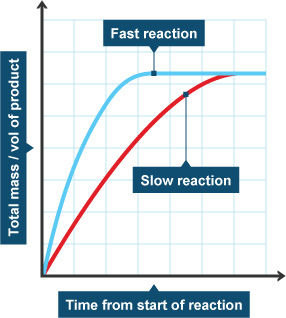
- The point on the graph becomes flat (horizontal) is called the end point. This is because there is no longer a product being produced, therefore the reaction has stopped.
- rate = change in volume or mass ------------------------------ change in time
- The point on the graph becomes flat (horizontal) is called the end point. This is because there is no longer a product being produced, therefore the reaction has stopped.
4 Ways to Speed Up The Rate of Reaction
- Temperature - Increases the energy of the particles making them move faster and so more successful collisions can occur. Low Temperature = slow reaction. High Temperature = fast reaction.
- Concentration - There are more atoms present, more collisions take place. Low Concentration = slow reaction. High Concentration = fast reaction.
- Particle Size - Small particle size results in a large surface area meaning that collisions happen more frequently. Large Particle Size = slow reaction. Small Particle Size = fast reaction.
- Catalysts - They speed up reactions at lower temperatures (saves energy and money). They are reusable and unchanged . Catalysts alter the rate of a reaction but are not used in a reaction.
Catalysts
- Homogeneous - Is in the same state as the reactant. These are available in all states.
- Heterogeneous - Is in the same state as the reactants. These are available in all states.
The two most common ways of monitoring a reaction are measuring the volume of gas produced and measuring the loss in mass over a period of time.
- Note the units for the rate = the volume is given in cm³ and the time is given in seconds so the rate is cm³s-1.