
Mind map
4.3 - Efficiency and Labour Productivity hw
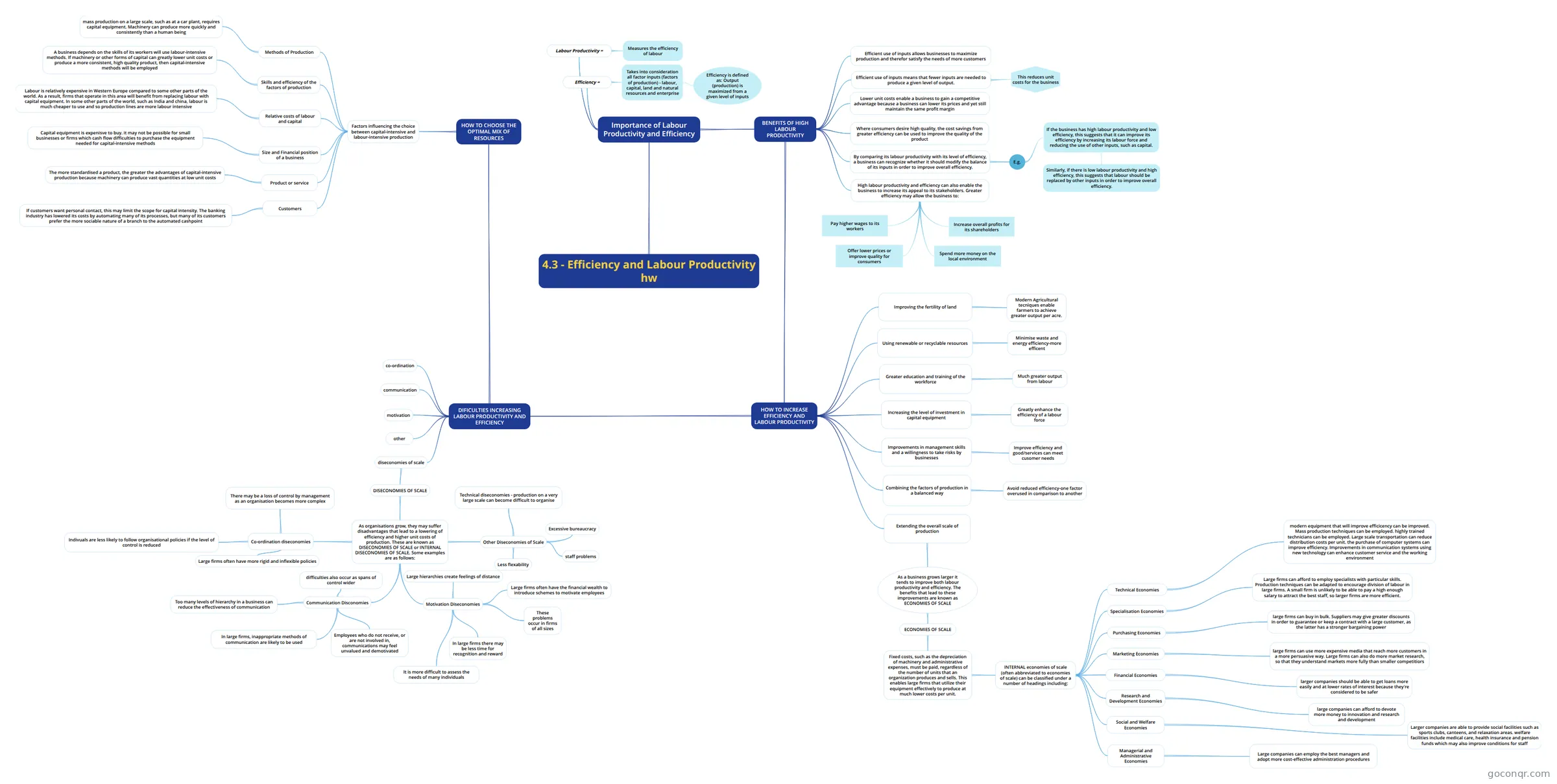
Mind map: Efficiency and labour productivity
Map content
4.3 - Efficiency and Labour Productivity hw
Importance of Labour Productivity and Efficiency
- Labour Productivity =
- Measures the efficiency of labour
- Efficiency =
- Takes into consideration all factor inputs (factors of production) - labour, capital, land and natural resources and enterprise
- Efficiency is defined as: Output (production) is maximized from a given level of inputs
- Takes into consideration all factor inputs (factors of production) - labour, capital, land and natural resources and enterprise
- BENEFITS OF HIGH LABOUR PRODUCTIVITY
- Efficient use of inputs allows businesses to maximize production and therefor satisfy the needs of more customers
- Efficient use of inputs means that fewer inputs are needed to produce a given level of output.
- This reduces unit costs for the business
- Lower unit costs enable a business to gain a competitive advantage because a business can lower its prices and yet still maintain the same profit margin
- Where consumers desire high quality, the cost savings from greater efficiency can be used to improve the quality of the product
- By comparing its labour productivity with its level of efficiency, a business can recognize whether it should modify the balance of its inputs in order to improve overall efficiency.
- E.g.
- If the business has high labour productivity and low efficiency, this suggests that it can improve its efficiency by increasing its labour force and reducing the use of other inputs, such as capital.
- Similarly, if there is low labour productivity and high efficiency, this suggests that labour should be replaced by other inputs in order to improve overall efficiency.
- If the business has high labour productivity and low efficiency, this suggests that it can improve its efficiency by increasing its labour force and reducing the use of other inputs, such as capital.
- E.g.
- High labour productivity and efficiency can also enable the business to increase its appeal to its stakeholders. Greater efficiency may allow the business to:
- Pay higher wages to its workers
- Offer lower prices or improve quality for consumers
- Spend more money on the local environment
- Increase overall profits for its shareholders
- HOW TO INCREASE EFFICIENCY AND LABOUR PRODUCTIVITY
- Improving the fertility of land
- Modern Agricultural tecniques enable farmers to achieve greater output per acre.
- Using renewable or recyclable resources
- Minimise waste and energy efficiency-more efficent
- Greater education and training of the workforce
- Much greater output from labour
- Increasing the level of investment in capital equipment
- Greatly enhance the efficiency of a labour force
- Improvements in management skills and a willingness to take risks by businesses
- Improve efficiency and good/services can meet cusomer needs
- Combining the factors of production in a balanced way
- Avoid reduced efficiency-one factor overused in comparison to another
- Extending the overall scale of production
- As a business grows larger it tends to improve both labour productivity and efficiency. The benefits that lead to these improvements are known as ECONOMIES OF SCALE
- ECONOMIES OF SCALE
- Fixed costs, such as the depreciation of machinery and administrative expenses, must be paid, regardless of the number of units that an organization produces and sells. This enables large firms that utilize their equipment effectively to produce at much lower costs per unit.
- INTERNAL economies of scale (often abbreviated to economies of scale) can be classified under a number of headings including:
- Technical Economies
- modern equipment that will improve efficicency can be improved. Mass production techniques can be employed. highly trained technicians can be employed. Large scale transportation can reduce distribution costs per unit. the purchase of computer systems can improve efficiency. Improvements in communication systems using new technology can enhance customer service and the working environment
- Specialisation Economies
- Large firms can afford to employ specialists with particular skills. Production techniques can be adapted to encourage division of labour in large firms. A small firm is unlikely to be able to pay a high enough salary to attract the best staff, so larger firms are more efficient.
- Purchasing Economies
- large firms can buy in bulk. Suppliers may give greater discounts in order to guarantee or keep a contract with a large customer, as the latter has a stronger bargaining power
- Marketing Economies
- large firms can use more expensive media that reach more customers in a more persuasive way. Large firms can also do more market research, so that they understand markets more fully than smaller competitiors
- Financial Economies
- larger companies should be able to get loans more easily and at lower rates of interest because they're considered to be safer
- Research and Development Economies
- large companies can afford to devote more money to innovation and research and development
- Social and Welfare Economies
- Larger companies are able to provide social facilities such as sports clubs, canteens, and relaxation areas. welfare facilities include medical care, health insurance and pension funds which may also improve conditions for staff
- Managerial and Administrative Economies
- Large companies can employ the best managers and adopt more cost-effective administration procedures
- Technical Economies
- INTERNAL economies of scale (often abbreviated to economies of scale) can be classified under a number of headings including:
- Fixed costs, such as the depreciation of machinery and administrative expenses, must be paid, regardless of the number of units that an organization produces and sells. This enables large firms that utilize their equipment effectively to produce at much lower costs per unit.
- ECONOMIES OF SCALE
- As a business grows larger it tends to improve both labour productivity and efficiency. The benefits that lead to these improvements are known as ECONOMIES OF SCALE
- DIFICULTIES INCREASING LABOUR PRODUCTIVITY AND EFFICIENCY
- co-ordination
- communication
- motivation
- other
- diseconomies of scale
- DISECONOMIES OF SCALE
- As organisations grow, they may suffer disadvantages that lead to a lowering of efficiency and higher unit costs of production. These are known as DISECONOMIES OF SCALE or INTERNAL DISECONOMIES OF SCALE. Some examples are as follows:
- Co-ordination diseconomies
- There may be a loss of control by management as an organisation becomes more complex
- Indivuals are less likely to follow organisational policies if the level of control is reduced
- Large firms often have more rigid and inflexible policies
- Communication Disconomies
- difficulties also occur as spans of control wider
- Too many levels of hierarchy in a business can reduce the effectiveness of communication
- In large firms, inappropriate methods of communication are likely to be used
- Employees who do not receive, or are not involved in, communications may feel unvalued and demotivated
- Motivation Diseconomies
- Large hierarchies create feelings of distance
- Large firms often have the financial wealth to introduce schemes to motivate employees
- These problems occur in firms of all sizes
- In large firms there may be less time for recognition and reward
- It is more difficult to assess the needs of many individuals
- Other Diseconomies of Scale
- Technical diseconomies - production on a very large scale can become difficult to organise
- Excessive bureaucracy
- staff problems
- Less flexability
- Co-ordination diseconomies
- As organisations grow, they may suffer disadvantages that lead to a lowering of efficiency and higher unit costs of production. These are known as DISECONOMIES OF SCALE or INTERNAL DISECONOMIES OF SCALE. Some examples are as follows:
- DISECONOMIES OF SCALE
- HOW TO CHOOSE THE OPTIMAL MIX OF RESOURCES
- Factors influencing the choice between capital-intensive and labour-intensive production
- Methods of Production
- mass production on a large scale, such as at a car plant, requires capital equipment. Machinery can produce more quickly and consistently than a human being
- Skills and efficiency of the factors of production
- A business depends on the skills of its workers will use labour-intensive methods. If machinery or other forms of capital can greatly lower unit costs or produce a more consistent, high quality product, then capital-intensive methods will be employed
- Relative costs of labour and capital
- Labour is relatively expensive in Western Europe compared to some other parts of the world. As a result, firms that operate in this area will benefit from replacing labour with capital equipment. In some other parts of the world, such as India and china, labour is much cheaper to use and so production lines are more labour intensive
- Size and Financial position of a business
- Capital equipment is expenisve to buy. it may not be possible for small businesses or firms which cash flow difficulties to purchase the equipment needed for capital-intensive methods
- Product or service
- The more standardised a product, the greater the advantages of capital-intensive production because machinery can produce vast quantities at low unit costs
- Customers
- If customers want personal contact, this may limit the scope for capital intensity. The banking industry has lowered its costs by automating many of its processes, but many of its customers prefer the more sociable nature of a branch to the automated cashpoint
- Methods of Production
- Factors influencing the choice between capital-intensive and labour-intensive production
- Improving the fertility of land
- Labour Productivity =
Information
- Description
- A level Business Studies Mind Map on 4.3 - Efficiency and Labour Productivity hw, created by sarah carroll on 10/01/2019.
- Created by
- sarah carroll
- Views
- 2
- History
-
- Created by Carina Storm · Jan 10, 2019
- Copied by Carina Storm · Jan 10, 2019
- Copied by sarah carroll · Jan 10, 2019
- Rating
More on Productivity and Efficiency