
Mind map
Tourism (Gateway 1)
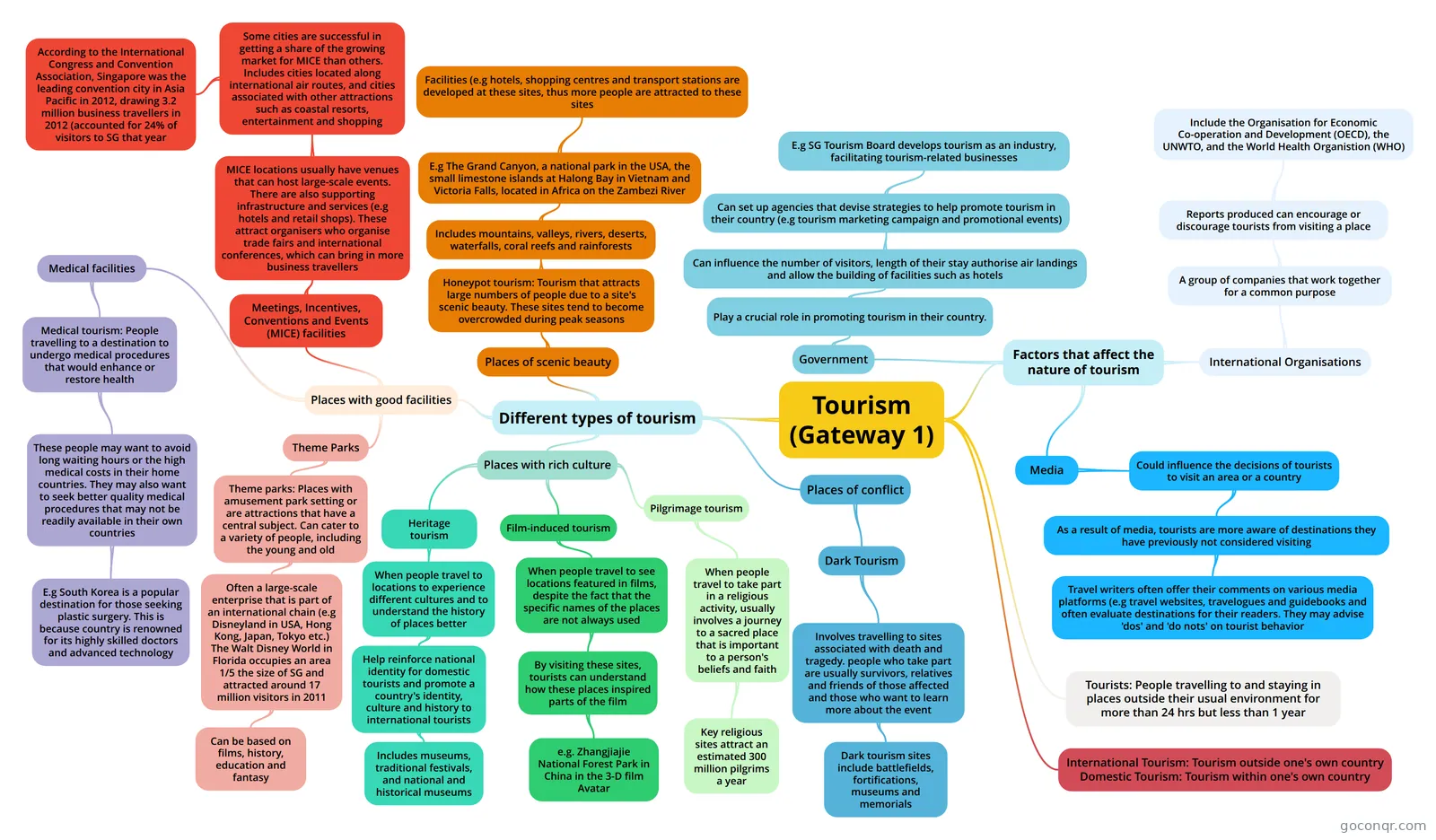
Mind map: Tourism (Gateway 1)
Map content
Tourism (Gateway 1)
Tourists: People travelling to and staying in places outside their usual environment for more than 24 hrs but less than 1 year
International Tourism: Tourism outside one's own country Domestic Tourism: Tourism within one's own country
Different types of tourism
- Places of scenic beauty
- Honeypot tourism: Tourism that attracts large numbers of people due to a site's scenic beauty. These sites tend to become overcrowded during peak seasons
- Includes mountains, valleys, rivers, deserts, waterfalls, coral reefs and rainforests
- E.g The Grand Canyon, a national park in the USA, the small limestone islands at Halong Bay in Vietnam and Victoria Falls, located in Africa on the Zambezi River
- Facilities (e.g hotels, shopping centres and transport stations are developed at these sites, thus more people are attracted to these sites
- E.g The Grand Canyon, a national park in the USA, the small limestone islands at Halong Bay in Vietnam and Victoria Falls, located in Africa on the Zambezi River
- Includes mountains, valleys, rivers, deserts, waterfalls, coral reefs and rainforests
- Honeypot tourism: Tourism that attracts large numbers of people due to a site's scenic beauty. These sites tend to become overcrowded during peak seasons
- Places with good facilities
- Meetings, Incentives, Conventions and Events (MICE) facilities
- MICE locations usually have venues that can host large-scale events. There are also supporting infrastructure and services (e.g hotels and retail shops). These attract organisers who organise trade fairs and international conferences, which can bring in more business travellers
- Some cities are successful in getting a share of the growing market for MICE than others. Includes cities located along international air routes, and cities associated with other attractions such as coastal resorts, entertainment and shopping
- According to the International Congress and Convention Association, Singapore was the leading convention city in Asia Pacific in 2012, drawing 3.2 million business travellers in 2012 (accounted for 24% of visitors to SG that year
- Some cities are successful in getting a share of the growing market for MICE than others. Includes cities located along international air routes, and cities associated with other attractions such as coastal resorts, entertainment and shopping
- MICE locations usually have venues that can host large-scale events. There are also supporting infrastructure and services (e.g hotels and retail shops). These attract organisers who organise trade fairs and international conferences, which can bring in more business travellers
- Medical facilities
- Medical tourism: People travelling to a destination to undergo medical procedures that would enhance or restore health
- These people may want to avoid long waiting hours or the high medical costs in their home countries. They may also want to seek better quality medical procedures that may not be readily available in their own countries
- E.g South Korea is a popular destination for those seeking plastic surgery. This is because country is renowned for its highly skilled doctors and advanced technology
- These people may want to avoid long waiting hours or the high medical costs in their home countries. They may also want to seek better quality medical procedures that may not be readily available in their own countries
- Medical tourism: People travelling to a destination to undergo medical procedures that would enhance or restore health
- Theme Parks
- Theme parks: Places with amusement park setting or are attractions that have a central subject. Can cater to a variety of people, including the young and old
- Often a large-scale enterprise that is part of an international chain (e.g Disneyland in USA, Hong Kong, Japan, Tokyo etc.) The Walt Disney World in Florida occupies an area 1/5 the size of SG and attracted around 17 million visitors in 2011
- Can be based on films, history, education and fantasy
- Often a large-scale enterprise that is part of an international chain (e.g Disneyland in USA, Hong Kong, Japan, Tokyo etc.) The Walt Disney World in Florida occupies an area 1/5 the size of SG and attracted around 17 million visitors in 2011
- Theme parks: Places with amusement park setting or are attractions that have a central subject. Can cater to a variety of people, including the young and old
- Meetings, Incentives, Conventions and Events (MICE) facilities
- Places with rich culture
- Heritage tourism
- When people travel to locations to experience different cultures and to understand the history of places better
- Help reinforce national identity for domestic tourists and promote a country's identity, culture and history to international tourists
- Includes museums, traditional festivals, and national and historical museums
- Help reinforce national identity for domestic tourists and promote a country's identity, culture and history to international tourists
- When people travel to locations to experience different cultures and to understand the history of places better
- Film-induced tourism
- When people travel to see locations featured in films, despite the fact that the specific names of the places are not always used
- By visiting these sites, tourists can understand how these places inspired parts of the film
- e.g. Zhangjiajie National Forest Park in China in the 3-D film Avatar
- By visiting these sites, tourists can understand how these places inspired parts of the film
- When people travel to see locations featured in films, despite the fact that the specific names of the places are not always used
- Pilgrimage tourism
- When people travel to take part in a religious activity, usually involves a journey to a sacred place that is important to a person's beliefs and faith
- Key religious sites attract an estimated 300 million pilgrims a year
- When people travel to take part in a religious activity, usually involves a journey to a sacred place that is important to a person's beliefs and faith
- Heritage tourism
- Places of conflict
- Dark Tourism
- Involves travelling to sites associated with death and tragedy. people who take part are usually survivors, relatives and friends of those affected and those who want to learn more about the event
- Dark tourism sites include battlefields, fortifications, museums and memorials
- Involves travelling to sites associated with death and tragedy. people who take part are usually survivors, relatives and friends of those affected and those who want to learn more about the event
- Dark Tourism
- Places of scenic beauty
Factors that affect the nature of tourism
- Government
- Play a crucial role in promoting tourism in their country.
- Can influence the number of visitors, length of their stay authorise air landings and allow the building of facilities such as hotels
- Can set up agencies that devise strategies to help promote tourism in their country (e.g tourism marketing campaign and promotional events)
- E.g SG Tourism Board develops tourism as an industry, facilitating tourism-related businesses
- Can set up agencies that devise strategies to help promote tourism in their country (e.g tourism marketing campaign and promotional events)
- Can influence the number of visitors, length of their stay authorise air landings and allow the building of facilities such as hotels
- Play a crucial role in promoting tourism in their country.
- Media
- Could influence the decisions of tourists to visit an area or a country
- As a result of media, tourists are more aware of destinations they have previously not considered visiting
- Travel writers often offer their comments on various media platforms (e.g travel websites, travelogues and guidebooks and often evaluate destinations for their readers. They may advise 'dos' and 'do nots' on tourist behavior
- As a result of media, tourists are more aware of destinations they have previously not considered visiting
- Could influence the decisions of tourists to visit an area or a country
- International Organisations
- A group of companies that work together for a common purpose
- Reports produced can encourage or discourage tourists from visiting a place
- Include the Organisation for Economic Co-operation and Development (OECD), the UNWTO, and the World Health Organistion (WHO)
- Reports produced can encourage or discourage tourists from visiting a place
- A group of companies that work together for a common purpose
- Government
Information
- Description
- GCE O-Level Geography (Tourism) Mind Map on Tourism (Gateway 1), created by Celeste Ang Jianing on 13/01/2019.
- Created by
- Celeste Ang Jianing
- Views
- 3
- Rating
More on History and Growth of Tourism