
Mind map
English Civil War
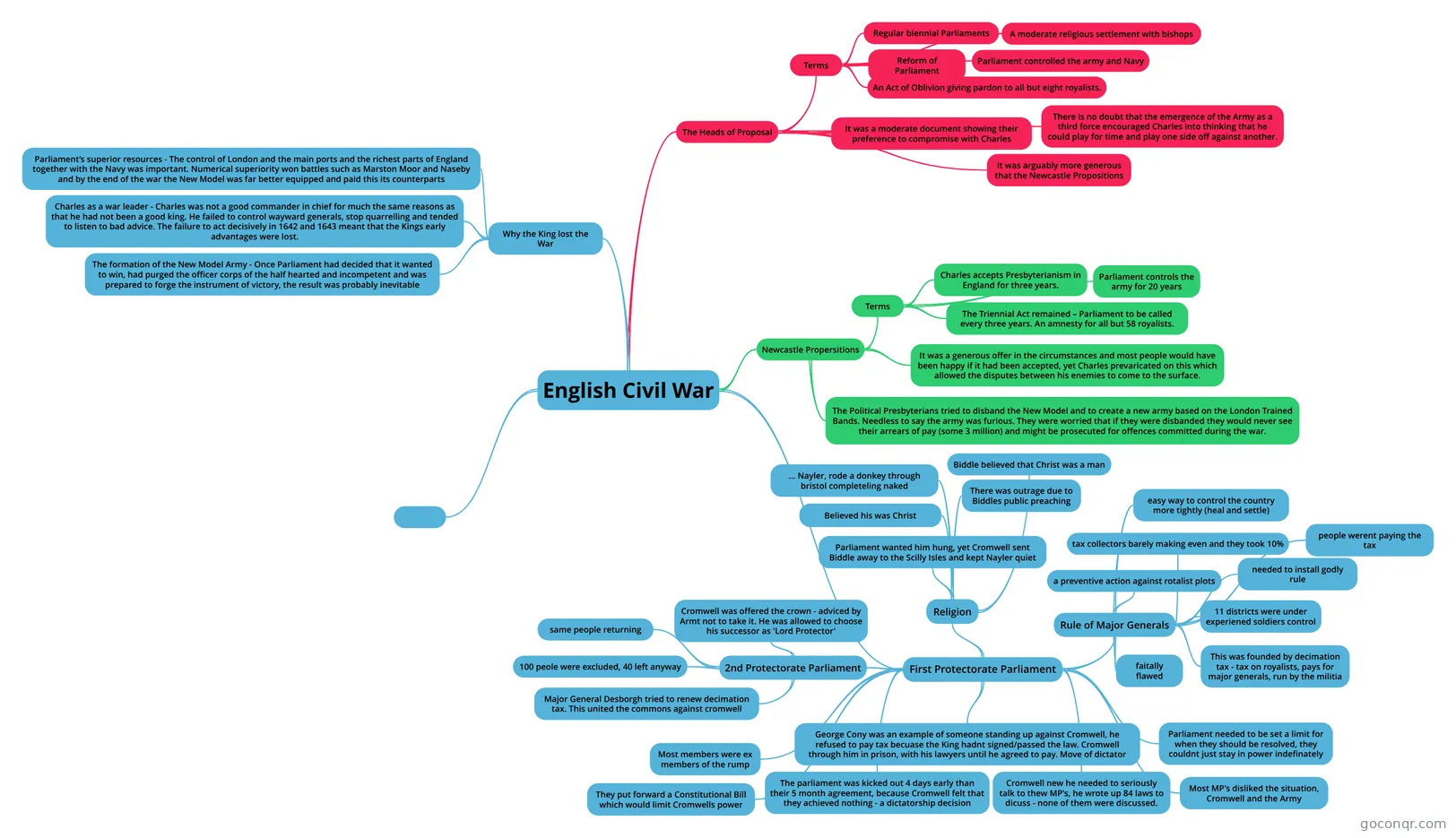
Mind map: English Civil War
Map content
English Civil War
Newcastle Propersitions
- It was a generous offer in the circumstances and most people would have been happy if it had been accepted, yet Charles prevaricated on this which allowed the disputes between his enemies to come to the surface.
- Terms
- Charles accepts Presbyterianism in England for three years.
- Parliament controls the army for 20 years
- The Triennial Act remained – Parliament to be called every three years. An amnesty for all but 58 royalists.
- The Political Presbyterians tried to disband the New Model and to create a new army based on the London Trained Bands. Needless to say the army was furious. They were worried that if they were disbanded they would never see their arrears of pay (some 3 million) and might be prosecuted for offences committed during the war.
Why the King lost the War
- Parliament’s superior resources - The control of London and the main ports and the richest parts of England together with the Navy was important. Numerical superiority won battles such as Marston Moor and Naseby and by the end of the war the New Model was far better equipped and paid this its counterparts
- Charles as a war leader - Charles was not a good commander in chief for much the same reasons as that he had not been a good king. He failed to control wayward generals, stop quarrelling and tended to listen to bad advice. The failure to act decisively in 1642 and 1643 meant that the Kings early advantages were lost.
- The formation of the New Model Army - Once Parliament had decided that it wanted to win, had purged the officer corps of the half hearted and incompetent and was prepared to forge the instrument of victory, the result was probably inevitable
The Heads of Proposal
- Terms
- Regular biennial Parliaments
- Reform of Parliament
- Parliament controlled the army and Navy
- A moderate religious settlement with bishops
- An Act of Oblivion giving pardon to all but eight royalists.
- It was a moderate document showing their preference to compromise with Charles
- It was arguably more generous that the Newcastle Propositions
- There is no doubt that the emergence of the Army as a third force encouraged Charles into thinking that he could play for time and play one side off against another.
- Terms
First Protectorate Parliament
- Most MP's disliked the situation, Cromwell and the Army
- Parliament needed to be set a limit for when they should be resolved, they couldnt just stay in power indefinately
- They put forward a Constitutional Bill which would limit Cromwells power
- Most members were ex members of the rump
- Religion
- Biddle believed that Christ was a man
- There was outrage due to Biddles public preaching
- Parliament wanted him hung, yet Cromwell sent Biddle away to the Scilly Isles and kept Nayler quiet
- ... Nayler, rode a donkey through bristol completeling naked
- Believed his was Christ
- Cromwell new he needed to seriously talk to thew MP's, he wrote up 84 laws to dicuss - none of them were discussed.
- The parliament was kicked out 4 days early than their 5 month agreement, because Cromwell felt that they achieved nothing - a dictatorship decision
- George Cony was an example of someone standing up against Cromwell, he refused to pay tax becuase the King hadnt signed/passed the law. Cromwell through him in prison, with his lawyers until he agreed to pay. Move of dictator
- Rule of Major Generals
- needed to install godly rule
- a preventive action against rotalist plots
- easy way to control the country more tightly (heal and settle)
- 11 districts were under experiened soldiers control
- This was founded by decimation tax - tax on royalists, pays for major generals, run by the militia
- faitally flawed
- people werent paying the tax
- tax collectors barely making even and they took 10%
- 2nd Protectorate Parliament
- same people returning
- 100 peole were excluded, 40 left anyway
- Major General Desborgh tried to renew decimation tax. This united the commons against cromwell
- Cromwell was offered the crown - adviced by Armt not to take it. He was allowed to choose his successor as 'Lord Protector'
Information
- Description
- Mind Map on English Civil War, created by 08-adolph on 01/12/2014.
- Created by
- 08-adolph
- Views
- 18
- Rating