
Mind map
Factors Influencing Soil Formation
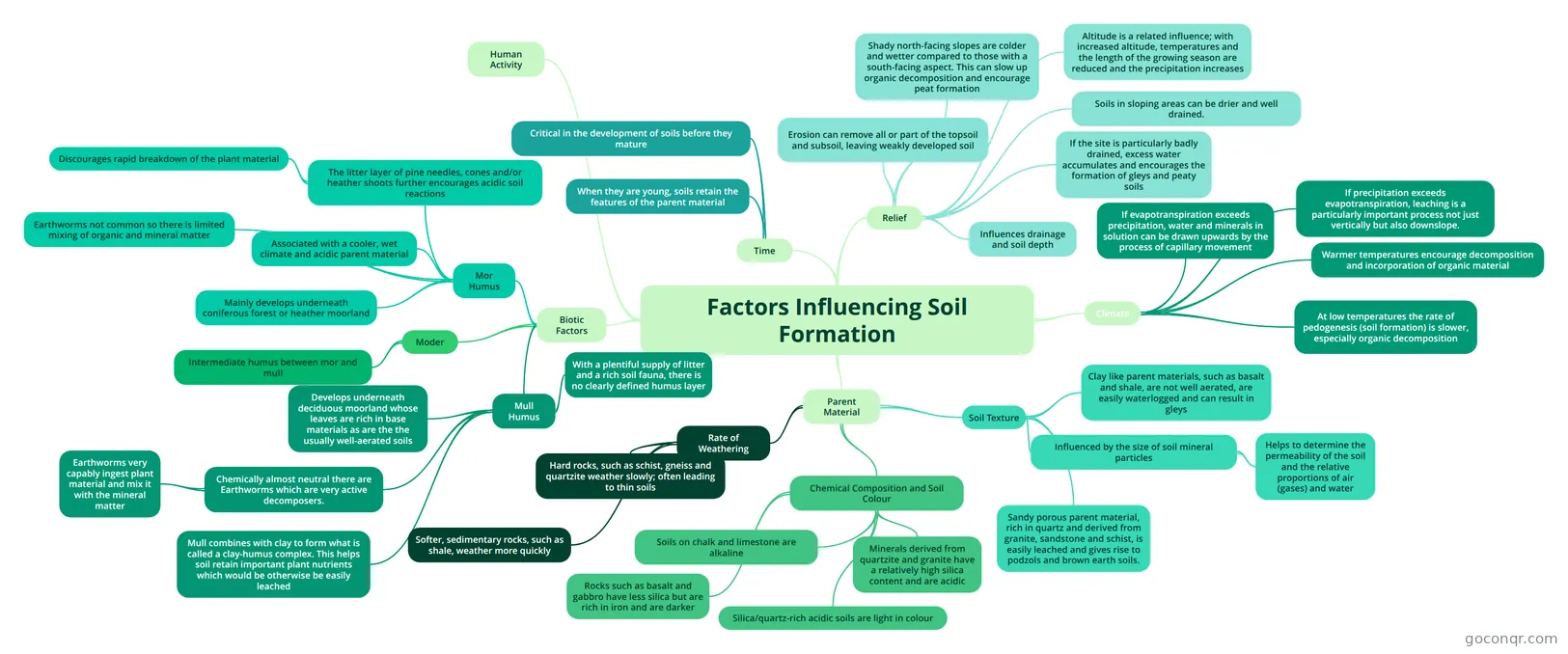
Mind map: Factors influencing soil formation
Map content
Factors Influencing Soil Formation
Parent Material
- Rate of Weathering
- Hard rocks, such as schist, gneiss and quartzite weather slowly; often leading to thin soils
- Softer, sedimentary rocks, such as shale, weather more quickly
- Chemical Composition and Soil Colour
- Minerals derived from quartzite and granite have a relatively high silica content and are acidic
- Soils on chalk and limestone are alkaline
- Silica/quartz-rich acidic soils are light in colour
- Rocks such as basalt and gabbro have less silica but are rich in iron and are darker
- Soil Texture
- Influenced by the size of soil mineral particles
- Helps to determine the permeability of the soil and the relative proportions of air (gases) and water
- Sandy porous parent material, rich in quartz and derived from granite, sandstone and schist, is easily leached and gives rise to podzols and brown earth soils.
- Clay like parent materials, such as basalt and shale, are not well aerated, are easily waterlogged and can result in gleys
- Influenced by the size of soil mineral particles
- Rate of Weathering
Biotic Factors
- Mor Humus
- Mainly develops underneath coniferous forest or heather moorland
- Associated with a cooler, wet climate and acidic parent material
- The litter layer of pine needles, cones and/or heather shoots further encourages acidic soil reactions
- Discourages rapid breakdown of the plant material
- Earthworms not common so there is limited mixing of organic and mineral matter
- Mull Humus
- Develops underneath deciduous moorland whose leaves are rich in base materials as are the the usually well-aerated soils
- With a plentiful supply of litter and a rich soil fauna, there is no clearly defined humus layer
- Chemically almost neutral there are Earthworms which are very active decomposers.
- Earthworms very capably ingest plant material and mix it with the mineral matter
- Mull combines with clay to form what is called a clay-humus complex. This helps soil retain important plant nutrients which would be otherwise be easily leached
- Moder
- Intermediate humus between mor and mull
- Mor Humus
Climate
- At low temperatures the rate of pedogenesis (soil formation) is slower, especially organic decomposition
- Warmer temperatures encourage decomposition and incorporation of organic material
- If precipitation exceeds evapotranspiration, leaching is a particularly important process not just vertically but also downslope.
- If evapotranspiration exceeds precipitation, water and minerals in solution can be drawn upwards by the process of capillary movement
Relief
- Influences drainage and soil depth
- If the site is particularly badly drained, excess water accumulates and encourages the formation of gleys and peaty soils
- Soils in sloping areas can be drier and well drained.
- Erosion can remove all or part of the topsoil and subsoil, leaving weakly developed soil
- Shady north-facing slopes are colder and wetter compared to those with a south-facing aspect. This can slow up organic decomposition and encourage peat formation
- Altitude is a related influence; with increased altitude, temperatures and the length of the growing season are reduced and the precipitation increases
Time
- Critical in the development of soils before they mature
- When they are young, soils retain the features of the parent material
Human Activity
Information
- Description
- Higher/Advanced Higher Geography (Biosphere) Mind Map on Factors Influencing Soil Formation, created by Shannon Lafferty on 15/01/2015.
- Created by
- Shannon Lafferty
- Views
- 5
- Rating
More on Soil Formation and Weathering