
Mind map
J.S.Bach Brandenburg.
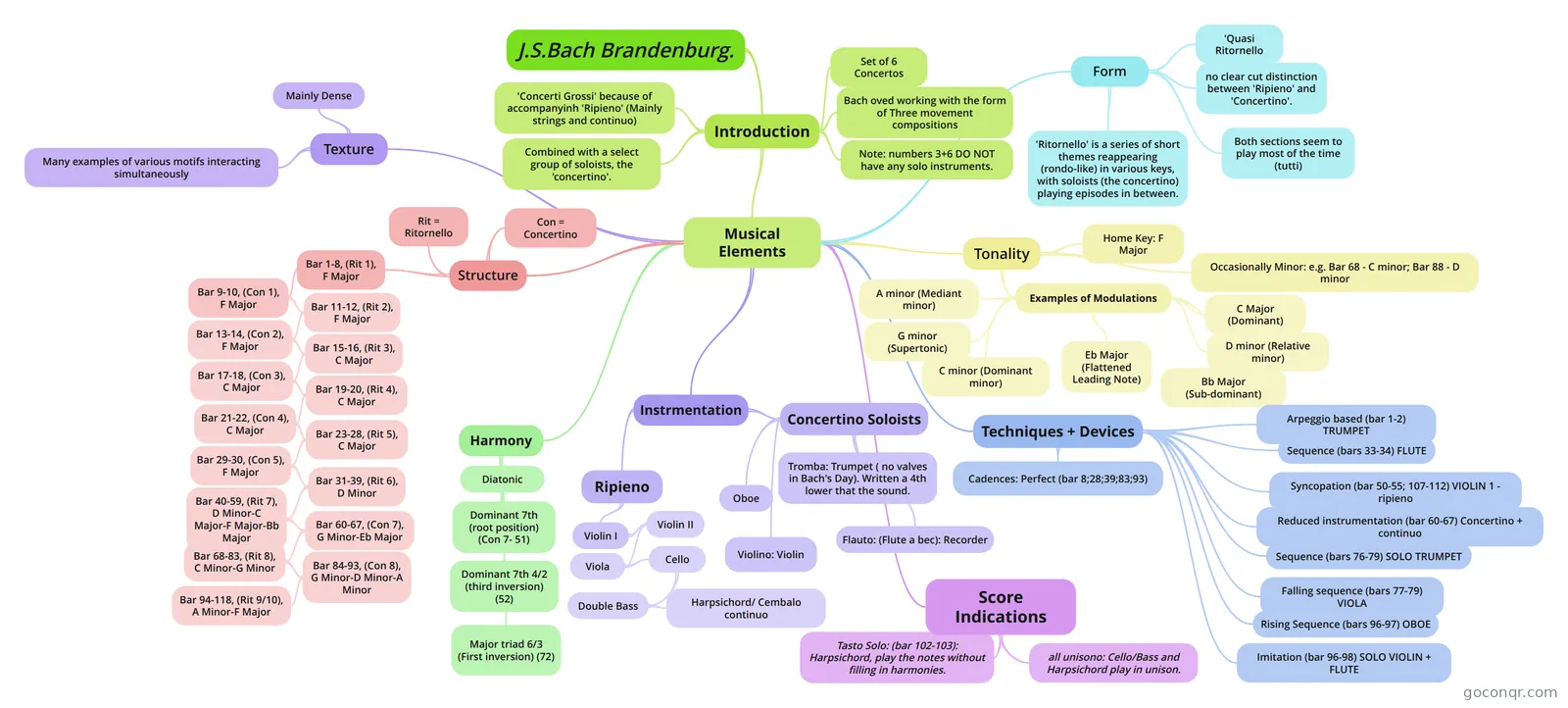
Mind map: J.S. Bach Brandenburg concertos
Map content
J.S.Bach Brandenburg.
Introduction
- Set of 6 Concertos
- 'Concerti Grossi' because of accompanyinh 'Ripieno' (Mainly strings and continuo)
- Combined with a select group of soloists, the 'concertino'.
- Bach oved working with the form of Three movement compositions
- Note: numbers 3+6 DO NOT have any solo instruments.
- Musical Elements
- Form
- 'Quasi Ritornello
- no clear cut distinction between 'Ripieno' and 'Concertino'.
- Both sections seem to play most of the time (tutti)
- 'Ritornello' is a series of short themes reappearing (rondo-like) in various keys, with soloists (the concertino) playing episodes in between.
- Structure
- Rit = Ritornello
- Con = Concertino
- Bar 1-8, (Rit 1), F Major
- Bar 9-10, (Con 1), F Major
- Bar 11-12, (Rit 2), F Major
- Bar 13-14, (Con 2), F Major
- Bar 15-16, (Rit 3), C Major
- Bar 17-18, (Con 3), C Major
- Bar 19-20, (Rit 4), C Major
- Bar 21-22, (Con 4), C Major
- Bar 23-28, (Rit 5), C Major
- Bar 29-30, (Con 5), F Major
- Bar 31-39, (Rit 6), D Minor
- Bar 40-59, (Rit 7), D Minor-C Major-F Major-Bb Major
- Bar 60-67, (Con 7), G Minor-Eb Major
- Bar 68-83, (Rit 8), C Minor-G Minor
- Bar 84-93, (Con 8), G Minor-D Minor-A Minor
- Bar 94-118, (Rit 9/10), A Minor-F Major
- Bar 84-93, (Con 8), G Minor-D Minor-A Minor
- Bar 68-83, (Rit 8), C Minor-G Minor
- Bar 60-67, (Con 7), G Minor-Eb Major
- Bar 40-59, (Rit 7), D Minor-C Major-F Major-Bb Major
- Bar 31-39, (Rit 6), D Minor
- Bar 29-30, (Con 5), F Major
- Bar 23-28, (Rit 5), C Major
- Bar 21-22, (Con 4), C Major
- Bar 19-20, (Rit 4), C Major
- Bar 17-18, (Con 3), C Major
- Bar 15-16, (Rit 3), C Major
- Bar 13-14, (Con 2), F Major
- Bar 11-12, (Rit 2), F Major
- Bar 9-10, (Con 1), F Major
- Texture
- Mainly Dense
- Many examples of various motifs interacting simultaneously
- Tonality
- Home Key: F Major
- Occasionally Minor: e.g. Bar 68 - C minor; Bar 88 - D minor
- Examples of Modulations
- C Major (Dominant)
- D minor (Relative minor)
- Bb Major (Sub-dominant)
- Eb Major (Flattened Leading Note)
- C minor (Dominant minor)
- G minor (Supertonic)
- A minor (Mediant minor)
- Harmony
- Diatonic
- Dominant 7th (root position) (Con 7- 51)
- Dominant 7th 4/2 (third inversion) (52)
- Major triad 6/3 (First inversion) (72)
- Techniques + Devices
- Rising Sequence (bars 96-97) OBOE
- Sequence (bars 33-34) FLUTE
- Sequence (bars 76-79) SOLO TRUMPET
- Falling sequence (bars 77-79) VIOLA
- Syncopation (bar 50-55; 107-112) VIOLIN 1 - ripieno
- Cadences: Perfect (bar 8;28;39;83;93)
- Imitation (bar 96-98) SOLO VIOLIN + FLUTE
- Arpeggio based (bar 1-2) TRUMPET
- Reduced instrumentation (bar 60-67) Concertino + continuo
- Instrmentation
- Concertino Soloists
- Tromba: Trumpet ( no valves in Bach's Day). Written a 4th lower that the sound.
- Flauto: (Flute a bec): Recorder
- Oboe
- Violino: Violin
- Ripieno
- Violin I
- Violin II
- Viola
- Cello
- Double Bass
- Harpsichord/ Cembalo continuo
- Double Bass
- Cello
- Viola
- Violin II
- Violin I
- Concertino Soloists
- Score Indications
- Tasto Solo: (bar 102-103): Harpsichord, play the notes without filling in harmonies.
- all unisono: Cello/Bass and Harpsichord play in unison.
- Form
Information
- Description
- Information on J.S.Bach's Brandenburg No.2, 1st Movement
- Created by
- Adam Pilcher
- Views
- 0
- History
-
- Created by csinewyork · May 10, 2014
- Copied by Adam Pilcher · Nov 10, 2019
- Rating