
Mind map
Chapter 4: Cognitive Aspects (3720)
Map content
Chapter 4: Cognitive Aspects (3720)
The study of human cognition can help us understand the impact of multitasking on human behavior.
provide insights into other types of digital behaviors, such as decision-making, searching, and designing
4.2 What Is Cognition?
- Experiential cognition is a state of mind where people perceive, act, and react to events around them intuitively and effortlessly
- driving a car
- Fast thinking
- instinctive, reflexive, and effortless, and it has no sense of voluntary control.
- Reflective cognition involves mental effort, attention, judgment, and decision-making, which can lead to new ideas and creativity
- designing, learning, and writing a report.
- Cognition has also been described in terms of specific kinds of processes
- • Attention
- central to everyday life
- process is easy or difficult depends on
- (1) whether someone has clear goals
- When someone is not sure exactly what they are looking for, they may browse through information
- If someone knows exactly what they want to find out, they try to match this with the information that is available
- (2) whether the information they need is salient in the environment.
- The way information is displayed can also greatly influence how easy or difficult it is to comprehend
- (1) whether someone has clear goals
- many people now multitask, frequently switching their attention among different tasks.
- multitasking can be detrimental to performance
- • Perception
- how information is acquired from the environment via the five sense organs (vision, hearing, taste, smell, and touch)
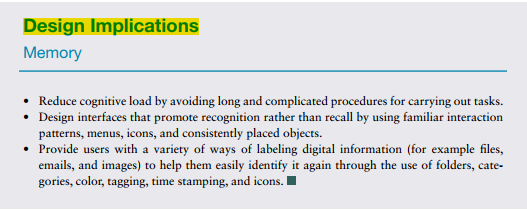
- • Memory
- recalling various kinds of knowledge
- Personal Information Management
- The design challenge here is deciding which is the best way of helping users organize their content so that it can be easily searched
- Naming is the most common means of encoding content
- adding metadata to documents
- Memory Load and Passwords
- how to manage security concerns
- multifactor authentication (MFA)
- Design Implications
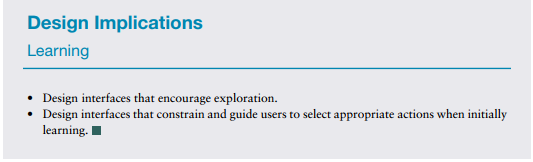
- • Learning
- closely connected with memory
- Incidental learning occurs without any intention to learn
- intentional learning is goal-directed with the goal of being able to remember it.
- people find it hard to learn by reading a set of instructions in a manual. Instead, they much prefer to learn through doing.
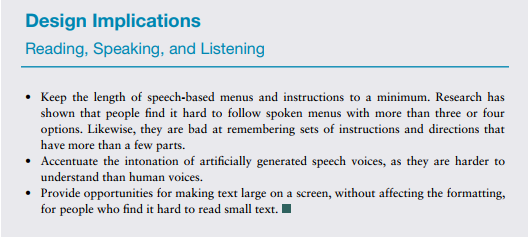
- • Reading, speaking, and listening
- three forms of language processing
- One similarity is that the meaning of sentences or phrases is the same regardless of the mode
- differences between the three modes
- Written language is permanent while listening is transient.
- Reading can be quicker than speaking or listening
- Listening requires less cognitive effort than reading or speaking
- Listening requires less cognitive effort than reading or speaking
- applications have been developed either to capitalize on people’s reading, writing, and listening skills
- interactive books and apps
- Speech-recognition systems
- Speech-output systems
- Natural-language interfaces
- Tactile interfaces that allow people who are visually impaired to read graphs
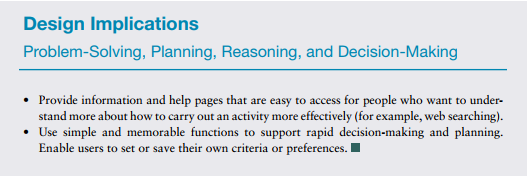
- • Problem-solving, planning, reasoning, and decision-making
- involving reflective cognition.
- making a choice involves weighing up the costs and benefits of different courses of action
- an effective design strategy is to make key information about a product highly salient
- provide just enough information, and in the right form, to facilitate good choices.
- many of these cognitive processes are interdependent
- • Attention
- Experiential cognition is a state of mind where people perceive, act, and react to events around them intuitively and effortlessly
4.3 Cognitive Frameworks
- 4.3.1 Mental Models
- Mental models are used by people when needing to reason
- internal constructions of some aspect of the external world that are manipulated, enabling predictions and inferences to be made
- Using incorrect mental models to guide behavior is surprisingly common.
- How can user experience (UX) designers help people to develop better mental models?
- • Clear and easy-to-follow instructions
- • Appropriate online help, tutorials, and context-sensitive guidance
- • Background information that can be accessed
- • Affordances of what actions an interface allows
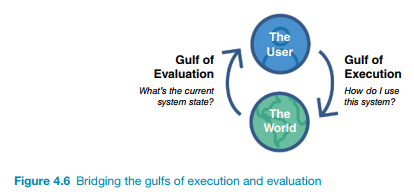
- 4.3.2 Gulfs of Execution and Evaluation
- describe the gaps that exist between the user and the interface
- gulf of execution
- The distance from the user to the physical system
- This can be achieved on the one hand, by designing usable interfaces that match the psychological characteristics of the user
- gulf of evaluation
- the distance from the physical system to the user
- This can be achieved on the other hand, by the user learning to create goals, plans, and action sequences that fit with how the interface works.
- when bridging the gap, reduce the cognitive effort required to perform a task
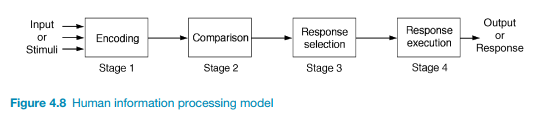
- 4.3.3. Information Processing
- The information processing model provides a basis from which to make predictions about human performance.
- the mind is an information processor
- based on modeling mental activities that happen exclusively inside the head
- 4.3.1 Mental Models
Images and files in the map
Information
- Description
- Computer Science Mind Map on Chapter 4: Cognitive Aspects (3720), created by Gideon Van on 18/02/2020.
- Created by
- Gideon Van
- Views
- 0
- Rating