
Mind map
Theory and Methods
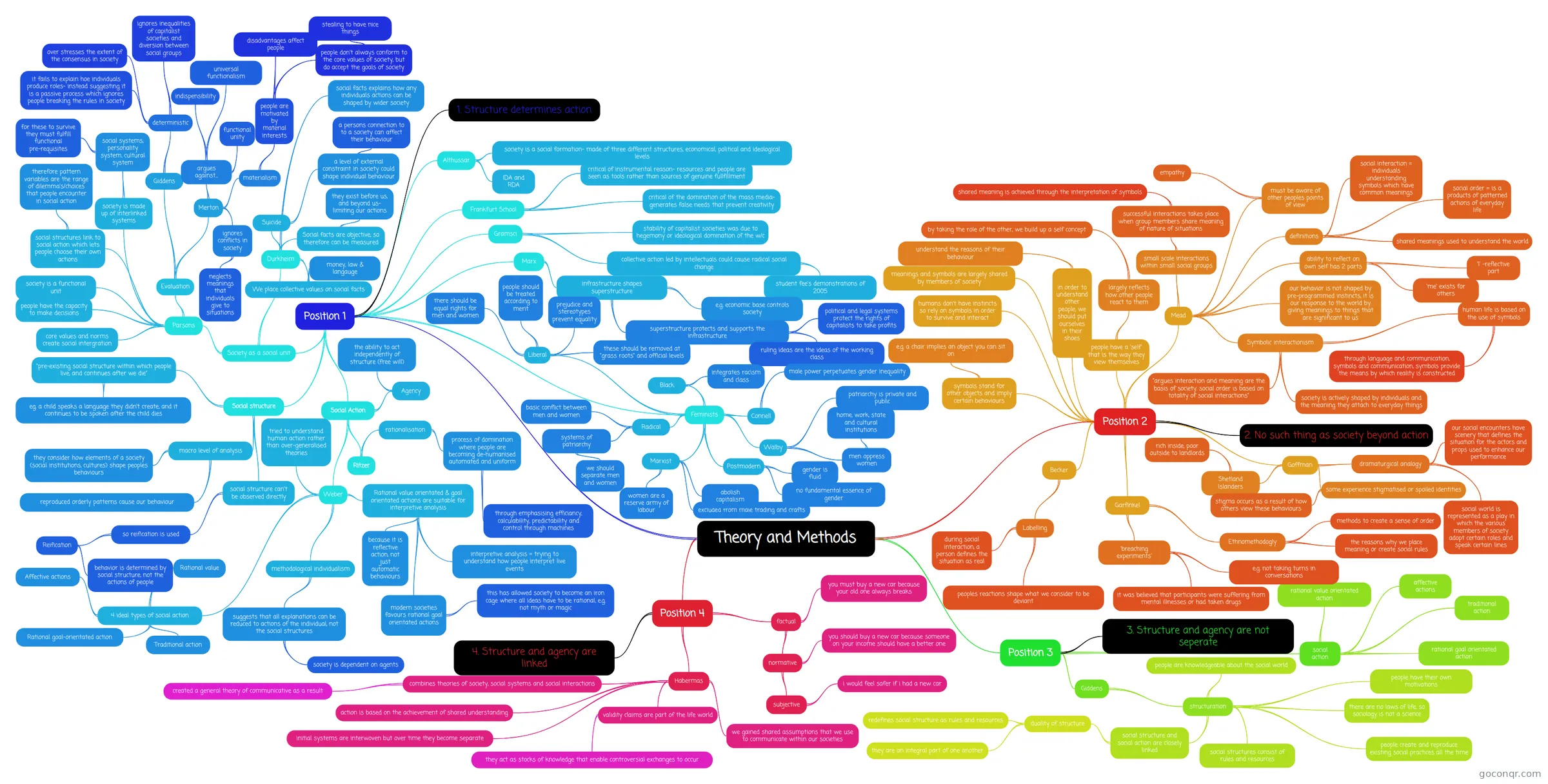
Mind map: Theory and methods
Map content
Theory and Methods
Position 1
- 1. Structure determines action
- Althussar
- society is a social formation- made of three different structures, economical, political and ideological levels
- IDA and RDA
- Social structure
- "pre-existing social structure within which people live, and continues after we die"
- eg. a child speaks a language they didn't create, and it continues to be spoken after the child dies
- macro level of analysis
- they consider how elements of a society (social institutions, cultures) shape peoples behaviours
- reproduced orderly patterns cause our behaviour
- social structure can't be observed directly
- so reification is used
- Reification
- behavior is determined by social structure, not the actions of people
- Reification
- so reification is used
- "pre-existing social structure within which people live, and continues after we die"
- Society as a social unit
- Durkheim
- We place collective values on social facts
- money, law & langauge
- Social facts are objective, so therefore can be measured
- they exist before us, and beyond us- limiting our actions
- Suicide
- a level of external constraint in society could shape individual behaviour
- a persons connection to to a society can affect their behaviour
- a level of external constraint in society could shape individual behaviour
- social facts explains how any individuals actions can be shaped by wider society
- We place collective values on social facts
- Parsons
- society is a functional unit
- people have the capacity to make decisions
- core values and norms create social intergration
- society is made up of interlinked systems
- social systems, personality system, cultural system
- for these to survive they must fulfill functional pre-requisites
- social systems, personality system, cultural system
- social structures link to social action which lets people choose their own actions
- therefore pattern variables are the range of dilemma's/choices that people encounter in social action
- Evaluation
- Merton
- materialism
- people are motivated by material interests
- people don't always conform to the core values of society, but do accept the goals of society
- stealing to have nice things
- disadvantages affect people
- people don't always conform to the core values of society, but do accept the goals of society
- people are motivated by material interests
- argues against...
- functional unity
- universal functionalism
- indispensibility
- ignores conflicts in society
- neglects meanings that individuals give to situations
- materialism
- Giddens
- deterministic
- it fails to explain hoe individuals produce roles- instead suggesting it is a passive process which ignores people breaking the rules in society
- over stresses the extent of the consensus in society
- ignores inequalities of capitalist societies and diversion between social groups
- deterministic
- Merton
- Durkheim
- Frankfurt School
- critical of instrumental reason- resources and people are seen as tools rather than sources of genuine fullfillment
- critical of the domination of the mass media- generates false needs that prevent creativity
- Marx
- infrastructure shapes superstructure
- e.g. economic base controls society
- superstructure protects and supports the infrastructure
- political and legal systems protect the rights of capitalists to take profits
- ruling ideas are the ideas of the working class
- infrastructure shapes superstructure
- Gramsci
- stability of capitalist societies was due to hegemony or ideological domination of the w/c
- collective action led by intellectuals could cause radical social change
- student fee's demonstrations of 2005
- Feminists
- Walby
- men oppress women
- home, work, state and cultural institutions
- patriarchy is private and public
- men oppress women
- Liberal
- there should be equal rights for men and women
- people should be treated according to merit
- prejudice and stereotypes prevent equality
- these should be removed at "grass roots" and official levels
- Radical
- basic conflict between men and women
- systems of patriarchy
- we should separate men and women
- Marxist
- women are a reserve army of labour
- excluded from male trading and crafts
- abolish capitalism
- Black
- integrates racism and class
- Postmodern
- gender is fluid
- no fundamental essence of gender
- Connell
- male power perpetuates gender inequality
- Walby
- Social Action
- Weber
- tried to understand human action rather than over-generalised theories
- 4 ideal types of social action
- Traditional action
- Affective actions
- Rational value
- Rational goal-orientated action
- Rational value orientated & goal orientated actions are suitable for interpretive analysis
- interpretive analysis = trying to understand how people interpret live events
- because it is reflective action, not just automatic behaviours
- modern societies favours rational goal orientated actions
- this has allowed society to become an iron cage where all ideas have to be rational, e.g. not myth or magic
- methodological individualism
- suggests that all explanations can be reduced to actions of the individual, not the social structures
- society is dependent on agents
- suggests that all explanations can be reduced to actions of the individual, not the social structures
- Agency
- the ability to act independently of structure (free will)
- Ritzer
- rationalisation
- process of domination where people are becoming de-humanised automated and uniform
- through emphasising efficiancy, calculability, predictability and control through machines
- process of domination where people are becoming de-humanised automated and uniform
- rationalisation
- Weber
Position 2
- 2. No such thing as society beyond action
- Goffman
- dramaturgical analogy
- our social encounters have scenery that defines the situation for the actors and props used to enhance our performance
- social world is represented as a play in which the various members of society adopt certain roles and speak certain lines
- Shetland Islanders
- rich inside, poor outside to landlords
- some experience stigmatised or spoiled identities
- stigma occurs as a result of how others view these behaviours
- dramaturgical analogy
- Mead
- Symbolic interactionism
- human life is based on the use of symbols
- through language and communication, symbols and communication, symbols provide the means by which reality is constructed
- society is actively shaped by individuals and the meaning they attach to everyday things
- "argues interaction and meaning are the basis of society. social order is based on totality of social interactions"
- human life is based on the use of symbols
- small scale interactions within small social groups
- successful interactions takes place when group members share meaning of nature of situations
- shared meaning is achieved through the interpretation of symbols
- successful interactions takes place when group members share meaning of nature of situations
- must be aware of other peoples points of view
- empathy
- definitions
- social interaction = individuals understanding symbols which have common meanings
- social order = is a products of patterned actions of everyday life
- shared meanings used to understand the world
- ability to reflect on own self has 2 parts
- 'I' -reflective part
- 'me' exists for others
- our behavior is not shaped by pre-programmed instincts, it is our response to the world by giving meanings to things that are significant to us
- Symbolic interactionism
- Becker
- Labelling
- peoples reactions shape what we consider to be deviant
- during social interaction, a person defines the situation as real
- Labelling
- Garfinkel
- Ethnomethodogly
- methods to create a sense of order
- the reasons why we place meaning or create social rules
- 'breaching experiments'
- e.g. not taking turns in conversations
- it was believed that participants were suffering from mental illnesses or had taken drugs
- Ethnomethodogly
- symbols stand for other objects and imply certain behaviours
- e.g. a chair implies an object you can sit on
- humans don't have instincts so rely on symbols in order to survive and interact
- meanings and symbols are largely shared by members of society
- in order to understand other people, we should put ourselves in their shoes
- understand the reasons of their behaviour
- people have a 'self' that is the way they view themselves
- largely reflects how other people react to them
- by taking the role of the other, we build up a self concept
- largely reflects how other people react to them
Position 3
- 3. Structure and agency are not seperate
- Giddens
- structuration
- people are knowledgeable about the social world
- people have their own motivations
- there are no laws of life, so sociology is not a science
- people create and reproduce existing social practices all the time
- social structures consist of rules and resources
- social structure and social action are closely linked
- duality of structure
- they are an integral part of one another
- redefines social structure as rules and resources
- duality of structure
- structuration
- social action
- traditional action
- rational goal orientated action
- rational value orientated action
- affective actions
Position 4
- 4. Structure and agency are linked
- Habermas
- combines theories of society, social systems and social interactions
- created a general theory of communicative as a result
- action is based on the achievement of shared understanding
- initial systems are interwoven but over time they become separate
- validity claims are part of the life world
- they act as stocks of knowledge that enable controversial exchanges to occur
- we gained shared assumptions that we use to communicate within our societies
- combines theories of society, social systems and social interactions
- factual
- you must buy a new car because your old one always breaks
- normative
- you should buy a new car because someone on your income should have a better one
- subjective
- i would feel safer if i had a new car
Information
- Description
- Mind Map on Theory and Methods, created by warmana on 25/03/2015.
- Created by
- warmana
- Views
- 14
- Rating