
Mind map
Chapter 2: Intelligent Agents (3751)
Map content
Chapter 2: Intelligent Agents (3751)
Rational agent--one that behaves as well as possible.
- depends on the nature of the environment
2.1 Agents and environments
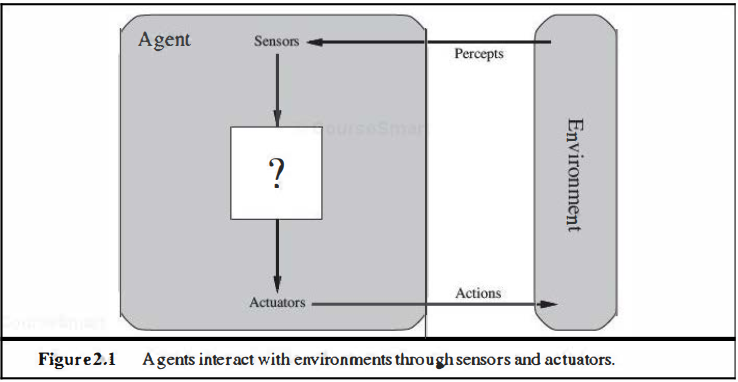
- An agent is anything that can be viewed as perceiving its environment through sensors and acting upon that environment through actuators.
- We use the term percept to refer to the agent's perceptual inputs at any given instant.
- percept sequence is the complete history of everything the agent has ever perceived
- an agent's choice of action at any given instant can depend on the entire percept sequence observed to date, but not on anything it hasn't perceived
- agent's behavior is described by the agent function that maps any given percept sequence to an action.
- Percept sequence -> History of stimulus coming from the environment
- Agent function ->Externally a table can be created which shows each percept sequence to some action
- Agent function -> Internally the agent program implements the function
- The agent function is an abstract mathematical description; the agent program is a concrete implementation, running within some physical system
2.2 Good Behaviour: The concept of rationality
- A rational agent is one that does the right thing--conceptually speaking
- by considering the consequences of the agent's behavior.
- Actions in response to percept of environment leads to different environmental states, can be desirable or not
- Not agent states, as the agent can always conclude that it had perfect performance
- If the sequence is desirable, then the agent has perfonned well. This notion of desirability is captured by a performance measure that evaluates any given sequence of environment states.
- a general rule, it is better to design performance measures according to what one actually wants in the environment, rather than according to how one thinks the agem should behave
- 2.2.1 Rationality
- • The performance measure that defines the criterion of success. • The agent's prior knowledge of the environment. • The actions that the agent can perform. • The agent's percept sequence to date.
- definition of a rational agent:
- For each possible percept sequence, a rational agent should select an action that is expected to maximize its performance measure, given the evidence provided by the percept sequence and whatever built-in knowledge the agent has.
- 2.2.2 Omniscience, learning, and autonomy
- An omniscient agent knows the actual outcome of its actions and can act accordingly; but omniscience is impossible in reality.
- Rationality maximizes expected performance, while perfection maximizes actual performance.
- Doing actions in order to modify future percepts-sometimes called information gathering-is an important part of rationality
- A rational agent should be autonomous-it should learn what it can to compensate for partial or incorrect prior knowledge.
- the extent that an agent relies on the prior knowledge of its designer rather than on its own percepts, we say that the agent lacks autonomy
- A rational agent is one that does the right thing--conceptually speaking
2.3 The nature of environments
- task environments, which are essentially the "problems" to which rational agents are the "solutions."
- 2.3.1 Specifying the task environment
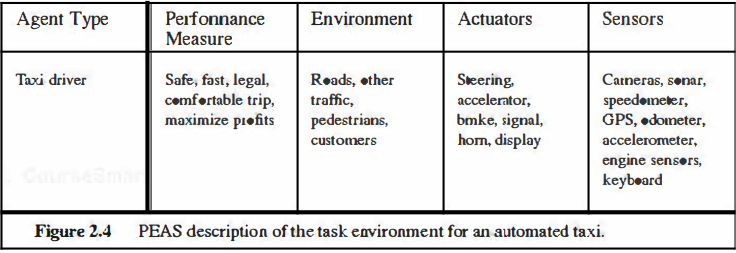
- we can this the PEAS (Performance, Environment, Actuators, Sensors) description
- the first step must always be to specify the task environment as fully as possible.
- 2.3.2 Properties of task environments
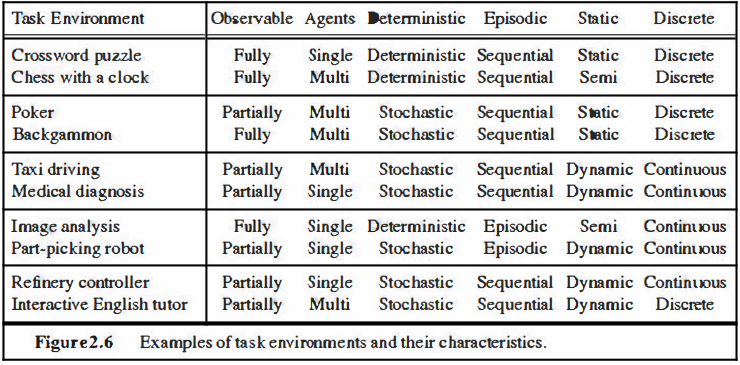
- Fully observable vs. partially observable:
- agent's sensors give it access to the complete state of the environment at each point in time, then we say that the task environment is fully observable.
- detect all aspects that are relevant to the choice of action; relevance, in turn, depends on the perfonnance measure.
- Fully observable environments are convenient because the agent need not maintain any internal state to keep track of the world
- partially observable because of noisy and inaccurate sensors or because parts of the state are simply missing from the sensor data
- If the agent has no sensors at all then the environment is unobservable
- agent's sensors give it access to the complete state of the environment at each point in time, then we say that the task environment is fully observable.
- Single agent vs. multiagent:
- Single -> eg. Agent working on crossword puzzle
- Multi -> eg. More than one Agent in the environment
- chess is a competitive multiagent environment.
- driving is a cooperative multiagent environment.
- communication often emerges as a rational behavior in multiagent environments; in some competitive environments, randomized behavior is rational because it avoids the pitfalls ofpredictability
- Deterministic vs. stochastic
- Deterministic -> If the next state of the environment is completely determined by the current state and the action executed by the agent
- Stochastic
- "stochastic" generally implies that uncertainty about outcomes is quantified in terms of probabilities; a nondeterministic environment is one in which actions are characterized by their possible outcomes, but no probabilities are attached to them
- Fully observable environment -> Deterministic
- Partially observable environments -> Appear stochastic, due to uncertainty
- Environment is uncertain if it is not fully observable or not deterministic
- Episodic vs. sequential:
- Episodic -> the agent's experience is divided into atomic episodes. In each episode the agent receives a percept and then performs a single action. eg. checking car parts
- the next episode does not depend on the actions taken in previous episodes.
- Sequential -> the current decision could affect all future decisions.
- Episodic -> the agent's experience is divided into atomic episodes. In each episode the agent receives a percept and then performs a single action. eg. checking car parts
- Static vs. dynamic:
- Dynamic -> environment can change while an agent is deliberating
- Static -> Doesnt change
- semidynamic -> Static environment, but agent performance score changes
- Discrete vs. continuous:
- applies to the state ofthe environment, to the way time is handled, and to the percepts and actions of the agent
- Known vs. unknown
- this distinction refers not to the environment itself but to the agent's (or designer's) state of knowledge about the "laws of physics" of the environment.
- the hardest case is partially observable, multiagent, stochastic, sequential, dynamic, continuous, and unknown
- Fully observable vs. partially observable:
2.4 The structure of agents
- agent = architecture +program .
- Architecture -> physical hardware
- Agent program -> Agent function -> Mapping from precepts to action
- 2.4.1 Agent programs
- Notice the difference between the agent program, which takes the current percept as input, and the agent function, which takes the entire percept history.
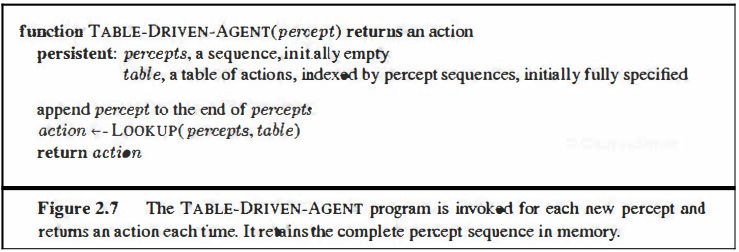
- Figure 2.7 shows a rather trivial agent program that keeps track of the percept sequence and then uses it to index into a table of actions to decide what to do
- The size of this table gets too large to work in complex environments
- four basic kinds of agent programs that embody the principles underlying almost all intelligent systems:
- • Simple reflex agents • Model-based reflex agents • Goal-based agents • Utility-based agents.
- 2.4.5 Utility-based agents
- Goals alone are not enough to generate high-quality behavior in most environments
- Goals just provide a crude binary distinction between "happy" and "unhappy" states.
- computer scientists use the term utility instead.
- An agent's utility function is essentially an internalization of the performance measure.
- Partial observability and stochasticity are ubiquitous in the real world, and so, therefore, is decision making w1der uncertainty.
- a rational utility-based agent chooses the action that maximizes the expected utility of the action outcomes-that is, the utility the agent expects to derive, on average, given the probabilities and utilities of each outcome.
- A utility-based agent has to model and keep track of its environment
- 2.4.2 Simple reflex agents
- The simplest kind
- select actions on the basis of the current percept, ignoring the rest of the percept history
- Also occurs in complex environments, in cases where percept to action is simple
- condition-action rule
- IF car-in-front-is-braking THEN initiate-braking
- Also called situation-action rules, productions, or if-then rules
- condition-action rule
- will work only if the correct decision can be made on the basis ofonly the currentpercept-that is, only if the environment is fully observable.
- 2.4.3 Model-based reflex agents
- The most effective way to handle partial observability is for the agent to keep track of the part ofthe world it can't see now.
- the agent should maintain some sort of internal state that depends on the percept history and thereby reflects at least some of the unobserved aspects of the current state.
- Updating this internal state information as time goes by requires two kinds of knowledge to be encoded in the agent program
- how the world evolves independently of the agent-for example, that an overtaking car generally will be closer behind than it was a moment ago.
- how the agent's own actions affect the world-for exrunple, that when the agent turns the steering wheel clockwise, the car turns to the right
- knowledge about "how the world works" is called a model of the world.
- Updating this internal state information as time goes by requires two kinds of knowledge to be encoded in the agent program
- 2.4.4 Goal-based agents
- as well as a current state description, the agent needs some sort of goal information that desctibes situations that are desirable
- Search (Chapters 3 to 5) and planning (Chapters 10 and 11) are the subfields of AI devoted to finding action sequences that achieve the agent's goals
- it is more flexible because the knowledge that supports its decisions is represented explicitly and can be modified.
- 2.4.6 Learning agents
- A learning agent can be divided into four conceptual components
- important distinction is between the learning element, which is responsible for making improvements, and the performance element, which is responsible for selecting extemal actions.
- The performance element is what we have previously considered to be the entire agent: it takes in percepts and decides on actions.
- The learning element uses feedback from the critic on how the agent is doing and determines how the performance element should be modified to do better in the future
- The design ofthe learning element depends very much on the design of the performance element
- The critic tells the learning agent how well the agent is doing in respect to a fixed performance standard.
- The last component of the learning agent is the problem generator.
- responsible for suggesting actions that will lead to new and informative experiences.
- if the agent is willing to explore a little and do some perhaps suboptimal actions in the short run, it might discover much better actions for the long run.
- The problem generator suggests these exploratory options
- The learning element can make changes to any of the "knowledge" components shown in the agent diagrams
- a process of modification of each component of the agent to bring the components into closer agreement with the available feedback information, thereby improving the overall performance of the agent.
- 2.4.7 How the components of agent programs work
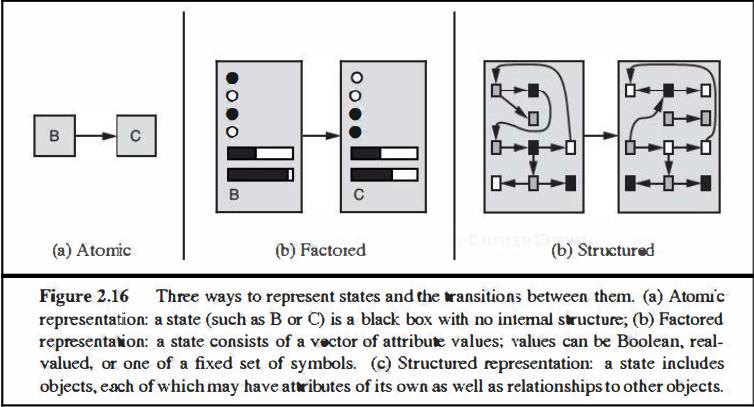
- Algorithm underlying search and game-playing (Chapters 3-5), Hidden Markov models (Chapter 15), and Markov decision processes (Chapter 17) all work with atomic representations
- Atomic - > Taxi driving from one city to the next. State only contains atomic knowledge, of the city name
- Factored -> Taxi must track fuel, tolls, GPS, engine lights etc
- A factored representation splits up each state into a fixed set of variables or attributes
- Many important areas of AI are based on factored representations, including constraint satisfaction algorithms (Chapter 6), propositional logic (Chapter 7), planning (Chapters lO and 11), Bayesian networks (Chapters 13-16), and the machine learning algorithms in Chapters 18, 20, and 21.
- Structured
- Structured representations underlie relational databases and first-order logic (Chapters 8, 9, and 12), first-order probability models (Chapter 14), knowledge-based learning (Chapter 19) and much of natural language understanding (Chapters 22 and 23).
- For many purposes, we need to understand the world as having things in it that are related to each other, not just variables with values.
- intelligent systems for the real world mayneed to operate at all points along the axis simultaneously.
Images and files in the map
Information
- Description
- Computer Science Mind Map on Chapter 2: Intelligent Agents (3751), created by Gideon Van on 27/07/2020.
- Created by
- Gideon Van · Jul 2020
- Updated
- Jul 30, 2020
- Views
- 2
- Rating