
Mind map
Hamlet: appearance vs. reality
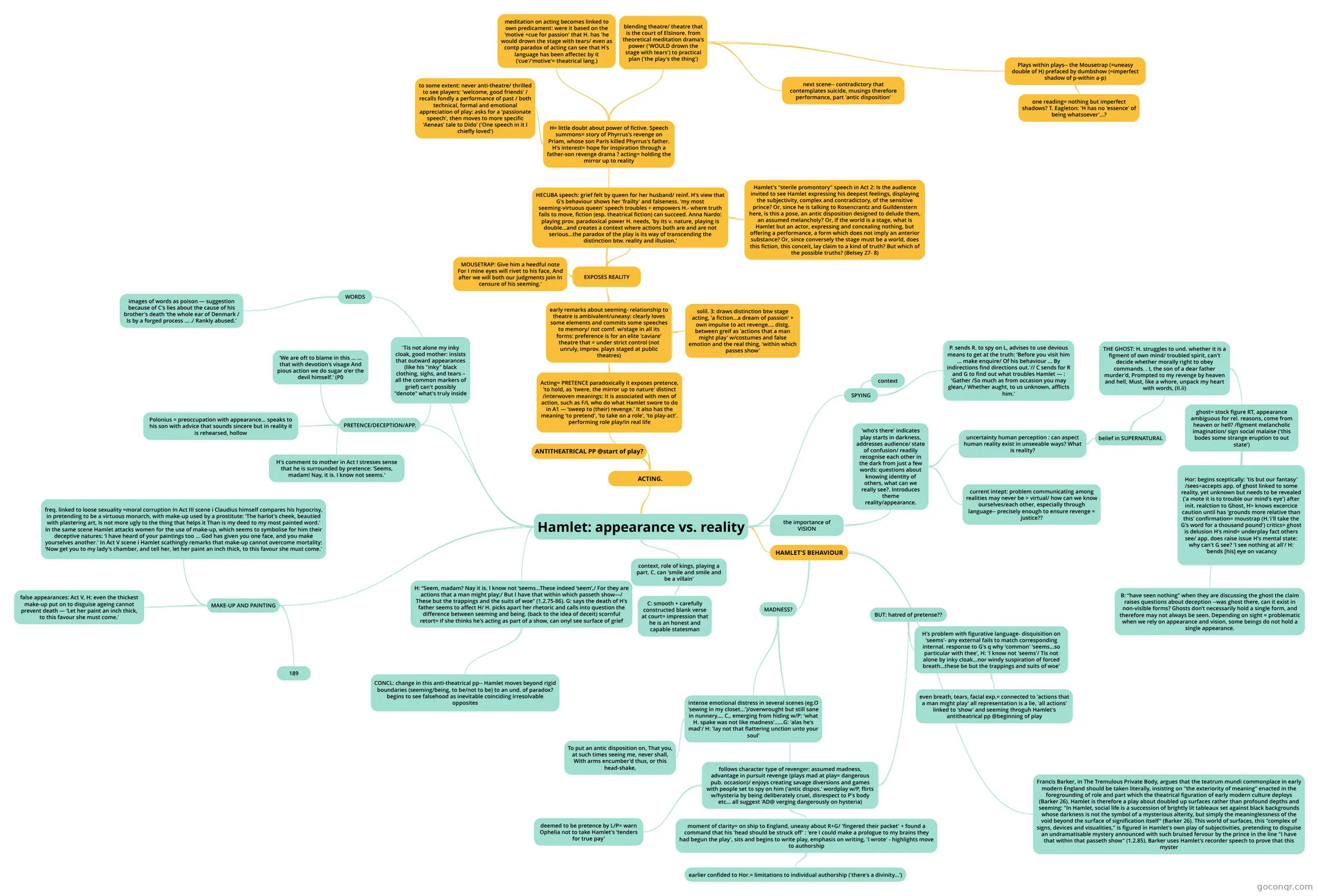
Mind map: Hamlet appearance vs reality
Map content
Hamlet: appearance vs. reality
the importance of VISION
- 'who's there' indicates play starts in darkness, addresses audience/ state of confusion/ readily recognise each other in the dark from just a few words: questions about knowing identity of others, what can we really see?. Introduces theme reality/appearance.
- uncertainty human perception : can aspect human reality exist in unseeable ways? What is reality?
- belief in SUPERNATURAL
- THE GHOST: H. struggles to und. whether it is a figment of own mind/ troubled spirit, can't decide whether morally right to obey commands. . I, the son of a dear father murder'd, Prompted to my revenge by heaven and hell, Must, like a whore, unpack my heart with words, (II.ii)
- ghost= stock figure RT, appearance ambiguous for rel. reasons, come from heaven or hell? /figment melancholic imagination/ sign social malaise ('this bodes some strange eruption to out state')
- https://books.google.co.uk/books?id=TD0iFLqy0TMC&pg=PA65&lpg=PA65&dq=hamlet+seeming&source=bl&ots=dk8i-kfP6R&sig=I22-9PL7Grt4svBjlYJEBIk_RQM&hl=en&sa=X&ei=z8kqVYf7B9PaaIjCgZAJ&ved=0CCgQ6AEwAzgU#v=onepage&q&f=false
- B: “have seen nothing” when they are discussing the ghost the claim raises questions about deception --was ghost there, can it exist in non-visible forms? Ghosts don’t necessarily hold a single form, and therefore may not always be seen. Depending on sight = problematic when we rely on appearance and vision, some beings do not hold a single appearance.
- Hor: begins sceptically: 'tis but our fantasy' /sees+accepts app. of ghost linked to some reality, yet unknown but needs to be revealed ('a mote it is to trouble our mind's eye') after init. realction to Ghost, H> knows excercice caution until has 'grounds more relative than this' confirmation= moustrap (H.'i'll take the G's word for a thousand pound') critics= ghost is delusion H's mind= underplay fact others see/ app. does raise issue H's mental state: why can't G see? 'I see nothing at all'/ H: 'bends [his] eye on vacancy
- ghost= stock figure RT, appearance ambiguous for rel. reasons, come from heaven or hell? /figment melancholic imagination/ sign social malaise ('this bodes some strange eruption to out state')
- THE GHOST: H. struggles to und. whether it is a figment of own mind/ troubled spirit, can't decide whether morally right to obey commands. . I, the son of a dear father murder'd, Prompted to my revenge by heaven and hell, Must, like a whore, unpack my heart with words, (II.ii)
- belief in SUPERNATURAL
- current intept: problem communicating among realities may never be > virtual/ how can we know ourselves/each other, especially through language-- precisely enough to ensure revenge = justice??
- uncertainty human perception : can aspect human reality exist in unseeable ways? What is reality?
- 'who's there' indicates play starts in darkness, addresses audience/ state of confusion/ readily recognise each other in the dark from just a few words: questions about knowing identity of others, what can we really see?. Introduces theme reality/appearance.
H: “Seem, madam? Nay it is. I know not ‘seems...These indeed ‘seem’,/ For they are actions that a man might play;/ But I have that within which passeth show—/ These but the trappings and the suits of woe” (1.2.75-86). G: says the death of H's father seems to affect H/ H. picks apart her rhetoric and calls into question the difference between seeming and being. (back to the idea of deceit) scornful retort= if she thinks he's acting as part of a show, can onyl see surface of grief
- CONCL: change in this anti-theatrical pp-- Hamlet moves beyond rigid boundaries (seeming/being, to be/not to be) to an und. of paradox? begins to see falsehood as inevitable coinciding irresolvable opposites
MAKE-UP AND PAINTING
- false appearances: Act V, H: even the thickest make-up put on to disguise ageing cannot prevent death — ‘Let her paint an inch thick, to this favour she must come.'
- freq. linked to loose sexuality =moral corruption In Act III scene i Claudius himself compares his hypocrisy, in pretending to be a virtuous monarch, with make-up used by a prostitute: ‘The harlot's cheek, beautied with plastering art, Is not more ugly to the thing that helps it Than is my deed to my most painted word.' In the same scene Hamlet attacks women for the use of make-up, which seems to symbolise for him their deceptive natures: ‘I have heard of your paintings too … God has given you one face, and you make yourselves another.' In Act V scene i Hamlet scathingly remarks that make-up cannot overcome mortality: ‘Now get you to my lady's chamber, and tell her, let her paint an inch thick, to this favour she must come.'
- 189
HAMLET'S BEHAVIOUR
- Francis Barker, in The Tremulous Private Body, argues that the teatrum mundi commonplace in early modern England should be taken literally, insisting on "the exteriority of meaning" enacted in the foregrounding of role and part which the theatrical figuration of early modern culture deploys (Barker 26). Hamlet is therefore a play about doubled up surfaces rather than profound depths and seeming: "In Hamlet, social life is a succession of brightly lit tableaux set against black backgrounds whose darkness is not the symbol of a mysterious alterity, but simply the meaninglessness of the void beyond the surface of signification itself" (Barker 26). This world of surfaces, this "complex of signs, devices and visualities," is figured in Hamlet's own play of subjectivities, pretending to disguise an undramatisable mystery announced with such bruised fervour by the prince in the line "I have that within that passeth show" (1.2.85). Barker uses Hamlet's recorder speech to prove that this myster
- MADNESS?
- follows character type of revenger: assumed madness, advantage in pursuit revenge (plays mad at play= dangerous pub. occasion)/ enjoys creating savage diversions and games with people set to spy on him ('antic dispos.' wordplay w/P, flirts w/hysteria by being deliberately cruel, disrespect to P's body etc... all suggest 'AD@ verging dangerously on hysteria)
- deemed to be pretence by L/P= warn Ophelia not to take Hamlet's ‘tenders for true pay'
- moment of clarity= on ship to England, uneasy about R+G/ 'fingered their packet' + found a command that his 'head should be struck off' : 'ere I could make a prologue to my brains they had begun the play', sits and begins to write play, emphasis on writing, 'I wrote' - highlights move to authorship
- earlier confided to Hor.= limitations to individual authorship ('there's a divinity...')
- BUT: hatred of pretense??
- H's problem with figurative language- disquisition on 'seems'- any external fails to match corresponding internal. response to G's q why 'common' 'seems...so particular with thee', H: 'I know not 'seems'/ Tis not alone by inky cloak...nor windy suspiration of forced breath...these be but the trappings and suits of woe'
- even breath, tears, facial exp.= connected to 'actions that a man might play' all representation is a lie, 'all actions' linked to 'show' and seeming throguh Hamlet's antitheatrical pp @beginning of play
- H's problem with figurative language- disquisition on 'seems'- any external fails to match corresponding internal. response to G's q why 'common' 'seems...so particular with thee', H: 'I know not 'seems'/ Tis not alone by inky cloak...nor windy suspiration of forced breath...these be but the trappings and suits of woe'
- intense emotional distress in several scenes (eg.O 'sewing in my closet...')/overwrought but still sane in nunnery.... C., emerging from hiding w/P: 'what H. spake was not like madness'......G: 'alas he's mad'/ H: 'lay not that flattering unction unto your soul'
- To put an antic disposition on, That you, at such times seeing me, never shall, With arms encumber'd thus, or this head-shake,
- follows character type of revenger: assumed madness, advantage in pursuit revenge (plays mad at play= dangerous pub. occasion)/ enjoys creating savage diversions and games with people set to spy on him ('antic dispos.' wordplay w/P, flirts w/hysteria by being deliberately cruel, disrespect to P's body etc... all suggest 'AD@ verging dangerously on hysteria)
context, role of kings, playing a part. C. can 'smile and smile and be a villain'
- C: smooth + carefully constructed blank verse at court= impression that he is an honest and capable statesman
PRETENCE/DECEPTION/APP.
- H's comment to mother in Act I stresses sense that he is surrounded by pretence: ‘Seems, madam! Nay, it is. I know not seems.'
- ‘We are oft to blame in this … … that with devotion's visage And pious action we do sugar o'er the devil himself.' (P0
- 'Tis not alone my inky cloak, good mother: insists that outward appearances (like his "inky" black clothing, sighs, and tears – all the common markers of grief) can't possibly "denote" what's truly inside
- Polonius = preoccupation with appearance... speaks to his son with advice that sounds sincere but in reality it is rehearsed, hollow
ACTING.
- Acting= PRETENCE paradoxically it exposes pretence, 'to hold, as 'twere, the mirror up to nature' distinct /interwoven meanings: It is associated with men of action, such as F/L who do what Hamlet swore to do in A1 — ‘sweep to (their) revenge.' It also has the meaning ‘to pretend', ‘to take on a role', ‘to play-act'. performing role play/in real life
- early remarks about seeming- relationship to theatre is ambivalent/uneasy: clearly loves some elements and commits some speeches to memory/ not comf. w/stage in all its forms: preference is for an elite 'caviare' theatre that = under strict control (not unruly, improv. plays staged at public theatres)
- EXPOSES REALITY
- HECUBA speech: grief felt by queen for her husband/ reinf. H's view that G's behaviour shows her ‘frailty' and falseness. 'my most seeming-virtuous queen' speech troubles + empowers H.- where truth fails to move, fiction (esp. theatrical fiction) can succeed. Anna Nardo: playing prov. paradoxical power H. needs, 'by its v. nature, playing is double...and creates a context where actions both are and are not serious...the paradox of the play is its way of transcending the distinction btw. reality and illusion.'
- Hamlet's "sterile promontory" speech in Act 2: Is the audience invited to see Hamlet expressing his deepest feelings, displaying the subjectivity, complex and contradictory, of the sensitive prince? Or, since he is talking to Rosencrantz and Guildenstern here, is this a pose, an antic disposition designed to delude them, an assumed melancholy? Or, if the world is a stage, what is Hamlet but an actor, expressing and concealing nothing, but offering a performance, a form which does not imply an anterior substance? Or, since conversely the stage must be a world, does this fiction, this conceit, lay claim to a kind of truth? But which of the possible truths? (Belsey 27- 8)
- H= little doubt about power of fictive. Speech summons= story of Phyrrus's revenge on Priam, whose son Paris killed Phyrrus's father. H's interest= hope for inspiration through a father-son revenge drama ? acting= holding the mirror up to reality
- to some extent: never anti-theatre/ thrilled to see players: 'welcome, good friends' / recalls fondly a performance of past / both technical, formal and emotional appreciation of play: asks for a 'passionate speech', then moves to more specific 'Aeneas' tale to Dido' ('One speech in it I chiefly loved')
- meditation on acting becomes linked to own predicament: were it based on the 'motive +cue for passion' that H. has 'he would drown the stage with tears/ even as contp paradox of acting can see that H's language has been affectec by it ('cue'/'motive'= theatrical lang.)
- blending theatre/ theatre that is the court of Elsinore. from theoretical meditation drama's power ('WOULD drown the stage with tears') to practical plan ('the play's the thing')
- next scene-- contradictory that contemplates suicide, musings therefore performance, part 'antic disposition'
- Plays within plays-- the Mousetrap (=uneasy double of H) prefaced by dumbshow (=imperfect shadow of p-within a-p)
- one reading= nothing but imperfect shadows? T. Eagleton: 'H has no 'essence' of being whatsoever'...?
- MOUSETRAP: Give him a heedful note For I mine eyes will rivet to his face, And after we will both our judgments join In censure of his seeming.'
- HECUBA speech: grief felt by queen for her husband/ reinf. H's view that G's behaviour shows her ‘frailty' and falseness. 'my most seeming-virtuous queen' speech troubles + empowers H.- where truth fails to move, fiction (esp. theatrical fiction) can succeed. Anna Nardo: playing prov. paradoxical power H. needs, 'by its v. nature, playing is double...and creates a context where actions both are and are not serious...the paradox of the play is its way of transcending the distinction btw. reality and illusion.'
- solil. 3: draws distinction btw stage acting, 'a fiction...a dream of passion' + own impulse to act revenge.... distg. between greif as 'actions that a man might play' w/costumes and false emotion and the real thing, 'within which passes show'
- EXPOSES REALITY
- early remarks about seeming- relationship to theatre is ambivalent/uneasy: clearly loves some elements and commits some speeches to memory/ not comf. w/stage in all its forms: preference is for an elite 'caviare' theatre that = under strict control (not unruly, improv. plays staged at public theatres)
- ANTITHEATRICAL PP @start of play?
- Acting= PRETENCE paradoxically it exposes pretence, 'to hold, as 'twere, the mirror up to nature' distinct /interwoven meanings: It is associated with men of action, such as F/L who do what Hamlet swore to do in A1 — ‘sweep to (their) revenge.' It also has the meaning ‘to pretend', ‘to take on a role', ‘to play-act'. performing role play/in real life
WORDS
- images of words as poison — suggestion because of C's lies about the cause of his brother's death ‘the whole ear of Denmark / Is by a forged process … ./ Rankly abused.'
SPYING
- P. sends R. to spy on L, advises to use devious means to get at the truth: ‘Before you visit him … make enquire/ Of his behaviour … By indirections find directions out.'// C sends for R and G to find out what troubles Hamlet — : ‘Gather /So much as from occasion you may glean,/ Whether aught, to us unknown, afflicts him.'
- context
Information
- Description
- Mind Map on Hamlet: appearance vs. reality, created by Clara Atkinson on 12/04/2015.
- Created by
- Clara Atkinson
- Views
- 38
- Rating