
Mind map
Parliamentary law making
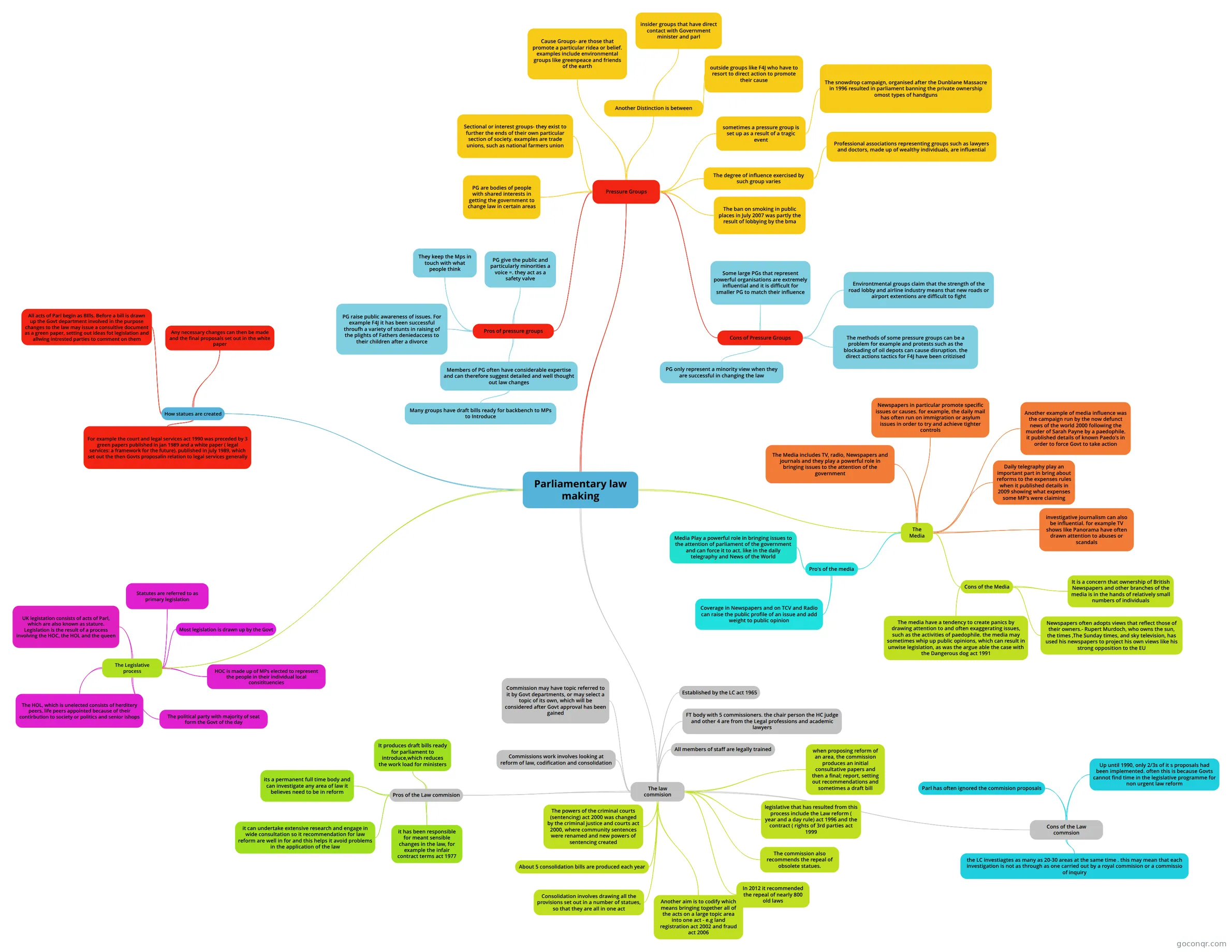
Mind map: Parliamentary law making
Map content
Parliamentary law making
Pressure Groups
- PG are bodies of people with shared interests in getting the government to change law in certain areas
- Sectional or interest groups- they exist to further the ends of their own particular section of society. examples are trade unions, such as national farmers union
- Cause Groups- are those that promote a particular ridea or belief. examples include environmental groups like greenpeace and friends of the earth
- Another Distinction is between
- insider groups that have direct contact with Government minister and parl
- outside groups like F4J who have to resort to direct action to promote their cause
- sometimes a pressure group is set up as a result of a tragic event
- The snowdrop campaign, organised after the Dunblane Massacre in 1996 resulted in parliament banning the private ownership omost types of handguns
- The degree of influence exercised by such group varies
- Professional associations representing groups such as lawyers and doctors, made up of wealthy individuals, are influential
- The ban on smoking in public places in July 2007 was partly the result of lobbying by the bma
- Pros of pressure groups
- PG give the public and particularly minorities a voice =. they act as a safety valve
- They keep the Mps in touch with what people think
- PG raise public awareness of issues. For example F4J it has been successful throufh a variety of stunts in raising of the plights of Fathers deniedaccess to their children after a divorce
- Members of PG often have considerable expertise and can therefore suggest detailed and well thought out law changes
- Many groups have draft bills ready for backbench to MPs to Introduce
- Cons of Pressure Groups
- Some large PGs that represent powerful organisations are extremely influential and it is difficult for smaller PG to match their influence
- Environtmental groups claim that the strength of the road lobby and airline industry means that new roads or airport extentions are difficult to fight
- The methods of some pressure groups can be a problem for example and protests such as the blockading of oil depots can cause disruption. the direct actions tactics for F4J have been critizised
- PG only represent a minority view when they are successful in changing the law
The Media
- The Media includes TV, radio, Newspapers and journals and they play a powerful role in bringing issues to the attention of the government
- Newspapers in particular promote specific issues or causes. for example, the daily mail has often run on immigration or asylum issues in order to try and achieve tighter controls
- Another example of media influence was the campaign run by the now defunct news of the world 2000 following the murder of Sarah Payne by a paedophile. it published details of known Paedo's in order to force Govt to take action
- investigative journalism can also be influential. for example TV shows like Panorama have often drawn attention to abuses or scandals
- Daily telegraphy play an important part in bring about reforms to the expenses rules when it published details in 2009 showing what expenses some MP's were claiming
- Pro's of the media
- Media Play a powerful role in bringing issues to the attention of parliament of the government and can force it to act. like in the daily telegraphy and News of the World
- Coverage in Newspapers and on TCV and Radio can raise the public profile of an issue and add weight to public opinion
- Cons of the Media
- It is a concern that ownership of British Newspapers and other branches of the media is in the hands of relatively small numbers of individuals
- Newspapers often adopts views that reflect those of their owners.- Rupert Murdoch, who owns the sun, the times ,The Sunday times, and sky television, has used his newspapers to project his own views like his strong opposition to the EU
- The media have a tendency to create panics by drawing attention to and often exaggerating issues, such as the activities of paedophile. the media may sometimes whip up public opinions, which can result in unwise legislation, as was the argue able the case with the Dangerous dog act 1991
The law commision
- Established by the LC act 1965
- FT body with 5 commissioners. the chair person the HC judge and other 4 are from the Legal professions and academic lawyers
- All members of staff are legally trained
- Commissions work involves looking at reform of law, codification and consolidation
- Commission may have topic referred to it by Govt departments, or may select a topic of its own, which will be considered after Govt approval has been gained
- when proposing reform of an area, the commission produces an initial consultative papers and then a final; report, setting out recommendations and sometimes a draft bill
- legislative that has resulted from this process include the Law reform ( year and a day rule) act 1996 and the contract ( rights of 3rd parties act 1999
- The commission also recommends the repeal of obsolete statues.
- In 2012 it recommended the repeal of nearly 800 old laws
- Another aim is to codify which means bringing together all of the acts on a large topic area into one act - e.g land registration act 2002 and fraud act 2006
- Consolidation involves drawing all the provisions set out in a number of statues, so that they are all in one act
- About 5 consolidation bills are produced each year
- The powers of the criminal courts (sentencing) act 2000 was changed by the criminal justice and courts act 2000, where community sentences were renamed and new powers of sentencing created
- Cons of the Law commsion
- Parl has often ignored the commision proposals
- Up until 1990, only 2/3s of it s proposals had been implemented. often this is because Govts cannot find time in the legislative programme for non urgent law reform
- the LC investiagtes as many as 20-30 areas at the same time . this may mean that each investigation is not as through as one carried out by a royal commision or a commissio of inquiry
- Pros of the Law commision
- its a permanent full time body and can investigate any area of law it believes need to be in reform
- It produces draft bills ready for parliament to introduce,which reduces the work load for ministers
- it has been responsible for meant sensible changes in the law, for example the infair contract terms act 1977
- it can undertake extensive research and engage in wide consultation so it recommendation for law reform are well in for and this helps it avoid problems in the application of the law
The Legislative process
- UK legistation consists of acts of Parl, which are also known as stature. Legislation is the result of a process involving the HOC, the HOL and the queen
- Statutes are referred to as primary legislation
- Most legislation is drawn up by the Govt
- HOC is made up of MPs elected to represent the people in their individual local consitituencies
- The political party with majority of seat form the Govt of the day
- The HOL, which is unelected consists of herditery peers, life peers appointed because of their contirbution to society or politics and senior ishops
How statues are created
- All acts of Parl begin as BIlls. Before a bill is drawn up the Govt department involved in the purpose changes to the law may issue a consultive document as a green paper, setting out ideas fot legislation and allwing intrested parties to comment on them
- Any necessary changes can then be made and the final proposals set out in the white paper
- For example the court and legal services act 1990 was preceded by 3 green papers published in jan 1989 and a white paper ( legal services: a framework for the future). published in july 1989, which set out the then Govts proposalin relation to legal services generally
Information
- Description
- As level Law Mind Map on Parliamentary law making, created by jonathan.newell2 on 05/05/2015.
- Created by
- jonathan.newell2
- Views
- 78
- Tags
- Rating
More on Parliamentary Law Making Process