
Mind map
Biodiversity on Mexico
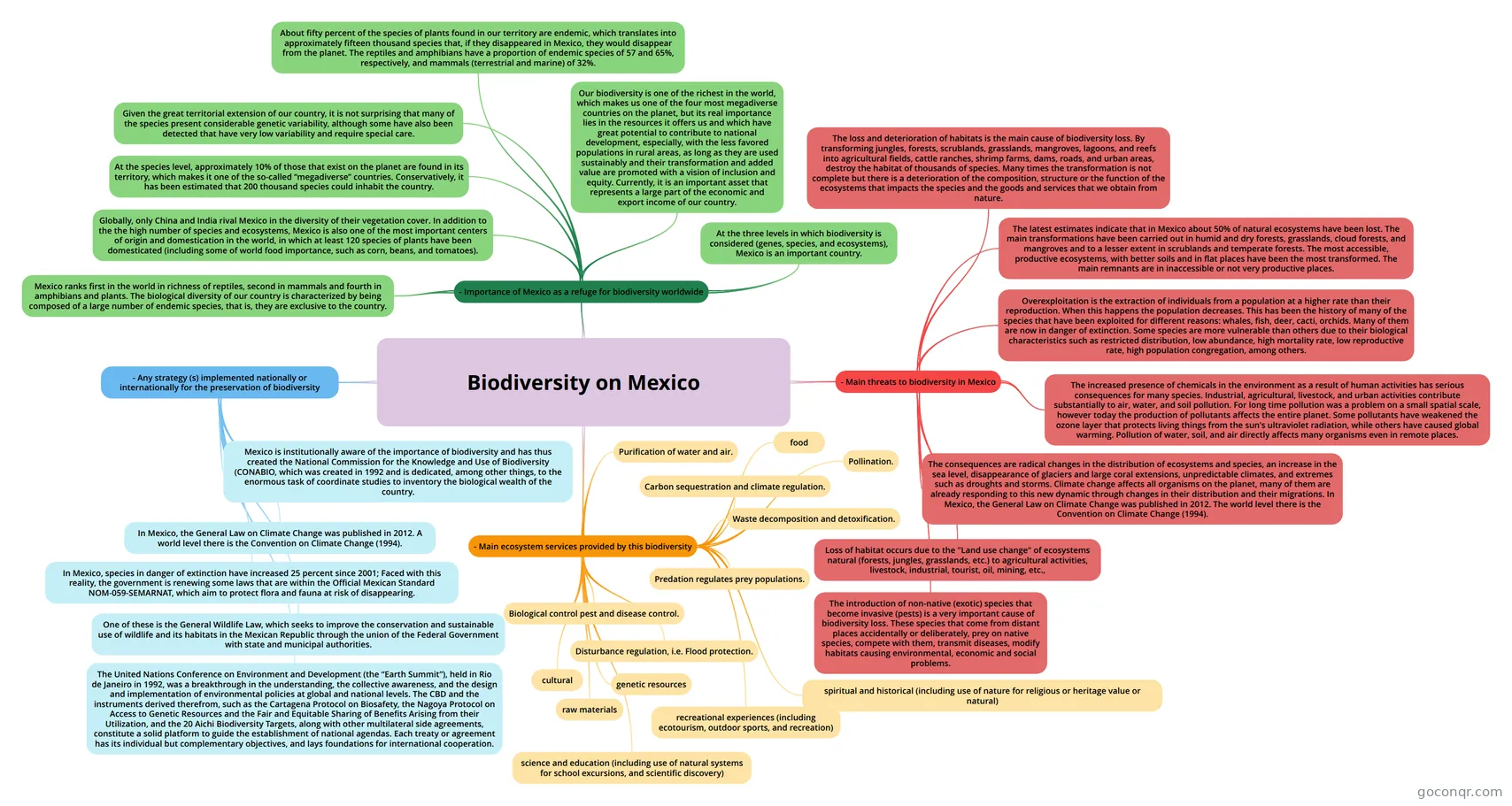
Mind map: Biodiversity in Mexico
Map content
Biodiversity on Mexico
- Main threats to biodiversity in Mexico
- The loss and deterioration of habitats is the main cause of biodiversity loss. By transforming jungles, forests, scrublands, grasslands, mangroves, lagoons, and reefs into agricultural fields, cattle ranches, shrimp farms, dams, roads, and urban areas, destroy the habitat of thousands of species. Many times the transformation is not complete but there is a deterioration of the composition, structure or the function of the ecosystems that impacts the species and the goods and services that we obtain from nature.
- The latest estimates indicate that in Mexico about 50% of natural ecosystems have been lost. The main transformations have been carried out in humid and dry forests, grasslands, cloud forests, and mangroves and to a lesser extent in scrublands and temperate forests. The most accessible, productive ecosystems, with better soils and in flat places have been the most transformed. The main remnants are in inaccessible or not very productive places.
- Loss of habitat occurs due to the "Land use change" of ecosystems natural (forests, jungles, grasslands, etc.) to agricultural activities, livestock, industrial, tourist, oil, mining, etc.,
- The introduction of non-native (exotic) species that become invasive (pests) is a very important cause of biodiversity loss. These species that come from distant places accidentally or deliberately, prey on native species, compete with them, transmit diseases, modify habitats causing environmental, economic and social problems.
- Overexploitation is the extraction of individuals from a population at a higher rate than their reproduction. When this happens the population decreases. This has been the history of many of the species that have been exploited for different reasons: whales, fish, deer, cacti, orchids. Many of them are now in danger of extinction. Some species are more vulnerable than others due to their biological characteristics such as restricted distribution, low abundance, high mortality rate, low reproductive rate, high population congregation, among others.
- The increased presence of chemicals in the environment as a result of human activities has serious consequences for many species. Industrial, agricultural, livestock, and urban activities contribute substantially to air, water, and soil pollution. For long time pollution was a problem on a small spatial scale, however today the production of pollutants affects the entire planet. Some pollutants have weakened the ozone layer that protects living things from the sun's ultraviolet radiation, while others have caused global warming. Pollution of water, soil, and air directly affects many organisms even in remote places.
- The consequences are radical changes in the distribution of ecosystems and species, an increase in the sea level, disappearance of glaciers and large coral extensions, unpredictable climates, and extremes such as droughts and storms. Climate change affects all organisms on the planet, many of them are already responding to this new dynamic through changes in their distribution and their migrations. In Mexico, the General Law on Climate Change was published in 2012. The world level there is the Convention on Climate Change (1994).
- Importance of Mexico as a refuge for biodiversity worldwide
- At the three levels in which biodiversity is considered (genes, species, and ecosystems), Mexico is an important country.
- At the species level, approximately 10% of those that exist on the planet are found in its territory, which makes it one of the so-called “megadiverse” countries. Conservatively, it has been estimated that 200 thousand species could inhabit the country.
- Globally, only China and India rival Mexico in the diversity of their vegetation cover. In addition to the the high number of species and ecosystems, Mexico is also one of the most important centers of origin and domestication in the world, in which at least 120 species of plants have been domesticated (including some of world food importance, such as corn, beans, and tomatoes).
- Mexico ranks first in the world in richness of reptiles, second in mammals and fourth in amphibians and plants. The biological diversity of our country is characterized by being composed of a large number of endemic species, that is, they are exclusive to the country.
- About fifty percent of the species of plants found in our territory are endemic, which translates into approximately fifteen thousand species that, if they disappeared in Mexico, they would disappear from the planet. The reptiles and amphibians have a proportion of endemic species of 57 and 65%, respectively, and mammals (terrestrial and marine) of 32%.
- Given the great territorial extension of our country, it is not surprising that many of the species present considerable genetic variability, although some have also been detected that have very low variability and require special care.
- Our biodiversity is one of the richest in the world, which makes us one of the four most megadiverse countries on the planet, but its real importance lies in the resources it offers us and which have great potential to contribute to national development, especially, with the less favored populations in rural areas, as long as they are used sustainably and their transformation and added value are promoted with a vision of inclusion and equity. Currently, it is an important asset that represents a large part of the economic and export income of our country.
- Main ecosystem services provided by this biodiversity
- Purification of water and air.
- Carbon sequestration and climate regulation.
- Waste decomposition and detoxification.
- Predation regulates prey populations.
- Biological control pest and disease control.
- Pollination.
- Disturbance regulation, i.e. Flood protection.
- food
- raw materials
- genetic resources
- cultural
- spiritual and historical (including use of nature for religious or heritage value or natural)
- recreational experiences (including ecotourism, outdoor sports, and recreation)
- science and education (including use of natural systems for school excursions, and scientific discovery)
- Any strategy (s) implemented nationally or internationally for the preservation of biodiversity
- Mexico is institutionally aware of the importance of biodiversity and has thus created the National Commission for the Knowledge and Use of Biodiversity (CONABIO, which was created in 1992 and is dedicated, among other things, to the enormous task of coordinate studies to inventory the biological wealth of the country.
- In Mexico, the General Law on Climate Change was published in 2012. A world level there is the Convention on Climate Change (1994).
- In Mexico, species in danger of extinction have increased 25 percent since 2001; Faced with this reality, the government is renewing some laws that are within the Official Mexican Standard NOM-059-SEMARNAT, which aim to protect flora and fauna at risk of disappearing.
- One of these is the General Wildlife Law, which seeks to improve the conservation and sustainable use of wildlife and its habitats in the Mexican Republic through the union of the Federal Government with state and municipal authorities.
- The United Nations Conference on Environment and Development (the “Earth Summit”), held in Rio de Janeiro in 1992, was a breakthrough in the understanding, the collective awareness, and the design and implementation of environmental policies at global and national levels. The CBD and the instruments derived therefrom, such as the Cartagena Protocol on Biosafety, the Nagoya Protocol on Access to Genetic Resources and the Fair and Equitable Sharing of Benefits Arising from their Utilization, and the 20 Aichi Biodiversity Targets, along with other multilateral side agreements, constitute a solid platform to guide the establishment of national agendas. Each treaty or agreement has its individual but complementary objectives, and lays foundations for international cooperation.
Information
- Description
- Segundo Biología Mind Map on Biodiversity on Mexico, created by Boris Jarod on 16/04/2021.
- Created by
- Boris Jarod
- Views
- 8
- Rating