
Mind map
STRUCTURE OF THE EARTH
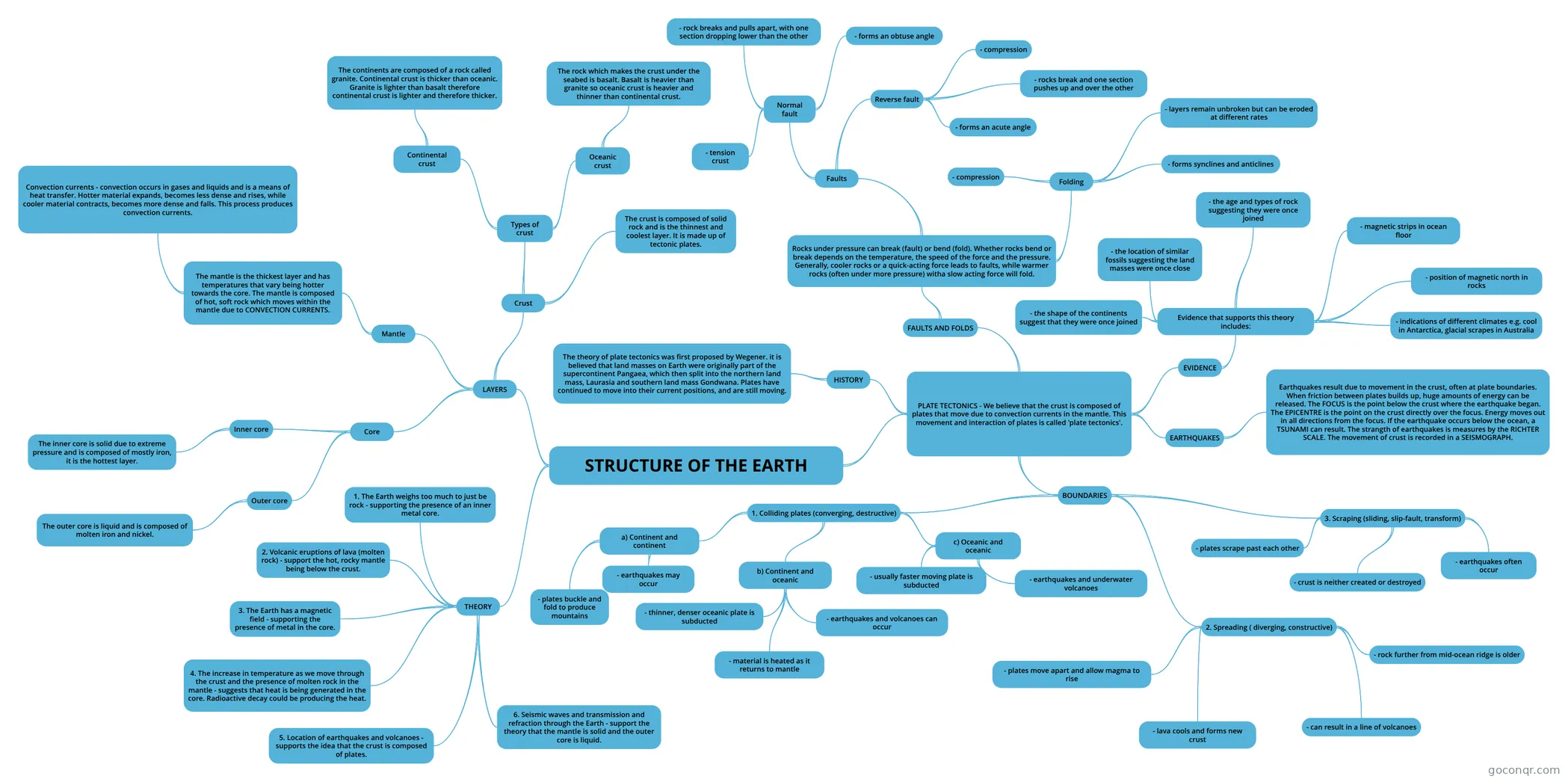
Mind map: Structure of the Earth
Map content
STRUCTURE OF THE EARTH
THEORY
- 1. The Earth weighs too much to just be rock - supporting the presence of an inner metal core.
- 2. Volcanic eruptions of lava (molten rock) - support the hot, rocky mantle being below the crust.
- 3. The Earth has a magnetic field - supporting the presence of metal in the core.
- 4. The increase in temperature as we move through the crust and the presence of molten rock in the mantle - suggests that heat is being generated in the core. Radioactive decay could be producing the heat.
- 5. Location of earthquakes and volcanoes - supports the idea that the crust is composed of plates.
- 6. Seismic waves and transmission and refraction through the Earth - support the theory that the mantle is solid and the outer core is liquid.
LAYERS
- Crust
- The crust is composed of solid rock and is the thinnest and coolest layer. It is made up of tectonic plates.
- Types of crust
- Oceanic crust
- The rock which makes the crust under the seabed is basalt. Basalt is heavier than granite so oceanic crust is heavier and thinner than continental crust.
- Continental crust
- The continents are composed of a rock called granite. Continental crust is thicker than oceanic. Granite is lighter than basalt therefore continental crust is lighter and therefore thicker.
- Oceanic crust
- Mantle
- The mantle is the thickest layer and has temperatures that vary being hotter towards the core. The mantle is composed of hot, soft rock which moves within the mantle due to CONVECTION CURRENTS.
- Convection currents - convection occurs in gases and liquids and is a means of heat transfer. Hotter material expands, becomes less dense and rises, while cooler material contracts, becomes more dense and falls. This process produces convection currents.
- The mantle is the thickest layer and has temperatures that vary being hotter towards the core. The mantle is composed of hot, soft rock which moves within the mantle due to CONVECTION CURRENTS.
- Core
- Inner core
- The inner core is solid due to extreme pressure and is composed of mostly iron, it is the hottest layer.
- Outer core
- The outer core is liquid and is composed of molten iron and nickel.
- Inner core
- Crust
PLATE TECTONICS - We believe that the crust is composed of plates that move due to convection currents in the mantle. This movement and interaction of plates is called 'plate tectonics'.
- HISTORY
- The theory of plate tectonics was first proposed by Wegener. it is believed that land masses on Earth were originally part of the supercontinent Pangaea, which then split into the northern land mass, Laurasia and southern land mass Gondwana. Plates have continued to move into their current positions, and are still moving.
- FAULTS AND FOLDS
- Rocks under pressure can break (fault) or bend (fold). Whether rocks bend or break depends on the temperature, the speed of the force and the pressure. Generally, cooler rocks or a quick-acting force leads to faults, while warmer rocks (often under more pressure) witha slow acting force will fold.
- Faults
- Normal fault
- - tension crust
- - rock breaks and pulls apart, with one section dropping lower than the other
- - forms an obtuse angle
- Reverse fault
- - compression
- - rocks break and one section pushes up and over the other
- - forms an acute angle
- Normal fault
- Folding
- - compression
- - layers remain unbroken but can be eroded at different rates
- - forms synclines and anticlines
- Faults
- Rocks under pressure can break (fault) or bend (fold). Whether rocks bend or break depends on the temperature, the speed of the force and the pressure. Generally, cooler rocks or a quick-acting force leads to faults, while warmer rocks (often under more pressure) witha slow acting force will fold.
- EVIDENCE
- Evidence that supports this theory includes:
- - the shape of the continents suggest that they were once joined
- - the location of similar fossils suggesting the land masses were once close
- - the age and types of rock suggesting they were once joined
- - magnetic strips in ocean floor
- - position of magnetic north in rocks
- - indications of different climates e.g. cool in Antarctica, glacial scrapes in Australia
- Evidence that supports this theory includes:
- EARTHQUAKES
- Earthquakes result due to movement in the crust, often at plate boundaries. When friction between plates builds up, huge amounts of energy can be released. The FOCUS is the point below the crust where the earthquake began. The EPICENTRE is the point on the crust directly over the focus. Energy moves out in all directions from the focus. If the earthquake occurs below the ocean, a TSUNAMI can result. The strangth of earthquakes is measures by the RICHTER SCALE. The movement of crust is recorded in a SEISMOGRAPH.
- BOUNDARIES
- 1. Colliding plates (converging, destructive)
- a) Continent and continent
- - plates buckle and fold to produce mountains
- - earthquakes may occur
- b) Continent and oceanic
- - thinner, denser oceanic plate is subducted
- - material is heated as it returns to mantle
- - earthquakes and volcanoes can occur
- c) Oceanic and oceanic
- - usually faster moving plate is subducted
- - earthquakes and underwater volcanoes
- a) Continent and continent
- 2. Spreading ( diverging, constructive)
- - plates move apart and allow magma to rise
- - can result in a line of volcanoes
- - lava cools and forms new crust
- - rock further from mid-ocean ridge is older
- 3. Scraping (sliding, slip-fault, transform)
- - plates scrape past each other
- - crust is neither created or destroyed
- - earthquakes often occur
- 1. Colliding plates (converging, destructive)
- HISTORY
Information
- Description
- Mind Map on STRUCTURE OF THE EARTH, created by 27610 on 13/08/2015.
- Created by
- 27610
- Views
- 0
- Rating
More on Earth's Internal Structure