
Mind map
1. Security and Risk P1
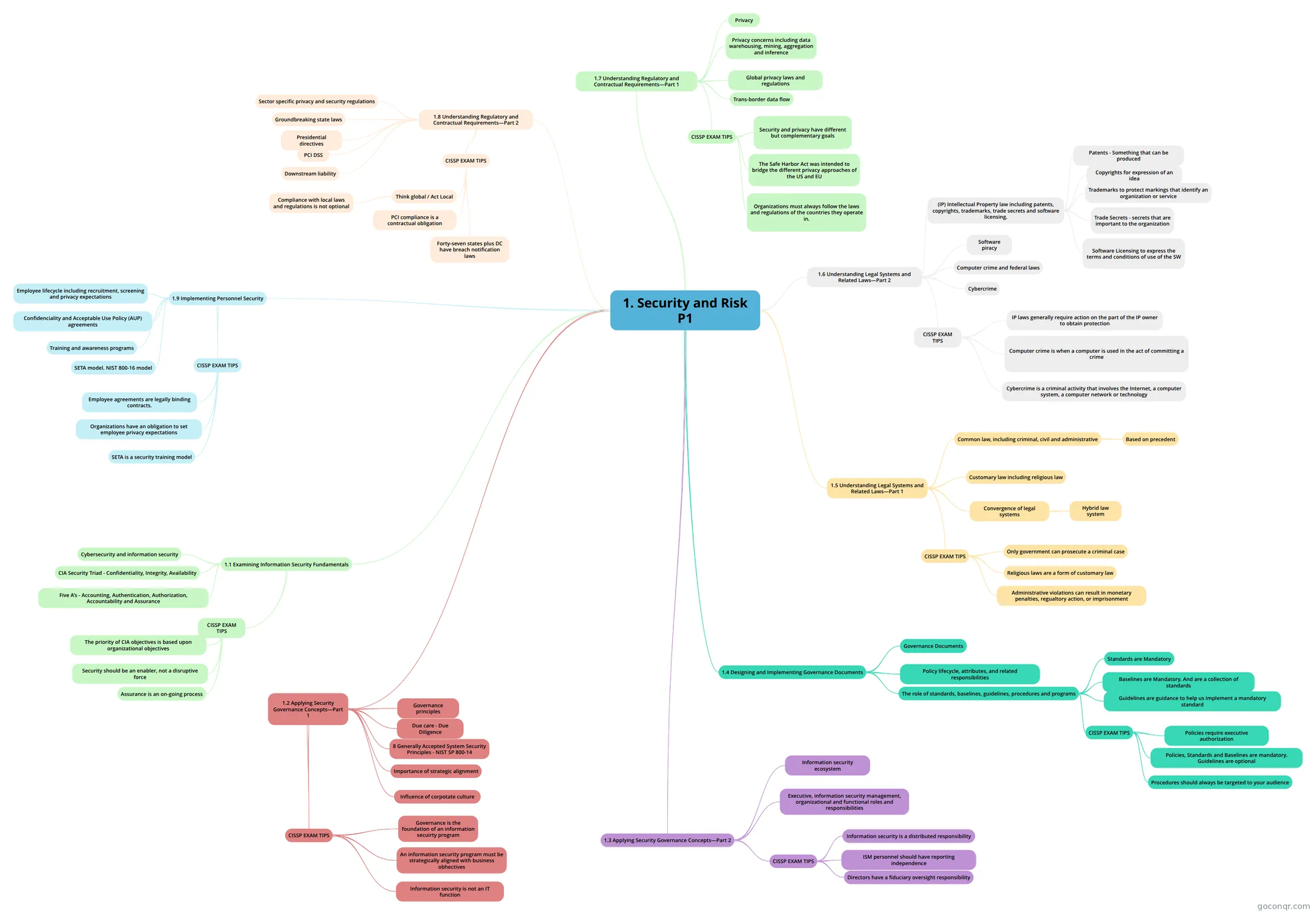
Mind map: CISSP security and risk
Map content
1. Security and Risk P1
1.9 Implementing Personnel Security
- Employee lifecycle including recruitment, screening and privacy expectations
- Confidenciality and Acceptable Use Policy (AUP) agreements
- Training and awareness programs
- SETA model. NIST 800-16 model
- CISSP EXAM TIPS
- Employee agreements are legally binding contracts.
- Organizations have an obligation to set employee privacy expectations
- SETA is a security training model
1.8 Understanding Regulatory and Contractual Requirements—Part 2
- Sector specific privacy and security regulations
- Groundbreaking state laws
- Presidential directives
- PCI DSS
- Downstream liability
- CISSP EXAM TIPS
- Think global / Act Local
- Compliance with local laws and regulations is not optional
- PCI compliance is a contractual obligation
- Forty-seven states plus DC have breach notification laws
- Think global / Act Local
1.7 Understanding Regulatory and Contractual Requirements—Part 1
- Privacy
- Privacy concerns including data warehousing, mining, aggregation and inference
- Global privacy laws and regulations
- Trans-border data flow
- CISSP EXAM TIPS
- Security and privacy have different but complementary goals
- The Safe Harbor Act was intended to bridge the different privacy approaches of the US and EU
- Organizations must always follow the laws and regulations of the countries they operate in.
1.6 Understanding Legal Systems and Related Laws—Part 2
- (IP) Intellectual Property law including patents, copyrights, trademarks, trade secrets and software licensing.
- Patents - Something that can be produced
- Copyrights for expression of an idea
- Trademarks to protect markings that identify an organization or service
- Trade Secrets - secrets that are important to the organization
- Software Licensing to express the terms and conditions of use of the SW
- Software piracy
- Computer crime and federal laws
- Cybercrime
- CISSP EXAM TIPS
- IP laws generally require action on the part of the IP owner to obtain protection
- Computer crime is when a computer is used in the act of committing a crime
- Cybercrime is a criminal activity that involves the Internet, a computer system, a computer network or technology
- (IP) Intellectual Property law including patents, copyrights, trademarks, trade secrets and software licensing.
1.5 Understanding Legal Systems and Related Laws—Part 1
- Common law, including criminal, civil and administrative
- Based on precedent
- Customary law including religious law
- Convergence of legal systems
- Hybrid law system
- CISSP EXAM TIPS
- Only government can prosecute a criminal case
- Religious laws are a form of customary law
- Administrative violations can result in monetary penalties, regualtory action, or imprisonment
- Common law, including criminal, civil and administrative
1.4 Designing and Implementing Governance Documents
- Governance Documents
- Policy lifecycle, attributes, and related responsibilities
- The role of standards, baselines, guidelines, procedures and programs
- Standards are Mandatory
- Baselines are Mandatory. And are a collection of standards
- Guidelines are guidance to help us implement a mandatory standard
- CISSP EXAM TIPS
- Policies require executive authorization
- Policies, Standards and Baselines are mandatory. Guidelines are optional
- Procedures should always be targeted to your audience
1.3 Applying Security Governance Concepts—Part 2
- Information security ecosystem
- Executive, information security management, organizational and functional roles and responsibilities
- CISSP EXAM TIPS
- Information security is a distributed responsibility
- ISM personnel should have reporting independence
- Directors have a fiduciary oversight responsibility
1.2 Applying Security Governance Concepts—Part 1
- Governance principles
- Due care - Due Diligence
- 8 Generally Accepted System Security Principles - NIST SP 800-14
- Importance of strategic alignment
- Influence of corpotate culture
- CISSP EXAM TIPS
- Governance is the foundation of an information secuirty program
- An information security program must be strategically aligned with business obhectives
- Information security is not an IT function
1.1 Examining Information Security Fundamentals
- Cybersecurity and information security
- CIA Security Triad - Confidentiality, Integrity, Availability
- Five A's - Accounting, Authentication, Authorization, Accountability and Assurance
- CISSP EXAM TIPS
- The priority of CIA objectives is based upon organizational objectives
- Security should be an enabler, not a disruptive force
- Assurance is an on-going process
Information
- Description
- 5 Mind Maps (CISSP CBK) Mind Map on 1. Security and Risk P1, created by Marisol Segade on 11/10/2015.
- Created by
- Marisol Segade
- Views
- 6
- Rating