
Mind map
Neuro-Cognitive Disorders
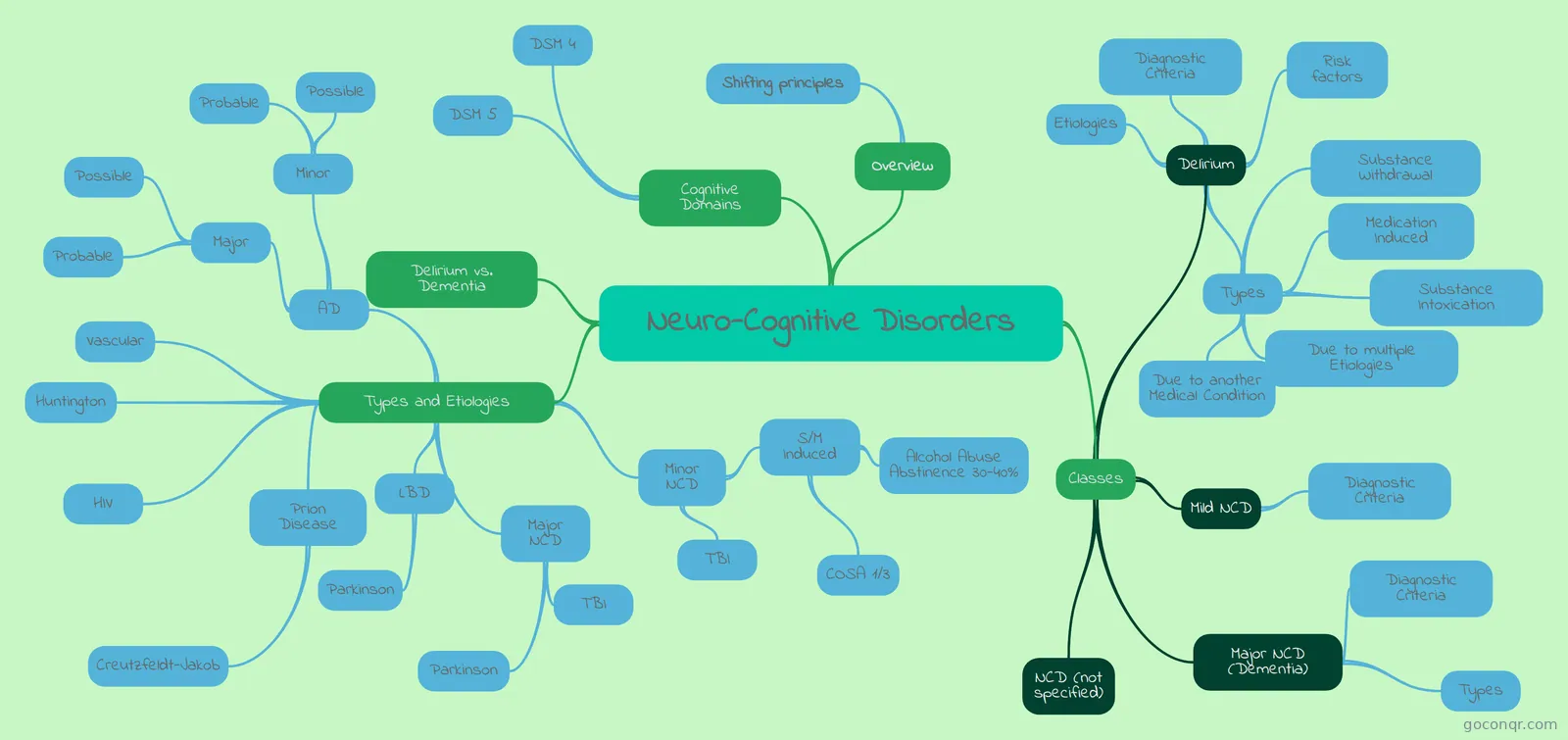
Mind map: Neuro-cognitive disorders
Map content
Neuro-Cognitive Disorders
Overview
- Primary deficit in cognitive functions: LMC
- Shifting principles
- Organic Mental Disorders Cognitive Disorders Neuro-cognitive Disorders
Cognitive Domains
- DSM 5
- Complex Attention Executive Function Language Perceptual motor problems Social Cognition
- DSM 4
- Memory impairment Aphasia Apraxia Agnosia Executive Function
- DSM 5
Classes
- Major NCD (Dementia)
- Dementia Before for elderly after for younger people: HIV andTBI
- Diagnostic Criteria
- Severe Cognitive Decline Interfere with Independence Not due to 2
- Types
- Alzheimer's Disease Frontotemporal Lobar Degeneration Lewy Body Disease Vascular Disease Traumatic Brain Injury Substance/Medication HIV infection Prion Disease Parkinson's Disease Huntington Disease
- Mild NCD
- Diagnostic Criteria
- Moderate Cognitive Decline Do not interefere with independence
- Diagnostic Criteria
- Delirium
- Absence of the criteria of delirium for Major/Minor NCD is called clear consciousness and can coexist.
- Disruption of the homeostasis of the brain
- Diagnostic Criteria
- Disturbance in attention (direct,focus,sustain,shift) and awareness(orientation) MAY INCLUDE COGNITION (One at least): Memory deficit, disorientation, language, visuospatial ability, or perceptionDue to something else May resolve Development Acute: hours to few daysPersistent: Weeks to months
- Sleep/wake cycle changes Emotional State changes Worsening of behavioral problems in the evening
- Risk factors
- Age, Cognitive/Sensory Impairment, Men, Severe illness, Hip fracture, Hyper/Hypo thermia, Hypotension, Malnutrition, Meds, Restraints, Metabolic (Hypo/Hyperglycemia, Azotemia), Depression, Alcoholism, and Pain
- Etiologies
- Organic 95% Multifactorial: Sensory Input, surroundings, and stressors DIMTOP
- Types
- Substance Intoxication
- Substance Withdrawal
- Medication Induced
- Due to another Medical Condition
- Due to multiple Etiologies
- NCD (not specified)
- Major NCD (Dementia)
Types and Etiologies
- Major NCD
- TBI
- Neuroimaging is required same as minor
- Parkinson
- TBI
- Minor NCD
- TBI
- Onset: known Loss of consciousnessDisorientationAmnesiaNeuroimaging not required
- Recovery: Partial or complete Weeks to months
- S/M Induced
- Alcohol Abuse Abstinence 30-40%
- COSA 1/3
- TBI
- LBD
- Onset:Insidious Flactuating cognitiong alertness attention Visual hallucination Cognitive impairment-->1year-->Parkinsonian movements REM sleep disorder Neuroleptic sensitivity
- Parkinson
- Onset: Insidious Tremor, rigidity, bradykinesia, shuffling of posture and gate Dementia happens later on
- substantia nigra in the brain stem pigmented lesions called lewy bodies no dopamine is produced Major NCD
- HIV
- Subcortical Pattern Impaired EF Slowing of processing speed Attention learning new info NO PROBLEM in recalling learned information 25-5%
- Prion Disease
- Onset:Insidious Fatigue Anxiety Appetite/Sleep/concentration problems then after some weeks incoordenation, altered vision, abnormal gait, Rapidly progressive dementia, myoclonus, ataxia
- Creutzfeldt-Jakob
- Transmitted by corneal grafts, injected crude of growth hormone derived from human pituitary, infected electrodes
- prion agent spongiform encephalopathy vacuolization of nerve cells
- Confusion Depression Altered Sensation then after weeks to months Dementia ataxia palsy cortical blindness
- Huntington
- Onset:Insiduous EF (processing speed, organization, and planning) not learning and memory bradykinesia and chorea(kerking)
- Vascular
- PR: above 65 second most common complex attention and EF
- due to large vessel stroke small vessel ischemic disease white matter ischemia
- AD
- lower beta amyloid protein deposition Elevated tau or phosphorelated Positron Emission Tomography These appear years before the onset of NCD symptoms
- Duration 10 years 3-20 years
- Major
- 2 or more cognitive domains impaired IADLS
- Probable
- 1 of the following: Genetic mutation evidence or memory impairment progressive gradual decline no other possible etiology
- Possible
- if none of probable occur
- Minor
- 1 or more cognitive domains IADLS intact
- Probable
- AD gene evidence
- Possible
- no evidence of AD gene but: Decline in memory progresive gradual decline in cognition no evidence of sources (Vascular, Lewy, Parkinson)
- Major NCD
Delirium vs. Dementia
- Onset attention/short term memory Flactuation during the day Visual hallucinations MMSE clock draw
Information
- Description
- University Level Nursing - Psychiatry Mind Map on Neuro-Cognitive Disorders, created by SaraJaarour on 13/10/2015.
- Created by
- SaraJaarour
- Views
- 223
- Rating