
Mind map
Measure for Measure - key themes
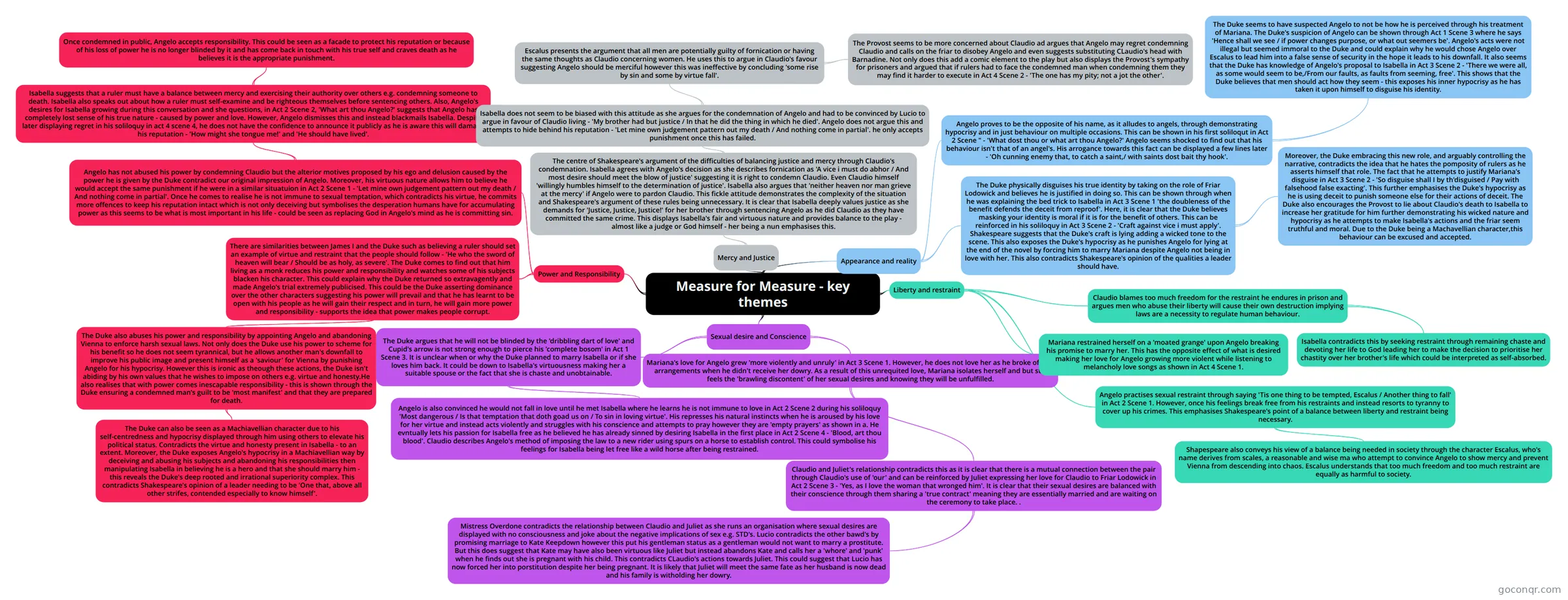
Mind map: Measure for Measure key themes
Map content
Measure for Measure - key themes
Liberty and restraint
- Claudio blames too much freedom for the restraint he endures in prison and argues men who abuse their liberty will cause their own destruction implying laws are a necessity to regulate human behaviour.
- Isabella contradicts this by seeking restraint through remaining chaste and devoting her life to God leading her to make the decision to prioritise her chastity over her brother's life which could be interpreted as self-absorbed.
- Mariana restrained herself on a 'moated grange' upon Angelo breaking his promise to marry her. This has the opposite effect of what is desired making her love for Angelo growing more violent while listening to melancholy love songs as shown in Act 4 Scene 1.
- Angelo practises sexual restraint through saying 'Tis one thing to be tempted, Escalus / Another thing to fall' in Act 2 Scene 1. However, once his feelings break free from his restraints and instead resorts to tyranny to cover up his crimes. This emphasises Shakespeare's point of a balance between liberty and restraint being necessary.
- Shapespeare also conveys his view of a balance being needed in society through the character Escalus, who's name derives from scales, a reasonable and wise ma who attempt to convince Angelo to show mercy and prevent Vienna from descending into chaos. Escalus understands that too much freedom and too much restraint are equally as harmful to society.
- Claudio blames too much freedom for the restraint he endures in prison and argues men who abuse their liberty will cause their own destruction implying laws are a necessity to regulate human behaviour.
Mercy and Justice
- The centre of Shakespeare's argument of the difficulties of balancing justice and mercy through Claudio's condemnation. Isabella agrees with Angelo's decision as she describes fornication as 'A vice i must do abhor / And most desire should meet the blow of justice' suggesting it is right to condemn Claudio. Even Claudio himself 'willingly humbles himself to the determination of justice'. Isabella also argues that 'neither heaven nor man grieve at the mercy' if Angelo were to pardon Claudio. This fickle attitude demonstrates the complexity of the situation and Shakespeare's argument of these rules being unnecessary. It is clear that Isabella deeply values justice as she demands for 'Justice, Justice, Justice!' for her brother through sentencing Angelo as he did Claudio as they have committed the same crime. This displays Isabella's fair and virtuous nature and provides balance to the play - almost like a judge or God himself - her being a nun emphasises this.
- Isabella does not seem to be biased with this attitude as she argues for the condemnation of Angelo and had to be convinced by Lucio to argue in favour of Claudio living - 'My brother had but justice / In that he did the thing in which he died'. Angelo does not argue this and attempts to hide behind his reputation - 'Let mine own judgement pattern out my death / And nothing come in partial'. he only accepts punishment once this has failed.
- Escalus presents the argument that all men are potentially guilty of fornication or having the same thoughts as Claudio concerning women. He uses this to argue in Claudio's favour suggesting Angelo should be merciful however this was ineffective by concluding 'some rise by sin and some by virtue fall'.
- The Provost seems to be more concerned about Claudio ad argues that Angelo may regret condemning Claudio and calls on the friar to disobey Angelo and even suggests substituting CLaudio's head with Barnadine. Not only does this add a comic element to the play but also displays the Provost's sympathy for prisoners and argued that if rulers had to face the condemned man when condemning them they may find it harder to execute in Act 4 Scene 2 - 'The one has my pity; not a jot the other'.
- Escalus presents the argument that all men are potentially guilty of fornication or having the same thoughts as Claudio concerning women. He uses this to argue in Claudio's favour suggesting Angelo should be merciful however this was ineffective by concluding 'some rise by sin and some by virtue fall'.
- Isabella does not seem to be biased with this attitude as she argues for the condemnation of Angelo and had to be convinced by Lucio to argue in favour of Claudio living - 'My brother had but justice / In that he did the thing in which he died'. Angelo does not argue this and attempts to hide behind his reputation - 'Let mine own judgement pattern out my death / And nothing come in partial'. he only accepts punishment once this has failed.
- The centre of Shakespeare's argument of the difficulties of balancing justice and mercy through Claudio's condemnation. Isabella agrees with Angelo's decision as she describes fornication as 'A vice i must do abhor / And most desire should meet the blow of justice' suggesting it is right to condemn Claudio. Even Claudio himself 'willingly humbles himself to the determination of justice'. Isabella also argues that 'neither heaven nor man grieve at the mercy' if Angelo were to pardon Claudio. This fickle attitude demonstrates the complexity of the situation and Shakespeare's argument of these rules being unnecessary. It is clear that Isabella deeply values justice as she demands for 'Justice, Justice, Justice!' for her brother through sentencing Angelo as he did Claudio as they have committed the same crime. This displays Isabella's fair and virtuous nature and provides balance to the play - almost like a judge or God himself - her being a nun emphasises this.
Power and Responsibility
- There are similarities between James I and the Duke such as believing a ruler should set an example of virtue and restraint that the people should follow - 'He who the sword of heaven will bear / Should be as holy, as severe'. The Duke comes to find out that him living as a monk reduces his power and responsibility and watches some of his subjects blacken his character. This could explain why the Duke returned so extravagently and made Angelo's trial extremely publicised. This could be the Duke asserting dominance over the other characters suggesting his power will prevail and that he has learnt to be open with his people as he will gain their respect and in turn, he will gain more power and responsibility - supports the idea that power makes people corrupt.
- The Duke also abuses his power and responsibility by appointing Angelo and abandoning Vienna to enforce harsh sexual laws. Not only does the Duke use his power to scheme for his benefit so he does not seem tyrannical, but he allows another man's downfall to improve his public image and present himself as a 'saviour' for Vienna by punishing Angelo for his hypocrisy. However this is ironic as theough these actions, the Duke isn't abiding by his own values that he wishes to impose on others e.g. virtue and honesty.He also realises that with power comes inescapable responsibility - this is shown through the Duke ensuring a condemned man's guilt to be 'most manifest' and that they are prepared for death.
- The Duke can also be seen as a Machiavellian character due to his self-centredness and hypocrisy displayed through him using others to elevate his political status. Contradicts the virtue and honesty present in Isabella - to an extent. Moreover, the Duke exposes Angelo's hypocrisy in a Machiavellian way by deceiving and abusing his subjects and abandoning his responsibilities then manipulating Isabella in believing he is a hero and that she should marry him - this reveals the Duke's deep rooted and irrational superiority complex. This contradicts Shakespeare's opinion of a leader needing to be 'One that, above all other strifes, contended especially to know himself'.
- The Duke also abuses his power and responsibility by appointing Angelo and abandoning Vienna to enforce harsh sexual laws. Not only does the Duke use his power to scheme for his benefit so he does not seem tyrannical, but he allows another man's downfall to improve his public image and present himself as a 'saviour' for Vienna by punishing Angelo for his hypocrisy. However this is ironic as theough these actions, the Duke isn't abiding by his own values that he wishes to impose on others e.g. virtue and honesty.He also realises that with power comes inescapable responsibility - this is shown through the Duke ensuring a condemned man's guilt to be 'most manifest' and that they are prepared for death.
- Angelo has not abused his power by condemning Claudio but the alterior motives proposed by his ego and delusion caused by the power he is given by the Duke contradict our original impression of Angelo. Moreover, his virtuous nature allows him to believe he would accept the same punishment if he were in a similar situatuion in Act 2 Scene 1 - 'Let mine own judgement pattern out my death / And nothing come in partial'. Once he comes to realise he is not immune to sexual temptation, which contradicts his virtue, he commits more offences to keep his reputation intact which is not only deceiving but symbolises the desperation humans have for accumulating power as this seems to be what is most important in his life - could be seen as replacing God in Angelo's mind as he is committing sin.
- Isabella suggests that a ruler must have a balance between mercy and exercising their authority over others e.g. condemning someone to death. Isabella also speaks out about how a ruler must self-examine and be righteous themselves before sentencing others. Also, Angelo's desires for Isabella growing during this conversation and she questions, in Act 2 Scene 2, 'What art thou Angelo?' suggests that Angelo has completely lost sense of his true nature - caused by power and love. However, Angelo dismisses this and instead blackmails Isabella. Despite later displaying regret in his soliloquy in act 4 scene 4, he does not have the confidence to announce it publicly as he is aware this will damage his reputation - 'How might she tongue me!' and 'He should have lived'.
- Once condemned in public, Angelo accepts responsibility. This could be seen as a facade to protect his reputation or because of his loss of power he is no longer blinded by it and has come back in touch with his true self and craves death as he believes it is the appropriate punishment.
- Isabella suggests that a ruler must have a balance between mercy and exercising their authority over others e.g. condemning someone to death. Isabella also speaks out about how a ruler must self-examine and be righteous themselves before sentencing others. Also, Angelo's desires for Isabella growing during this conversation and she questions, in Act 2 Scene 2, 'What art thou Angelo?' suggests that Angelo has completely lost sense of his true nature - caused by power and love. However, Angelo dismisses this and instead blackmails Isabella. Despite later displaying regret in his soliloquy in act 4 scene 4, he does not have the confidence to announce it publicly as he is aware this will damage his reputation - 'How might she tongue me!' and 'He should have lived'.
- There are similarities between James I and the Duke such as believing a ruler should set an example of virtue and restraint that the people should follow - 'He who the sword of heaven will bear / Should be as holy, as severe'. The Duke comes to find out that him living as a monk reduces his power and responsibility and watches some of his subjects blacken his character. This could explain why the Duke returned so extravagently and made Angelo's trial extremely publicised. This could be the Duke asserting dominance over the other characters suggesting his power will prevail and that he has learnt to be open with his people as he will gain their respect and in turn, he will gain more power and responsibility - supports the idea that power makes people corrupt.
Sexual desire and Conscience
- The Duke argues that he will not be blinded by the 'dribbling dart of love' and Cupid's arrow is not strong enough to pierce his 'complete bosom' in Act 1 Scene 3. It is unclear when or why the Duke planned to marry Isabella or if she loves him back. It could be down to Isabella's virtuousness making her a suitable spouse or the fact that she is chaste and unobtainable.
- Angelo is also convinced he would not fall in love until he met Isabella where he learns he is not immune to love in Act 2 Scene 2 during his soliloquy 'Most dangerous / Is that temptation that doth goad us on / To sin in loving virtue'. His represses his natural instincts when he is aroused by his love for her virtue and instead acts violently and struggles with his conscience and attempts to pray however they are 'empty prayers' as shown in a. He evntually lets his passion for Isabella free as he believed he has already sinned by desiring Isabella in the first place in Act 2 Scene 4 - 'Blood, art thou blood'. Claudio describes Angelo's method of imposing the law to a new rider using spurs on a horse to establish control. This could symbolise his feelings for Isabella being let free like a wild horse after being restrained.
- Mariana's love for Angelo grew 'more violently and unruly' in Act 3 Scene 1. However, he does not love her as he broke off the arrangements when he didn't receive her dowry. As a result of this unrequited love, Mariana isolates herself and but still feels the 'brawling discontent' of her sexual desires and knowing they will be unfulfilled.
- Claudio and Juliet's relationship contradicts this as it is clear that there is a mutual connection between the pair through Claudio's use of 'our' and can be reinforced by Juliet expressing her love for Claudio to Friar Lodowick in Act 2 Scene 3 - 'Yes, as I love the woman that wronged him'. It is clear that their sexual desires are balanced with their conscience through them sharing a 'true contract' meaning they are essentially married and are waiting on the ceremony to take place. .
- Mistress Overdone contradicts the relationship between Claudio and Juliet as she runs an organisation where sexual desires are displayed with no consciousness and joke about the negative implications of sex e.g. STD's. Lucio contradicts the other bawd's by promising marriage to Kate Keepdown however this put his gentleman status as a gentleman would not want to marry a prostitute. But this does suggest that Kate may have also been virtuous like Juliet but instead abandons Kate and calls her a 'whore' and 'punk' when he finds out she is pregnant with his child. This contradicts CLaudio's actions towards Juliet. This could suggest that Lucio has now forced her into porstitution despite her being pregnant. It is likely that Juliet will meet the same fate as her husband is now dead and his family is witholding her dowry.
- Claudio and Juliet's relationship contradicts this as it is clear that there is a mutual connection between the pair through Claudio's use of 'our' and can be reinforced by Juliet expressing her love for Claudio to Friar Lodowick in Act 2 Scene 3 - 'Yes, as I love the woman that wronged him'. It is clear that their sexual desires are balanced with their conscience through them sharing a 'true contract' meaning they are essentially married and are waiting on the ceremony to take place. .
- The Duke argues that he will not be blinded by the 'dribbling dart of love' and Cupid's arrow is not strong enough to pierce his 'complete bosom' in Act 1 Scene 3. It is unclear when or why the Duke planned to marry Isabella or if she loves him back. It could be down to Isabella's virtuousness making her a suitable spouse or the fact that she is chaste and unobtainable.
Appearance and reality
- The Duke physically disguises his true identity by taking on the role of Friar Lodowick and believes he is justified in doing so. This can be shown through when he was explaining the bed trick to Isabella in Act 3 Scene 1 'the doubleness of the benefit defends the deceit from reproof'. Here, it is clear that the Duke believes masking your identity is moral if it is for the benefit of others. This can be reinforced in his soliloquy in Act 3 Scene 2 - 'Craft against vice i must apply'. Shakespeare suggests that the Duke's craft is lying adding a wicked tone to the scene. This also exposes the Duke's hypocrisy as he punishes Angelo for lying at the end of the novel by forcing him to marry Mariana despite Angelo not being in love with her. This also contradicts Shakespeare's opinion of the qualities a leader should have.
- Moreover, the Duke embracing this new role, and arguably controlling the narrative, contradicts the idea that he hates the pomposity of rulers as he asserts himself that role. The fact that he attempts to justify Mariana's disguise in Act 3 Scene 2 - 'So disguise shall I by th'disguised / Pay with falsehood false exacting'. This further emphasises the Duke's hypocrisy as he is using deceit to punish someone else for their actions of deceit. The Duke also encourages the Provost to lie about Claudio's death to Isabella to increase her gratitude for him further demonstrating his wicked nature and hypocrisy as he attempts to make Isabella's actions and the friar seem truthful and moral. Due to the Duke being a Machavellian character,this behaviour can be excused and accepted.
- Angelo proves to be the opposite of his name, as it alludes to angels, through demonstrating hypocrisy and in just behaviour on multiple occasions. This can be shown in his first soliloqut in Act 2 Scene " - 'What dost thou or what art thou Angelo?' Angelo seems shocked to find out that his behaviour isn't that of an angel's. His arrogance towards this fact can be displayed a few lines later - 'Oh cunning enemy that, to catch a saint,/ with saints dost bait thy hook'.
- The Duke seems to have suspected Angelo to not be how he is perceived through his treatment of Mariana. The Duke's suspicion of Angelo can be shown through Act 1 Scene 3 where he says 'Hence shall we see / if power changes purpose, or what out seemers be'. Angelo's acts were not illegal but seemed immoral to the Duke and could explain why he would chose Angelo over Escalus to lead him into a false sense of security in the hope it leads to his downfall. It also seems that the Duke has knowledge of Angelo's proposal to Isabella in Act 3 Scene 2 - 'There we were all, as some would seem to be,/From our faults, as faults from seeming, free'. This shows that the Duke believes that men should act how they seem - this exposes his inner hypocrisy as he has taken it upon himself to disguise his identity.
- The Duke physically disguises his true identity by taking on the role of Friar Lodowick and believes he is justified in doing so. This can be shown through when he was explaining the bed trick to Isabella in Act 3 Scene 1 'the doubleness of the benefit defends the deceit from reproof'. Here, it is clear that the Duke believes masking your identity is moral if it is for the benefit of others. This can be reinforced in his soliloquy in Act 3 Scene 2 - 'Craft against vice i must apply'. Shakespeare suggests that the Duke's craft is lying adding a wicked tone to the scene. This also exposes the Duke's hypocrisy as he punishes Angelo for lying at the end of the novel by forcing him to marry Mariana despite Angelo not being in love with her. This also contradicts Shakespeare's opinion of the qualities a leader should have.
Information
- Description
- A Levels English Literature Mind Map on Measure for Measure - key themes, created by Kayleigh Smith on 04/03/2024.
- Created by
- Kayleigh Smith
- Views
- 3
- Rating