
Mind map
Haemolytic Anaemia
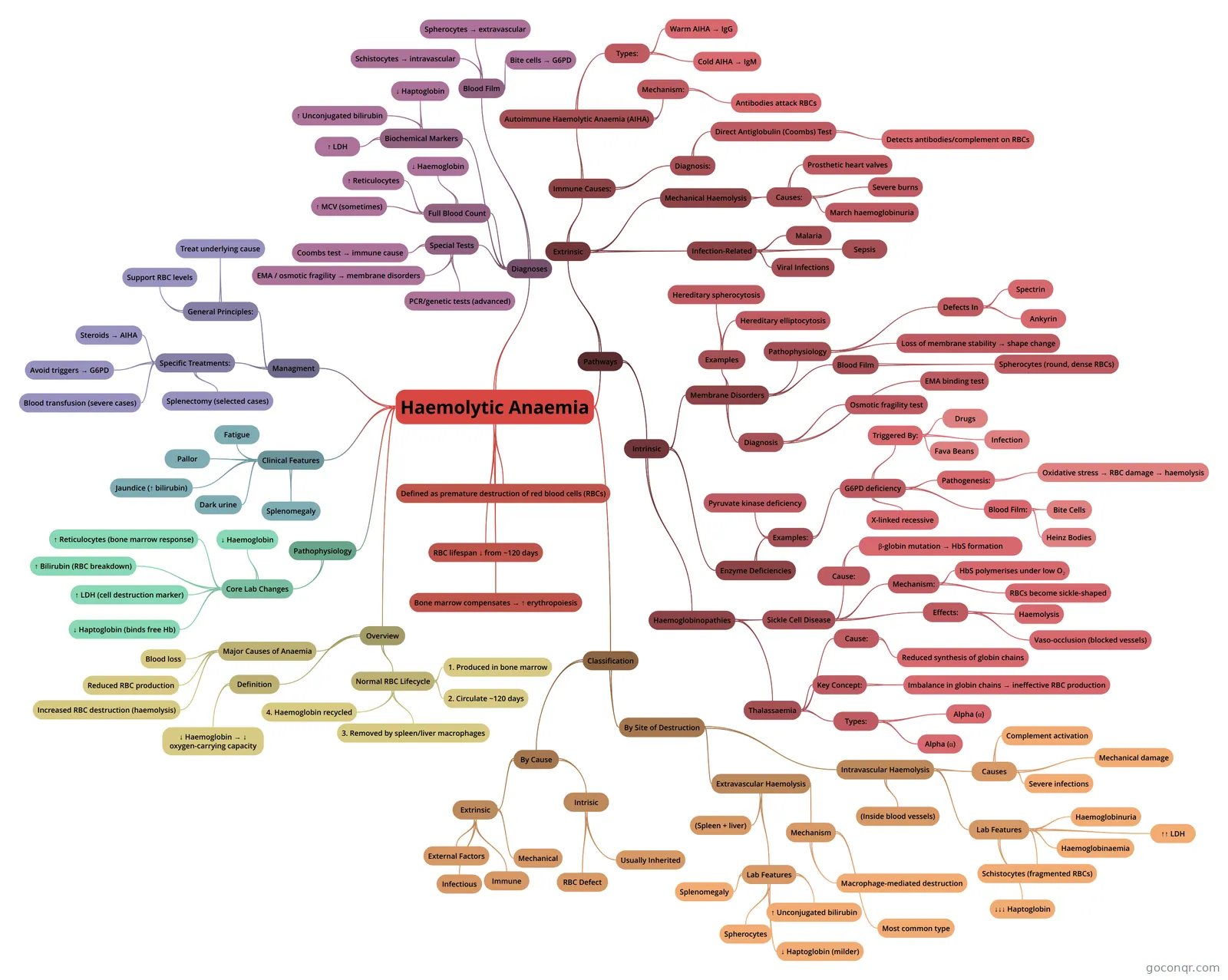
Mind map: haemolytic anaemia
Map content
Haemolytic Anaemia
Overview
- Definition
- ↓ Haemoglobin → ↓ oxygen-carrying capacity
- Major Causes of Anaemia
- Increased RBC destruction (haemolysis)
- Reduced RBC production
- Blood loss
- Normal RBC Lifecycle
- 4. Haemoglobin recycled
- 3. Removed by spleen/liver macrophages
- 2. Circulate ~120 days
- 1. Produced in bone marrow
- Definition
Pathophysiology
- Core Lab Changes
- ↑ Bilirubin (RBC breakdown)
- ↑ Reticulocytes (bone marrow response)
- ↑ LDH (cell destruction marker)
- ↓ Haemoglobin
- ↓ Haptoglobin (binds free Hb)
- Core Lab Changes
Classification
- By Site of Destruction
- Intravascular Haemolysis
- Causes
- Complement activation
- Mechanical damage
- Severe infections
- Lab Features
- Haemoglobinaemia
- Haemoglobinuria
- ↓↓↓ Haptoglobin
- ↑↑ LDH
- Schistocytes (fragmented RBCs)
- (Inside blood vessels)
- Causes
- Extravascular Haemolysis
- (Spleen + liver)
- Mechanism
- Macrophage-mediated destruction
- Most common type
- Lab Features
- ↑ Unconjugated bilirubin
- ↓ Haptoglobin (milder)
- Spherocytes
- Splenomegaly
- Intravascular Haemolysis
- By Cause
- Intrisic
- RBC Defect
- Usually Inherited
- Extrinsic
- External Factors
- Mechanical
- Immune
- Infectious
- Intrisic
- By Site of Destruction
Pathways
- Intrinsic
- Membrane Disorders
- Examples
- Hereditary spherocytosis
- Hereditary elliptocytosis
- Pathophysiology
- Defects In
- Spectrin
- Ankyrin
- Loss of membrane stability → shape change
- Defects In
- Blood Film
- Spherocytes (round, dense RBCs)
- Diagnosis
- EMA binding test
- Osmotic fragility test
- Examples
- Enzyme Deficiencies
- Examples:
- G6PD deficiency
- X-linked recessive
- Triggered By:
- Drugs
- Infection
- Fava Beans
- Pathogenesis:
- Oxidative stress → RBC damage → haemolysis
- Blood Film:
- Heinz Bodies
- Bite Cells
- Pyruvate kinase deficiency
- G6PD deficiency
- Examples:
- Haemoglobinopathies
- Sickle Cell Disease
- Cause:
- β-globin mutation → HbS formation
- Mechanism:
- HbS polymerises under low O₂
- RBCs become sickle-shaped
- Effects:
- Vaso-occlusion (blocked vessels)
- Haemolysis
- Cause:
- Thalassaemia
- Cause:
- Reduced synthesis of globin chains
- Key Concept:
- Imbalance in globin chains → ineffective RBC production
- Types:
- Alpha (α)
- Alpha (α)
- Cause:
- Sickle Cell Disease
- Membrane Disorders
- Extrinsic
- Infection-Related
- Malaria
- Viral Infections
- Sepsis
- Mechanical Haemolysis
- Causes:
- March haemoglobinuria
- Severe burns
- Prosthetic heart valves
- Causes:
- Immune Causes:
- Diagnosis:
- Direct Antiglobulin (Coombs) Test
- Detects antibodies/complement on RBCs
- Direct Antiglobulin (Coombs) Test
- Autoimmune Haemolytic Anaemia (AIHA)
- Mechanism:
- Antibodies attack RBCs
- Types:
- Cold AIHA → IgM
- Warm AIHA → IgG
- Mechanism:
- Diagnosis:
- Infection-Related
- Intrinsic
Diagnoses
- Full Blood Count
- ↑ MCV (sometimes)
- ↑ Reticulocytes
- ↓ Haemoglobin
- Blood Film
- Schistocytes → intravascular
- Spherocytes → extravascular
- Bite cells → G6PD
- Special Tests
- Coombs test → immune cause
- EMA / osmotic fragility → membrane disorders
- PCR/genetic tests (advanced)
- Biochemical Markers
- ↑ LDH
- ↑ Unconjugated bilirubin
- ↓ Haptoglobin
- Full Blood Count
Clinical Features
- Fatigue
- Jaundice (↑ bilirubin)
- Dark urine
- Splenomegaly
- Pallor
Managment
- General Principles:
- Treat underlying cause
- Support RBC levels
- Specific Treatments:
- Blood transfusion (severe cases)
- Avoid triggers → G6PD
- Steroids → AIHA
- Splenectomy (selected cases)
- General Principles:
Defined as premature destruction of red blood cells (RBCs)
RBC lifespan ↓ from ~120 days
Bone marrow compensates → ↑ erythropoiesis
Information
- Description
- Biomedicine (Intermediate Blood Sciences) Mind Map on Haemolytic Anaemia, created by abi williams on 05/05/2026.
- Created by
- abi williams
- Views
- 0
- Rating