
Mind map
US Supreme Court Cases
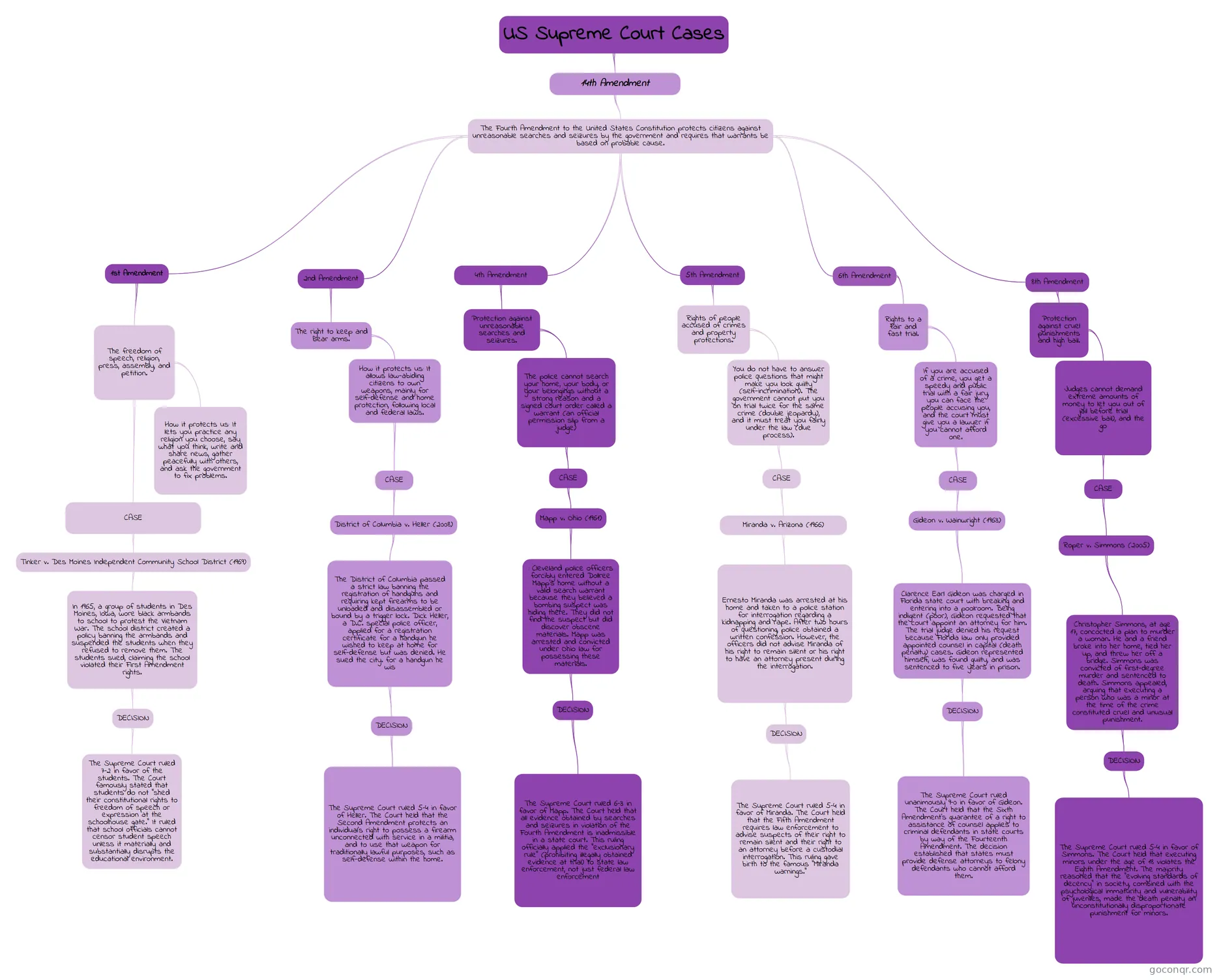
Mind map: US Supreme Court cases
Map content
US Supreme Court Cases
14th Amendment
- The Fourth Amendment to the United States Constitution protects citizens against unreasonable searches and seizures by the government and requires that warrants be based on probable cause.
- 1st Amendment
- The freedom of speech, religion, press, assembly, and petition.
- How it protects us: It lets you practice any religion you choose, say what you think, write and share news, gather peacefully with others, and ask the government to fix problems.
- CASE
- Tinker v. Des Moines Independent Community School District (1969)
- In 1965, a group of students in Des Moines, Iowa, wore black armbands to school to protest the Vietnam War. The school district created a policy banning the armbands and suspended the students when they refused to remove them. The students sued, claiming the school violated their First Amendment rights.
- DECISION
- The Supreme Court ruled 7–2 in favor of the students. The Court famously stated that students do not "shed their constitutional rights to freedom of speech or expression at the schoolhouse gate." It ruled that school officials cannot censor student speech unless it materially and substantially disrupts the educational environment.
- DECISION
- In 1965, a group of students in Des Moines, Iowa, wore black armbands to school to protest the Vietnam War. The school district created a policy banning the armbands and suspended the students when they refused to remove them. The students sued, claiming the school violated their First Amendment rights.
- Tinker v. Des Moines Independent Community School District (1969)
- The freedom of speech, religion, press, assembly, and petition.
- 2nd Amendment
- The right to keep and bear arms.
- How it protects us: It allows law-abiding citizens to own weapons, mainly for self-defense and home protection, following local and federal laws.
- CASE
- District of Columbia v. Heller (2008)
- The District of Columbia passed a strict law banning the registration of handguns and requiring kept firearms to be unloaded and disassembled or bound by a trigger lock. Dick Heller, a D.C. special police officer, applied for a registration certificate for a handgun he wished to keep at home for self-defense but was denied. He sued the city. for a handgun he wis
- DECISION
- The Supreme Court ruled 5–4 in favor of Heller. The Court held that the Second Amendment protects an individual's right to possess a firearm unconnected with service in a militia, and to use that weapon for traditionally lawful purposes, such as self-defense within the home.
- DECISION
- The District of Columbia passed a strict law banning the registration of handguns and requiring kept firearms to be unloaded and disassembled or bound by a trigger lock. Dick Heller, a D.C. special police officer, applied for a registration certificate for a handgun he wished to keep at home for self-defense but was denied. He sued the city. for a handgun he wis
- District of Columbia v. Heller (2008)
- CASE
- How it protects us: It allows law-abiding citizens to own weapons, mainly for self-defense and home protection, following local and federal laws.
- The right to keep and bear arms.
- 4th Amendment
- Protection against unreasonable searches and seizures.
- The police cannot search your home, your body, or your belongings without a strong reason and a signed court order called a warrant (an official permission slip from a judge)
- CASE
- Mapp v. Ohio (1961)
- : Cleveland police officers forcibly entered Dollree Mapp’s home without a valid search warrant because they believed a bombing suspect was hiding there. They did not find the suspect but did discover obscene materials. Mapp was arrested and convicted under Ohio law for possessing these materials.
- DECISION
- The Supreme Court ruled 6–3 in favor of Mapp. The Court held that all evidence obtained by searches and seizures in violation of the Fourth Amendment is inadmissible in a state court. This ruling officially applied the "exclusionary rule" (prohibiting illegally obtained evidence at trial) to state law enforcement, not just federal law enforcement
- DECISION
- : Cleveland police officers forcibly entered Dollree Mapp’s home without a valid search warrant because they believed a bombing suspect was hiding there. They did not find the suspect but did discover obscene materials. Mapp was arrested and convicted under Ohio law for possessing these materials.
- Mapp v. Ohio (1961)
- CASE
- The police cannot search your home, your body, or your belongings without a strong reason and a signed court order called a warrant (an official permission slip from a judge)
- Protection against unreasonable searches and seizures.
- 5th Amendment
- Rights of people accused of crimes and property protections.
- You do not have to answer police questions that might make you look guilty (self-incrimination). The government cannot put you on trial twice for the same crime (double jeopardy), and it must treat you fairly under the law (due process).
- CASE
- Miranda v. Arizona (1966)
- Ernesto Miranda was arrested at his home and taken to a police station for interrogation regarding a kidnapping and rape. After two hours of questioning, police obtained a written confession. However, the officers did not advise Miranda of his right to remain silent or his right to have an attorney present during the interrogation.
- DECISION
- The Supreme Court ruled 5–4 in favor of Miranda. The Court held that the Fifth Amendment requires law enforcement to advise suspects of their right to remain silent and their right to an attorney before a custodial interrogation. This ruling gave birth to the famous "Miranda warnings."
- DECISION
- Ernesto Miranda was arrested at his home and taken to a police station for interrogation regarding a kidnapping and rape. After two hours of questioning, police obtained a written confession. However, the officers did not advise Miranda of his right to remain silent or his right to have an attorney present during the interrogation.
- Miranda v. Arizona (1966)
- CASE
- You do not have to answer police questions that might make you look guilty (self-incrimination). The government cannot put you on trial twice for the same crime (double jeopardy), and it must treat you fairly under the law (due process).
- Rights of people accused of crimes and property protections.
- 6th Amendment
- Rights to a fair and fast trial.
- If you are accused of a crime, you get a speedy and public trial with a fair jury, you can face the people accusing you, and the court must give you a lawyer if you cannot afford one.
- CASE
- Gideon v. Wainwright (1963)
- Clarence Earl Gideon was charged in Florida state court with breaking and entering into a poolroom. Being indigent (poor), Gideon requested that the court appoint an attorney for him. The trial judge denied his request because Florida law only provided appointed counsel in capital (death penalty) cases. Gideon represented himself, was found guilty, and was sentenced to five years in prison.
- DECISION
- The Supreme Court ruled unanimously 9–0 in favor of Gideon. The Court held that the Sixth Amendment's guarantee of a right to assistance of counsel applies to criminal defendants in state courts by way of the Fourteenth Amendment. The decision established that states must provide defense attorneys to felony defendants who cannot afford them.
- DECISION
- Clarence Earl Gideon was charged in Florida state court with breaking and entering into a poolroom. Being indigent (poor), Gideon requested that the court appoint an attorney for him. The trial judge denied his request because Florida law only provided appointed counsel in capital (death penalty) cases. Gideon represented himself, was found guilty, and was sentenced to five years in prison.
- Gideon v. Wainwright (1963)
- CASE
- If you are accused of a crime, you get a speedy and public trial with a fair jury, you can face the people accusing you, and the court must give you a lawyer if you cannot afford one.
- Rights to a fair and fast trial.
- 8th Amendment
- Protection against cruel punishments and high bail.
- Judges cannot demand extreme amounts of money to let you out of jail before trial (excessive bail), and the go
- CASE
- Roper v. Simmons (2005)
- Christopher Simmons, at age 17, concocted a plan to murder a woman. He and a friend broke into her home, tied her up, and threw her off a bridge. Simmons was convicted of first-degree murder and sentenced to death. Simmons appealed, arguing that executing a person who was a minor at the time of the crime constituted cruel and unusual punishment.
- DECISION
- The Supreme Court ruled 5–4 in favor of Simmons. The Court held that executing minors under the age of 18 violates the Eighth Amendment. The majority reasoned that the "evolving standards of decency" in society, combined with the psychological immaturity and vulnerability of juveniles, made the death penalty an unconstitutionally disproportionate punishment for minors.
- DECISION
- Christopher Simmons, at age 17, concocted a plan to murder a woman. He and a friend broke into her home, tied her up, and threw her off a bridge. Simmons was convicted of first-degree murder and sentenced to death. Simmons appealed, arguing that executing a person who was a minor at the time of the crime constituted cruel and unusual punishment.
- Roper v. Simmons (2005)
- CASE
- Judges cannot demand extreme amounts of money to let you out of jail before trial (excessive bail), and the go
- Protection against cruel punishments and high bail.
- 1st Amendment
- The Fourth Amendment to the United States Constitution protects citizens against unreasonable searches and seizures by the government and requires that warrants be based on probable cause.
Information
- Description
- criminal law Mind Map on US Supreme Court Cases, created by Catalina Gaviria on 06/09/2026.
- Created by
- Catalina Gaviria
- Views
- 1
- Rating