
Mind map
Sepsis
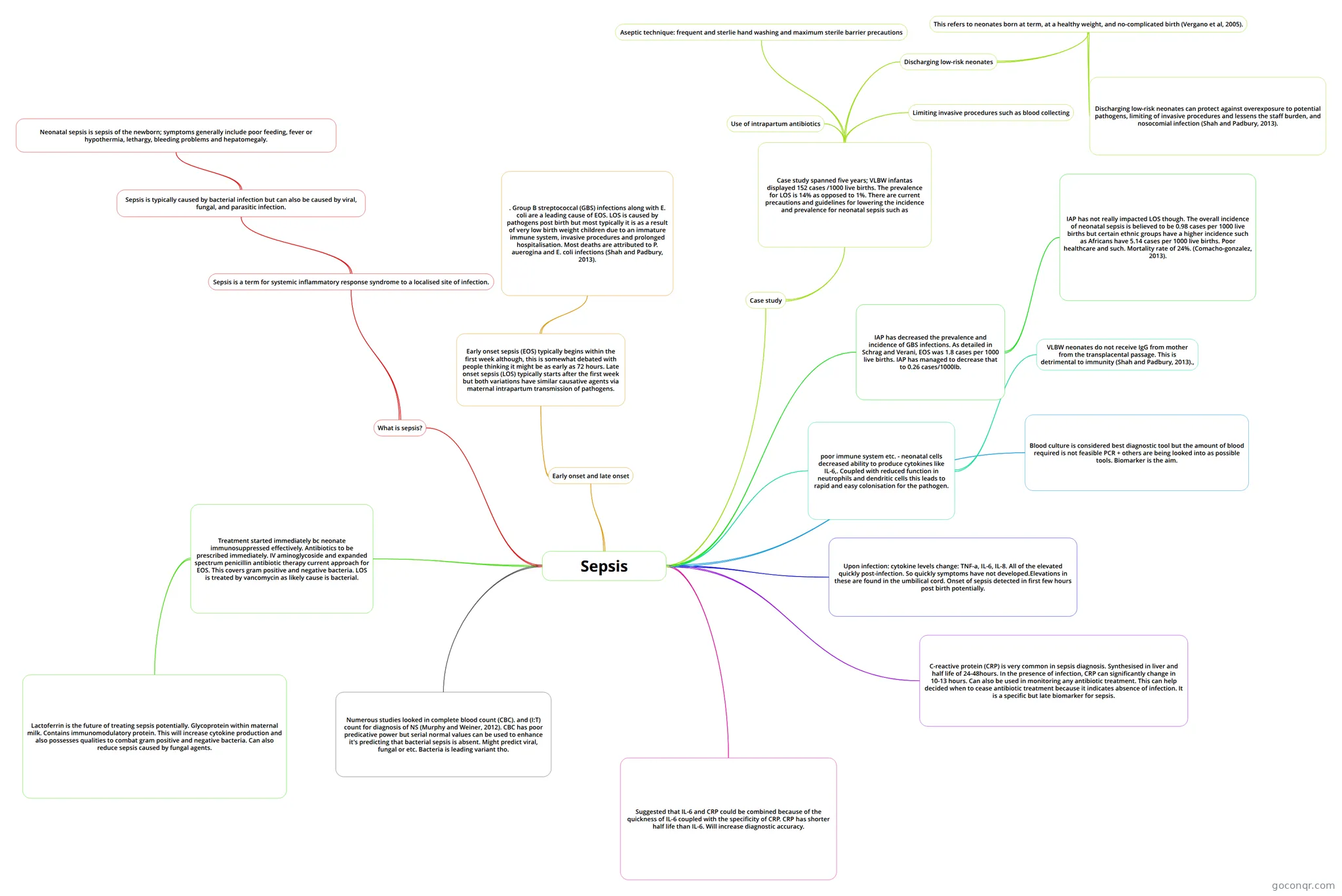
Mind map: neonatal sepsis
Map content
Sepsis
What is sepsis?
- Sepsis is a term for systemic inflammatory response syndrome to a localised site of infection.
- Sepsis is typically caused by bacterial infection but can also be caused by viral, fungal, and parasitic infection.
- Neonatal sepsis is sepsis of the newborn; symptoms generally include poor feeding, fever or hypothermia, lethargy, bleeding problems and hepatomegaly.
- Sepsis is typically caused by bacterial infection but can also be caused by viral, fungal, and parasitic infection.
- Sepsis is a term for systemic inflammatory response syndrome to a localised site of infection.
Early onset and late onset
- Early onset sepsis (EOS) typically begins within the first week although, this is somewhat debated with people thinking it might be as early as 72 hours. Late onset sepsis (LOS) typically starts after the first week but both variations have similar causative agents via maternal intrapartum transmission of pathogens.
- . Group B streptococcal (GBS) infections along with E. coli are a leading cause of EOS. LOS is caused by pathogens post birth but most typically it is as a result of very low birth weight children due to an immature immune system, invasive procedures and prolonged hospitalisation. Most deaths are attributed to P. auerogina and E. coli infections (Shah and Padbury, 2013).
- Early onset sepsis (EOS) typically begins within the first week although, this is somewhat debated with people thinking it might be as early as 72 hours. Late onset sepsis (LOS) typically starts after the first week but both variations have similar causative agents via maternal intrapartum transmission of pathogens.
Case study
- Case study spanned five years; VLBW infantas displayed 152 cases /1000 live births. The prevalence for LOS is 14% as opposed to 1%. There are current precautions and guidelines for lowering the incidence and prevalence for neonatal sepsis such as
- Aseptic technique: frequent and sterlie hand washing and maximum sterile barrier precautions
- Limiting invasive procedures such as blood collecting
- Use of intrapartum antibiotics
- Discharging low-risk neonates
- This refers to neonates born at term, at a healthy weight, and no-complicated birth (Vergano et al, 2005).
- Discharging low-risk neonates can protect against overexposure to potential pathogens, limiting of invasive procedures and lessens the staff burden, and nosocomial infection (Shah and Padbury, 2013).
- This refers to neonates born at term, at a healthy weight, and no-complicated birth (Vergano et al, 2005).
- Case study spanned five years; VLBW infantas displayed 152 cases /1000 live births. The prevalence for LOS is 14% as opposed to 1%. There are current precautions and guidelines for lowering the incidence and prevalence for neonatal sepsis such as
IAP has decreased the prevalence and incidence of GBS infections. As detailed in Schrag and Verani, EOS was 1.8 cases per 1000 live births. IAP has managed to decrease that to 0.26 cases/1000lb.
- IAP has not really impacted LOS though. The overall incidence of neonatal sepsis is believed to be 0.98 cases per 1000 live births but certain ethnic groups have a higher incidence such as Africans have 5.14 cases per 1000 live births. Poor healthcare and such. Mortality rate of 24%. (Comacho-gonzalez, 2013).
poor immune system etc. - neonatal cells decreased ability to produce cytokines like IL-6,. Coupled with reduced function in neutrophils and dendritic cells this leads to rapid and easy colonisation for the pathogen.
- VLBW neonates do not receive IgG from mother from the transplacental passage. This is detrimental to immunity (Shah and Padbury, 2013).,
Blood culture is considered best diagnostic tool but the amount of blood required is not feasible PCR + others are being looked into as possible tools. Biomarker is the aim.
Upon infection: cytokine levels change: TNF-a, IL-6, IL-8. All of the elevated quickly post-infection. So quickly symptoms have not developed.Elevations in these are found in the umbilical cord. Onset of sepsis detected in first few hours post birth potentially.
C-reactive protein (CRP) is very common in sepsis diagnosis. Synthesised in liver and half life of 24-48hours. In the presence of infection, CRP can significantly change in 10-13 hours. Can also be used in monitoring any antibiotic treatment. This can help decided when to cease antibiotic treatment because it indicates absence of infection. It is a specific but late biomarker for sepsis.
Suggested that IL-6 and CRP could be combined because of the quickness of IL-6 coupled with the specificity of CRP. CRP has shorter half life than IL-6. Will increase diagnostic accuracy.
Numerous studies looked in complete blood count (CBC). and (I:T) count for diagnosis of NS (Murphy and Weiner, 2012). CBC has poor predicative power but serial normal values can be used to enhance it's predicting that bacterial sepsis is absent. Might predict viral, fungal or etc. Bacteria is leading variant tho.
Treatment started immediately bc neonate immunosuppressed effectively. Antibiotics to be prescribed immediately. IV aminoglycoside and expanded spectrum penicillin antibiotic therapy current approach for EOS. This covers gram positive and negative bacteria. LOS is treated by vancomycin as likely cause is bacterial.
- Lactoferrin is the future of treating sepsis potentially. Glycoprotein within maternal milk. Contains immunomodulatory protein. This will increase cytokine production and also possesses qualities to combat gram positive and negative bacteria. Can also reduce sepsis caused by fungal agents.