
Mind map
Physics 1
Map content
Physics 1
Heat Energy Transfers
- Heat is transfered in 3 different ways.
- These are Radiation, Conduction and Convection.
- Radiation is the transfer of heat by infrared radiation.
- Conduction is the main form of heat transfer in solids.
- Conduction is the process where vibrating particles pass on their extra kinetic energy to neighbouring particles.
- Conduction is faster in denser solids as the particles are closer together.
- Metals are good conductors due to their free electrons.
- At the hot end, the electrons have more energy and so collide with other free electrons, passing on their energy.
- This is a much faster way of transfering energy than colliding atoms to pass energy.
- At the hot end, the electrons have more energy and so collide with other free electrons, passing on their energy.
- Metals are good conductors due to their free electrons.
- Conduction is faster in denser solids as the particles are closer together.
- Conduction is the process where vibrating particles pass on their extra kinetic energy to neighbouring particles.
- Convection is the main form of heat transfer in liquids and gasses.
- These both transfer energy by particles.
- Convection occurs when the more energetic particles move from the hotter region to the cooler region, taking their heat energy with them.
- This can be seen in immersion heaters and radiators.
- Convection currents are all about changes in density.
- Hot water is less dense than cold water meaning that it rises to the top.
- When this hot water is surrounded by the cold water, the energy gets transfered.
- Meaning that the water ends up getting warmer.
- Condensation is when gas turns to liquid.
- When a gas cools, the particles slow down and lose kinetic energy.
- If the temperature gets cold enough, the gas particles get close enough together that condensation takes place and the gas becomes a liquid.
- Water vapour in the air condenses when it comes into contact with cold surfaces.
- The steam you see rising from a boiling kettle is actually invisible water vapour condensing into tiny water droplets as it spreads into the air.
- Evaporation is when liquid turns to gas.
- Evaporation is when particles escape from a liquid.
- Particles can evaporate from a liquid at a much lower temperature than boiling point.
- The particles at the surface can escape and become a gas particle if the particle is travelling in the right direction to escape and the particles are travelling fast enough to overcome the attractive forces of the other liquid particles.
- This is what happens when you sweat.
- The rate of evaporation will be higher if the temperature is higher, the liquid is less dense, the surface area is larger or the airflow over the liquid is greater as the air will have more "room" for the new partilces.
- The rate of condensation will be higher if the temperature of the gas is lower, the temperature of the surface it touches is colder, the density is higher or the airflow is less.
- The rate of heat transfer depends on many things...
- Heat energy is radiated from the surface of the object so the bigger the surface area, the more infrared radiation is released.
- This is why car engines have fins to increase the surface area so that heat is radiated quicker and the engine cools down quicker.
- Heat sinks are devices designed to transfer heat away from objects they are in contact with. These also have fins so that it will cool down quicker.
- The bigger the surface area, the quicker it cools down.
- The type of material can have an impact on the rate too.
- Conductors transfer heat more quickly than insulators. It also makes a difference if the object it comes into contact with is an insulator or a conductor.
- Some devices are designed to limit heat transfer such as vacuum flasks.
- The glass bottle is double walled with a vacuum between the two walls which stops all conduction and convection on all sides. The walls are silvered to keep radiation loss to a minimum.
- The inside bottle is supported by foam to minimise conduction to the outer glass. The stopper is made of plastic filled with cork to reduce any heat conduction through it.
- The glass bottle is double walled with a vacuum between the two walls which stops all conduction and convection on all sides. The walls are silvered to keep radiation loss to a minimum.
- Some devices are designed to limit heat transfer such as vacuum flasks.
- Conductors transfer heat more quickly than insulators. It also makes a difference if the object it comes into contact with is an insulator or a conductor.
- The type of material can have an impact on the rate too.
- The bigger the surface area, the quicker it cools down.
- Heat sinks are devices designed to transfer heat away from objects they are in contact with. These also have fins so that it will cool down quicker.
- This is why car engines have fins to increase the surface area so that heat is radiated quicker and the engine cools down quicker.
- Heat energy is radiated from the surface of the object so the bigger the surface area, the more infrared radiation is released.
- This is what happens when you sweat.
- The particles at the surface can escape and become a gas particle if the particle is travelling in the right direction to escape and the particles are travelling fast enough to overcome the attractive forces of the other liquid particles.
- Particles can evaporate from a liquid at a much lower temperature than boiling point.
- Evaporation is when particles escape from a liquid.
- Evaporation is when liquid turns to gas.
- The steam you see rising from a boiling kettle is actually invisible water vapour condensing into tiny water droplets as it spreads into the air.
- Water vapour in the air condenses when it comes into contact with cold surfaces.
- If the temperature gets cold enough, the gas particles get close enough together that condensation takes place and the gas becomes a liquid.
- When a gas cools, the particles slow down and lose kinetic energy.
- Condensation is when gas turns to liquid.
- Meaning that the water ends up getting warmer.
- When this hot water is surrounded by the cold water, the energy gets transfered.
- Hot water is less dense than cold water meaning that it rises to the top.
- Convection currents are all about changes in density.
- This can be seen in immersion heaters and radiators.
- Infrared radiation is emitted by solids, liquids and gasses.
- Any object can both emit and absorb infrared radiation whether or not conduction or convection are taking place.
- Infrared radiation is the emission of electromagnetic waves.
- Everything is emitting and absorbing infrared radiation from its surface.
- An object that is hotter than its surroundings will emit more infrared radiation than it absorbs, causing it to cool down.
- An object that is colder than its surroundings will absorb more infrared radiation, causing it to cool down.
- The hotter the object is, the more infrared radiation it emits at a given time.
- The rate of radiation depends on the colour and texture of the surface.
- Dark, Matt surfaces absorb radiation well.
- They also emit more radiation at any given time.
- Light, shiny surfaces reflect radiation well.
- Solar panels are made of water pipes under a black surface.
- Radiation from the sun is absorbed by the black surfaces and heats the water in the pipes.
- This water can also be used for other house hold purposes afterwards.
- Radiation from the sun is absorbed by the black surfaces and heats the water in the pipes.
- Dark, Matt surfaces absorb radiation well.
- The rate of radiation depends on the colour and texture of the surface.
- The hotter the object is, the more infrared radiation it emits at a given time.
- An object that is colder than its surroundings will absorb more infrared radiation, causing it to cool down.
- An object that is hotter than its surroundings will emit more infrared radiation than it absorbs, causing it to cool down.
- Everything is emitting and absorbing infrared radiation from its surface.
- The bigger the difference between the temperature of the body and its surroundings, the faster the energy is transfered by heating.
- These are Radiation, Conduction and Convection.
- Kinetic Theory explains the three states of matter.
- Solid, strong forces of attraction, particles close together, fixed into a regular arangement, particles have little energy so can only vibrate in certain positions.
- Liquids, weaker forces of attraction, particles are close together and but can move past eachother, irregular arrangements, more energy than solids, the particles move in random directions at low speeds.
- Gasses, there are no forces of attraction, the particles have more energy and are free to move, the particles travel at high speed in all directions.
- Heat is transfered in 3 different ways.
Energy and Efficiency
- Effectiveness is not the same as cost-effectiveness.
- Payback time is the initial cost divided by the annual saving.
- For example, loft insulation costs £200 and will make an annual saving of £50 so the payback time is 4 years.
- The most effective methods of information are the ones that give the biggest annual saving.
- Eventually, the money you save on heating bills will equal the initial cost of putting in the insulation, this is called the payback time.
- The most COST-effective methods tend to be the cheapest ones as it means there is a shorter payback time, however they aren't always the most effective.
- Cavity wall insulation is foam that is put between the bricks to stop heat loss through radiation from convection currents through the gaps. The foam has air pockets trapped in it which helps to reduce heat loss through conduction.
- Loft insulation is a thick layer of fibreglass wool laid out across the loft floor and ceiling reducing heat loss from conduction and convection.
- Draught-proofing is foam strips around doors and windows to stop draughts.
- Hot water tanks often have jackets on them made of fibreglass wool to reduce radiation and conduction.
- Thick curtains can help to reduce heat loss from conduction and radiation.
- Heat travels faster through materials with high U-values. So good insulators have low U-values.
- Specific heat capacity tells you how much energy stuff can store.
- Materials which need to gain a lot of energy to heat up also release lots of energy when they cool down meaning that they store a lot of heat.
- The specific heat capacity is the amount of energy needed to raise the temperature of 1Kg of a substance by 1°C
- E= MxCxθ
- Energy transfered (J)
- Mass (kg)
- Specific heat capacity (j/kg°c)
- Temperature change (°C)
- The materials used to make heaters have a high specific heat capacity, meaning that they can store more heat energy.
- Water has a high specific heat capacity meaning that it is good for pumping around central heating systems.
- Electric heaters are designed to store heat at night when the electricity is cheaper and release it during the day.
- Potential and chemical energy are forms of stored energy.
- Energy can be transferred or stored but it can not be created or destroyed.
- Energy is only useful when it can be converted from one form to another.
- Energy can be transferred or stored but it can not be created or destroyed.
- Potential and chemical energy are forms of stored energy.
- Electric heaters are designed to store heat at night when the electricity is cheaper and release it during the day.
- Water has a high specific heat capacity meaning that it is good for pumping around central heating systems.
- E= MxCxθ
- Specific heat capacity tells you how much energy stuff can store.
- Heat travels faster through materials with high U-values. So good insulators have low U-values.
- Thick curtains can help to reduce heat loss from conduction and radiation.
- Hot water tanks often have jackets on them made of fibreglass wool to reduce radiation and conduction.
- Draught-proofing is foam strips around doors and windows to stop draughts.
- Loft insulation is a thick layer of fibreglass wool laid out across the loft floor and ceiling reducing heat loss from conduction and convection.
- Cavity wall insulation is foam that is put between the bricks to stop heat loss through radiation from convection currents through the gaps. The foam has air pockets trapped in it which helps to reduce heat loss through conduction.
- The most COST-effective methods tend to be the cheapest ones as it means there is a shorter payback time, however they aren't always the most effective.
- Eventually, the money you save on heating bills will equal the initial cost of putting in the insulation, this is called the payback time.
- Payback time is the initial cost divided by the annual saving.
- Most energy transfers involve some losses, often as heat.
- Useful devices are only useful when they can transform energy from one form to another.
- In doing so, some of the useful input energy is always lost or wasted as heat. The less energy that is wasted, the more efficient the device is said to be.
- Efficiency is worked out using, Efficiency= Useful energy out divided by total energy in.
- This wasted heat energy can be turned into something useful with the help of a heat exchanger.
- They do this by pumping cool fluid through escaping heat, this fluid heats up as it gains energy. This heat energy can then be used again somewhere else. For example, the heat energy from a cars engine can be used to heat the inside.
- This wasted heat energy can be turned into something useful with the help of a heat exchanger.
- Efficiency is worked out using, Efficiency= Useful energy out divided by total energy in.
- In doing so, some of the useful input energy is always lost or wasted as heat. The less energy that is wasted, the more efficient the device is said to be.
- Useful devices are only useful when they can transform energy from one form to another.
- Effectiveness is not the same as cost-effectiveness.
Using Electrical Energy
- Kilowatt hours are a unit of energy.
- The amount of electrical energy used by an appliance depends on its power (how fast the appliance transfers energy) and the amount of time that the appliance is on for.
- Energy is usually measured in joules. 1J is the amount of energy transfered by a 1W appliance in 1 second.
- Power is usually measured in watts or kilowatts. A 5KW appliance transfers 5000j in 1 second.
- When we are talking about large amounts of electrical energy it is easier to think of the power in Kilowatts and Hours.
- Number of units used (KWh) = Power (KW) x Time (hours)
- Cost = Number of Units x Price per Unit
- Number of units used (KWh) = Power (KW) x Time (hours)
- When we are talking about large amounts of electrical energy it is easier to think of the power in Kilowatts and Hours.
- Power is usually measured in watts or kilowatts. A 5KW appliance transfers 5000j in 1 second.
- Energy is usually measured in joules. 1J is the amount of energy transfered by a 1W appliance in 1 second.
- The amount of electrical energy used by an appliance depends on its power (how fast the appliance transfers energy) and the amount of time that the appliance is on for.
- Kilowatt hours are a unit of energy.
Generating Electricity
- Energy sources can be burned to drive turbines in power stations. Most of our power comes from non renewable sources in big power stations.
- The processes in a power station include a boiler, where the fossil fuels are burnt to turn their stored chemical energy into heat energy.
- This heat energy heats the water to produce steam, this steam turns a turbine converting it to kinetic energy.
- This turbine is connected to a generator which produces electrical energy.
- Nuclear reactions basically work the same except, the heat is generated by nuclear fission. Nuclear power stations take a long time to start up.
- Wind power generates electricity using lots of little turbines, turned by the wind.
- Wind turbines spoil the view as it takes around 1500 wind turbines to replace one coal power station.
- They can also be noisy for people living nearby.
- Another draw back is that if the wind stops, the generators stop.
- The initial costs are quite high but there are little running costs.
- Wind turbines cause no permanent damage to the environment as they can be removed without scarring the landscape.
- Solar cells are expensive but cause no environmental damage.
- Solar cells generate electricity directly from sunlight, these can often be used for watches and calculators as they do not take too much energy.
- It can be used in remote places to power road signs and satallites.
- The initial costs are high but the running costs are almost nil. They generate electricity on a relatively small scale meaning that they are not really practical for use on the national grid.
- Hydroelectric power uses falling water, usually from the flooding of a valley, by building a dam.
- Rain water is caught and flows downhill through turbines this means that there is no pollution produced.
- This can have a large impact on the environment as the valley has to be flooded which can cause habitat loss and rotting vegetation which releases methane and CO2. Reservoirs can be unsightly when they dry up which is why they are put in remote villages to minimise the impact on humans.
- Initial costs are high but running costs are low and it doesn't rely on fuels.
- This can be useful for generating energy on a small scale in remote areas.
- Normal power stations keep their boilers on overnight meaning that there is a surplus of energy at night, the best way to store it is to pump water up to a higher reservior.
- This water can then be released to generate extra energy in peak times like tea time when more energy is needed.
- Pumped energy is a form of energy storage, not generation.
- Wave power is lots of little turbines powered by waves, these are located around the coast.
- When waves come in, they make an up and down motion which can be used to power a generator.
- There is no pollution but it might ruin the view, it is fairly unreliable as when the wind drops, the waves stop.
- Initial costs are high but running costs are low as it doesn't require any fuels.
- Wave power is never going to be used on a large scale but it can be used on small, remote islands.
- Tidal barrages are big dams built across river estuaries with turbines in them.
- As the tide comes in, it fills up the estuary to a height of several metres, this drives the turbines when it is allowed through at a controlled speed.
- The source of the energy is the gravity of the sun and the moon.
- There is no pollution but it does prevent access for boats, it spoils the view and alters the habitat for animals.
- Tides are pretty reliable and can be predicted. the only draw back is that the height is variable so lower tides will produce less energy than bigger tides.
- Tidal barrages are excellent at storing energy.
- The initial costs are high, but running costs are minimal and no fuel is needed.
- Geothermal energy (heat from underground) can be used as an energy source.
- This is only possible in volcanic areas where hot rocks lie near the surface. The heat source is the slow decay of radioactive material including uranium deep inside the earth.
- Steam and hot water rise to the surface and are used to turn a generator. This creates free energy with very little environmental damage.
- In some places, geothermal energy is used to heat homes directly, without being converted into electrical energy.
- The main drawbacks are that geothermal energy can only be used in a few places and the costs of building the power plants is often high compared to the amount of energy that is gained.
- Biofuels are made from plants and waste, they are renewable sources of energy.
- They are used to make electricity in the same way that fossil fuels; they are burnt to heat up water.
- They can be used in some cars but these cars require adaptations to be made and this technology will require lots of time consuming work before it is able to be widely used.
- Biofuels can be solids, liquids or gasses.
- We can obtain biofuels from organisms that are still alive or from dead organic matter.
- Ethanol is an example of a biofuel and can be made by the fermentation of sugar.
- Non-renewable energies are blamed for certain environmental problems for example, burning coal and oil releases sulfur dioxide which causes acid rain. Acid rain can damage trees and soils.
- Coal mining makes a mess of the landscape, especially open-cast mining.
- Oil spillages can kill wildlife and spread for miles.
- Nuclear power is clean but the nuclear waste is very dangerous and difficult to dispose of. Nuclear fuel is pretty cheap but the overall cost of nuclear power is high due to the cost of the power plant and final decomissioning.
- Biofuels have their disadvantages too, although they are relatively quick and natural source of energy and are supposedly carbon neutral but there is still some debate to do with how biofuels impact on the environment once the full energy consumption is considered.
- In some places, forests have been cleared to make room to grow biofuels resulting in lots of species losing their habitats and the decay of this waste vegetation releases CO2 and methane.
- Biofuel has potential as a fuel source but it is limited by the amount of available farm land.
- Carbon capture and storage is used to reduce the amount of CO2 in the atmosphere. This can reduce the impact of the greenhouse effect.
- It works by collecting the CO2 from the power stations before it is released.
- The captured CO2 is pumped into empty gas and oil fields such as under the North Sea, where it can be stored safely.
- This is a new technology which is developing rapidly, other methods which are being investigated are storing dissolved CO2 in seawater at the bottom of the sea as well as capturing CO2 using algae which can be used to make biofuels.
- Coal and oil are running out so more gas fired power stations are being set up as they are quick to set up, there is quite a lot of gas left and it doesn't pollute as badly.
- When looking for a new type of power station to set up, you have to look at certain factors.
- SET UP COSTS- Renewable sources often need bigger power stations for the same output, the bigger the power station, the more expensive it is. Nuclear power and hydroelectric dams take huge amounts of engineering so therefore it is more expensive.
- SET UP AND DECOMISSIONING TIME- Affected by the size of the power station and the complexity of the engineering. This can also include arguments about where to build. Gas is one of the quickest to set up and nuclear is the slowest to decommission.
- RELIABILITY ISSUES- All the non-renewables are reliable until they run out. Things like wind power rely on weather and may not be producing the whole time.
- RUNNING AND FUEL COSTS- Renewables usually have the lowest running costs as no fuel is actually required.
- Electricity is distributed using the National Grid which takes energy from power stations to homes and businesses.
- This allows power to be generated anywhere in the country and supplied to anywhere.
- The national grid is capable of transmitting huge amounts of power at either a high current or a high voltage.
- The energy cannot be transmitted at a high current as lots of energy is lost through heat so it is cheaper to boost the voltage really high and keep the current low.
- The energy is transmitted at 400,000 V. This requires transformers and large pylons with huge insulators but it is still cheaper.
- The transformers have to step up the voltage as it goes up to the cables for efficient transmission and step it down at the other end to bring it back to a safe level.
- At the step up transformer (as it goes up to the wires) the voltage is increased and the current is decreased.
- At the step down transformer (as it comes down) the voltage is decreased and the current is increased.
- The transformers have to step up the voltage as it goes up to the cables for efficient transmission and step it down at the other end to bring it back to a safe level.
- The energy is transmitted at 400,000 V. This requires transformers and large pylons with huge insulators but it is still cheaper.
- The energy cannot be transmitted at a high current as lots of energy is lost through heat so it is cheaper to boost the voltage really high and keep the current low.
- The national grid is capable of transmitting huge amounts of power at either a high current or a high voltage.
- This allows power to be generated anywhere in the country and supplied to anywhere.
- Electricity is distributed using the National Grid which takes energy from power stations to homes and businesses.
- ENVIRONMENTAL ISSUES- If fuel is involved, there will be pollution released, air pollution, visual pollution, noise pollution. Or other issues such as dangerous nuclear waste, using up resources, disruption of habitats and leisure activities.
- LOCATION ISSUES- Solar energy needs to be exposed to the sun, gas can be almost anywhere, hydroelectric can be done in hilly, rainy areas. Wind needs to be in exposed areas, oil needs to be near the coast, coal needs to be near coal mines, nuclear needs to be away from people but near water, tidal needs big estuaries, geothermal needs volcanic energy.
- When looking for a new type of power station to set up, you have to look at certain factors.
- Coal and oil are running out so more gas fired power stations are being set up as they are quick to set up, there is quite a lot of gas left and it doesn't pollute as badly.
- This is a new technology which is developing rapidly, other methods which are being investigated are storing dissolved CO2 in seawater at the bottom of the sea as well as capturing CO2 using algae which can be used to make biofuels.
- The captured CO2 is pumped into empty gas and oil fields such as under the North Sea, where it can be stored safely.
- It works by collecting the CO2 from the power stations before it is released.
- Carbon capture and storage is used to reduce the amount of CO2 in the atmosphere. This can reduce the impact of the greenhouse effect.
- Biofuel has potential as a fuel source but it is limited by the amount of available farm land.
- In some places, forests have been cleared to make room to grow biofuels resulting in lots of species losing their habitats and the decay of this waste vegetation releases CO2 and methane.
- Biofuels have their disadvantages too, although they are relatively quick and natural source of energy and are supposedly carbon neutral but there is still some debate to do with how biofuels impact on the environment once the full energy consumption is considered.
- Nuclear power is clean but the nuclear waste is very dangerous and difficult to dispose of. Nuclear fuel is pretty cheap but the overall cost of nuclear power is high due to the cost of the power plant and final decomissioning.
- Oil spillages can kill wildlife and spread for miles.
- Coal mining makes a mess of the landscape, especially open-cast mining.
- Non-renewable energies are blamed for certain environmental problems for example, burning coal and oil releases sulfur dioxide which causes acid rain. Acid rain can damage trees and soils.
- Ethanol is an example of a biofuel and can be made by the fermentation of sugar.
- We can obtain biofuels from organisms that are still alive or from dead organic matter.
- Biofuels can be solids, liquids or gasses.
- They can be used in some cars but these cars require adaptations to be made and this technology will require lots of time consuming work before it is able to be widely used.
- They are used to make electricity in the same way that fossil fuels; they are burnt to heat up water.
- Biofuels are made from plants and waste, they are renewable sources of energy.
- The main drawbacks are that geothermal energy can only be used in a few places and the costs of building the power plants is often high compared to the amount of energy that is gained.
- In some places, geothermal energy is used to heat homes directly, without being converted into electrical energy.
- Steam and hot water rise to the surface and are used to turn a generator. This creates free energy with very little environmental damage.
- This is only possible in volcanic areas where hot rocks lie near the surface. The heat source is the slow decay of radioactive material including uranium deep inside the earth.
- Geothermal energy (heat from underground) can be used as an energy source.
- The initial costs are high, but running costs are minimal and no fuel is needed.
- Tidal barrages are excellent at storing energy.
- Tides are pretty reliable and can be predicted. the only draw back is that the height is variable so lower tides will produce less energy than bigger tides.
- There is no pollution but it does prevent access for boats, it spoils the view and alters the habitat for animals.
- The source of the energy is the gravity of the sun and the moon.
- As the tide comes in, it fills up the estuary to a height of several metres, this drives the turbines when it is allowed through at a controlled speed.
- Tidal barrages are big dams built across river estuaries with turbines in them.
- Wave power is never going to be used on a large scale but it can be used on small, remote islands.
- Initial costs are high but running costs are low as it doesn't require any fuels.
- There is no pollution but it might ruin the view, it is fairly unreliable as when the wind drops, the waves stop.
- When waves come in, they make an up and down motion which can be used to power a generator.
- Wave power is lots of little turbines powered by waves, these are located around the coast.
- Normal power stations keep their boilers on overnight meaning that there is a surplus of energy at night, the best way to store it is to pump water up to a higher reservior.
- This can be useful for generating energy on a small scale in remote areas.
- Initial costs are high but running costs are low and it doesn't rely on fuels.
- This can have a large impact on the environment as the valley has to be flooded which can cause habitat loss and rotting vegetation which releases methane and CO2. Reservoirs can be unsightly when they dry up which is why they are put in remote villages to minimise the impact on humans.
- Rain water is caught and flows downhill through turbines this means that there is no pollution produced.
- Hydroelectric power uses falling water, usually from the flooding of a valley, by building a dam.
- The initial costs are high but the running costs are almost nil. They generate electricity on a relatively small scale meaning that they are not really practical for use on the national grid.
- It can be used in remote places to power road signs and satallites.
- Solar cells generate electricity directly from sunlight, these can often be used for watches and calculators as they do not take too much energy.
- Solar cells are expensive but cause no environmental damage.
- Wind turbines cause no permanent damage to the environment as they can be removed without scarring the landscape.
- The initial costs are quite high but there are little running costs.
- Another draw back is that if the wind stops, the generators stop.
- They can also be noisy for people living nearby.
- Wind turbines spoil the view as it takes around 1500 wind turbines to replace one coal power station.
- Wind power generates electricity using lots of little turbines, turned by the wind.
- Nuclear reactions basically work the same except, the heat is generated by nuclear fission. Nuclear power stations take a long time to start up.
- This turbine is connected to a generator which produces electrical energy.
- This heat energy heats the water to produce steam, this steam turns a turbine converting it to kinetic energy.
- The processes in a power station include a boiler, where the fossil fuels are burnt to turn their stored chemical energy into heat energy.
- Energy sources can be burned to drive turbines in power stations. Most of our power comes from non renewable sources in big power stations.
Waves
- Waves have amplitude (the displacement from the "rest" position to the crest), wavelength (the length from one crest to the next) and frequency (the number of complete waves passing a certain point in a second or the number of waves produced per second. Measured in hertz which is one wave per second).
- Transverse waves have sideways movements, most waves are transverse such as light, waves in string and a slinky moving up and down.
- In transverse waves, the vibrations are 90° to the direction of energy transfer.
- Longditudinal waves have vibrations along the same line such as sound waves and shock waves.
- In longditudinal waves the vibrations are parallel to the direction of energy transfer.
- Wave speed = Frequency X Wavelength.
- Waves can be reflected, refracted and diffracted. When waves arrive at an obstacle (Meet a new material) their direction of travel can change.
- Reflection of light is what allows us to see objects, light bounces off of objects ad into our eyes.
- When light travelling in the same direction reflects from an uneven surface such as a piece of paper, the light reflects off at different angles.
- When light travelling in the same direction reflects on an even surface, it is reflected at the same angle so you get a clear reflection.
- The law of reflection is ANGLE OF INCIDENCE = ANGLE OF REFLECTION
- Refraction means that they go through a new material but change direction.
- Refraction means the changing of the speed of the light wave so that it looks like it has changed direction.
- When a wave crosses a boundary between two substances, it changes direction.
- When light shines on a window, some of it is reflected but most of it passes through and is refracted.
- Waves only refract if they meet a new medium at an angle.
- If they are travelling along the normal, it will change speed but will not change direction.
- Diffraction is waves spreading out at the edges when they pass through a gap or pass an obstacle.
- The amount of diffraction depends on the size of the gap relative to the wavelength of the wave. The narrower the gap or the longer the wavelength, the more it will spread out.
- A narrow gap is one that is the same order of magnitude as the wavelength.
- So whether the gap counts as narrow depends on the wave in question.
- Light has a very small wavelength so it can be diffracted but it needs a really small gap.
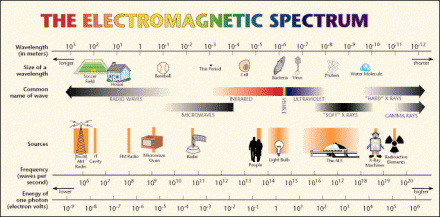
- Electromagnetic waves with different wavelengths have different properties.
- They can be grouped into 7 sections and they form a continuous spectrum.
- Radio waves Micro waves Infra red Visible light Ultra violet X-rays Gamma rays.
- As we move down, the wavelength varies from 10^-15 m to more than 10^4 m.
- All the different types of EM waves travel at the same speed in a vacuum.
- EM waves with higher frequencies have shorter wave lengths.
- Because of their different properties, EM waves can be used for different purposes.
- Radio waves are mainly used for communication. Radio waves are EM radiation with wavelengths longer than 10cm.
- Long-wave radio can be sent half way around the world because waves cane diffract around the curved surface of the earth.
- Long wave radios can diffract around hills and into tunnels and all sorts.
- This diffraction effect makes it possible for radio waves to be received even if the receiver is not in the line of site.
- Short radio waves are used for TV and FM radio transmissions but this means that the receiver must be in the direct line of sight.
- Short wave radio signals can be reflected from the ionosphere meaning that they can be sent long distances.
- Medium wave signals can be reflected from the ionosphere in certain conditions.
- Microwaves are used for satellite communication and mobile phones. You need to use microwaves which can easily pass through the earths watery atmosphere. Radio waves can not do this.
- For satellite TV, the signal is transmitted into space where it is picked up by the satellites receiver dish orbiting thousands of kilometres above the earth.
- The satellite transmits the signal back to the earth in a different direction where it is received by a satellite dish on the ground.
- Mobile phone calls also travel as microwaves between your phone and the nearest transmitter. Some wavelengths of microwaves are absorbed by water molecules and heat them up.
- If the water in question happens to be your cells, you might start to cook so people think that using phones too much is dangerous.
- Microwaves can also be used by remote-sensing satellites to see through the clouds and monitor oils spills, track iceberg movement and see what rainforests are cut down.
- Infrared waves are used in lots of wireless remote controllers.
- Remote controls work by emitting different patterns of infrared waves to send different commands to an appliance.
- Optical fibres can carry data over long distances very quickly. They use both infrared waves and visible light.
- The signal is carried as pulses of light or infrared radiation and is reflected off the sides of a very narrow core from one end of the fibre to the other.
- Visible light is used for photography. Cameras use a lens to focus visible light onto a light-sensitive film or electronic sensor.
- The lens aperture controls how much light enters the camera.
- The shutter speed determines how long the film or sensor is exposed to light for. By varying the shutter speed and aperture, the image can be altered.
- Sound waves are caused by vibrating objects. These mechanical vibrations are passed through the surrounding medium as a series of compressions. They are an example of Longditudinal wave.
- Sound can only be heard if the sound waves reach someones ear drum.
- Sound generally travels faster in solids that liquids and than gasses. Sound cannot travel in space as it is a vacuum and there are no particles.
- Sound waves can be reflected by hard flat surfaces. This is noticeable in an empty room as it sounds completely different when there is carpet, curtains and furniture. That is because the things absorb the sound and stop it echoing around the room. Echoes are just reflected sound waves.
- You hear a delay between the original sound and the echo because the sound waves in the echo have further to travel.
- Sound waves will also refract as they enter a different media. As they enter a more dense material, they speed up.
- High frequency sound waves sound high pitched.
- Low frequency sound waves sound low pitched.
- Frequency is the number of complete vibrations in each second.
- Common units are kHz (1000Hz) and MHz (1000000Hz)
- High frequency (pitch) means shorter wave length.
- Loudness of a sound depends on the amplitude of the sound wave. The bigger the amplitude, the louder the sound.
- High frequency (pitch) means shorter wave length.
- Common units are kHz (1000Hz) and MHz (1000000Hz)
- Frequency is the number of complete vibrations in each second.
- Low frequency sound waves sound low pitched.
- High frequency sound waves sound high pitched.
- Sound waves will also refract as they enter a different media. As they enter a more dense material, they speed up.
- You hear a delay between the original sound and the echo because the sound waves in the echo have further to travel.
- Sound waves can be reflected by hard flat surfaces. This is noticeable in an empty room as it sounds completely different when there is carpet, curtains and furniture. That is because the things absorb the sound and stop it echoing around the room. Echoes are just reflected sound waves.
- Sound generally travels faster in solids that liquids and than gasses. Sound cannot travel in space as it is a vacuum and there are no particles.
- Sound can only be heard if the sound waves reach someones ear drum.
- Sound waves are caused by vibrating objects. These mechanical vibrations are passed through the surrounding medium as a series of compressions. They are an example of Longditudinal wave.
- The shutter speed determines how long the film or sensor is exposed to light for. By varying the shutter speed and aperture, the image can be altered.
- The lens aperture controls how much light enters the camera.
- Visible light is used for photography. Cameras use a lens to focus visible light onto a light-sensitive film or electronic sensor.
- The signal is carried as pulses of light or infrared radiation and is reflected off the sides of a very narrow core from one end of the fibre to the other.
- Optical fibres can carry data over long distances very quickly. They use both infrared waves and visible light.
- Remote controls work by emitting different patterns of infrared waves to send different commands to an appliance.
- Infrared waves are used in lots of wireless remote controllers.
- Microwaves can also be used by remote-sensing satellites to see through the clouds and monitor oils spills, track iceberg movement and see what rainforests are cut down.
- If the water in question happens to be your cells, you might start to cook so people think that using phones too much is dangerous.
- Mobile phone calls also travel as microwaves between your phone and the nearest transmitter. Some wavelengths of microwaves are absorbed by water molecules and heat them up.
- The satellite transmits the signal back to the earth in a different direction where it is received by a satellite dish on the ground.
- For satellite TV, the signal is transmitted into space where it is picked up by the satellites receiver dish orbiting thousands of kilometres above the earth.
- Microwaves are used for satellite communication and mobile phones. You need to use microwaves which can easily pass through the earths watery atmosphere. Radio waves can not do this.
- Medium wave signals can be reflected from the ionosphere in certain conditions.
- Short wave radio signals can be reflected from the ionosphere meaning that they can be sent long distances.
- Short radio waves are used for TV and FM radio transmissions but this means that the receiver must be in the direct line of sight.
- This diffraction effect makes it possible for radio waves to be received even if the receiver is not in the line of site.
- Long wave radios can diffract around hills and into tunnels and all sorts.
- Long-wave radio can be sent half way around the world because waves cane diffract around the curved surface of the earth.
- Radio waves are mainly used for communication. Radio waves are EM radiation with wavelengths longer than 10cm.
- Because of their different properties, EM waves can be used for different purposes.
- EM waves with higher frequencies have shorter wave lengths.
- All the different types of EM waves travel at the same speed in a vacuum.
- As we move down, the wavelength varies from 10^-15 m to more than 10^4 m.
- | | | | | \/
- Radio waves Micro waves Infra red Visible light Ultra violet X-rays Gamma rays.
- They can be grouped into 7 sections and they form a continuous spectrum.
- Electromagnetic waves with different wavelengths have different properties.
- Light has a very small wavelength so it can be diffracted but it needs a really small gap.
- So whether the gap counts as narrow depends on the wave in question.
- A narrow gap is one that is the same order of magnitude as the wavelength.
- The amount of diffraction depends on the size of the gap relative to the wavelength of the wave. The narrower the gap or the longer the wavelength, the more it will spread out.
- Diffraction is waves spreading out at the edges when they pass through a gap or pass an obstacle.
- If they are travelling along the normal, it will change speed but will not change direction.
- Waves only refract if they meet a new medium at an angle.
- When light shines on a window, some of it is reflected but most of it passes through and is refracted.
- When a wave crosses a boundary between two substances, it changes direction.
- Refraction means the changing of the speed of the light wave so that it looks like it has changed direction.
- Refraction means that they go through a new material but change direction.
- The law of reflection is ANGLE OF INCIDENCE = ANGLE OF REFLECTION
- When light travelling in the same direction reflects on an even surface, it is reflected at the same angle so you get a clear reflection.
- When light travelling in the same direction reflects from an uneven surface such as a piece of paper, the light reflects off at different angles.
- Reflection of light is what allows us to see objects, light bounces off of objects ad into our eyes.
- Waves can be reflected, refracted and diffracted. When waves arrive at an obstacle (Meet a new material) their direction of travel can change.
- Wave speed = Frequency X Wavelength.
- In longditudinal waves the vibrations are parallel to the direction of energy transfer.
- Longditudinal waves have vibrations along the same line such as sound waves and shock waves.
- In transverse waves, the vibrations are 90° to the direction of energy transfer.
- Transverse waves have sideways movements, most waves are transverse such as light, waves in string and a slinky moving up and down.
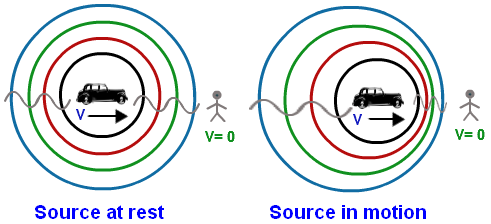
- The Doppler Effect.
- When something that emits waves moves towards or away from you, the wavelengths and the frequencies change.
- The frequency of the source moving towards you will seem higher and shorter in wavelength.
- The frequency of the source moving away from you will seem lower and longer in wavelength.
- This happens to both longditudinal waves and transverse waves.
- The frequency of the source moving away from you will seem lower and longer in wavelength.
- The frequency of the source moving towards you will seem higher and shorter in wavelength.
- When something that emits waves moves towards or away from you, the wavelengths and the frequencies change.
- Waves have amplitude (the displacement from the "rest" position to the crest), wavelength (the length from one crest to the next) and frequency (the number of complete waves passing a certain point in a second or the number of waves produced per second. Measured in hertz which is one wave per second).
The Origin of the Universe
- The universe seems to be expanding and galaxies seem to be moving away from each other.
- Light from different galaxies is red shifted. Different chemical elements absorb different frequencies of light.
- Different elements absorb different frequencies of light. Each element produces a specific pattern of dark lines at the frequencies that it absorbs in the visible spectrum.
- When we look at light from distant galaxies we can see the same patterns at a slightly lower frequency than they should be. They are shifted towards the red end of the spectrum. They are said to be "red-shifted."
- This effect works in the same way as the doppler effect.
- The further away the galaxy, the greater the red shift.
- Measurements of the red shift suggests that all the galaxies are moving away from us very quickly. This can be seen from every direction.
- More distant galaxies have greater red shifts. This means that the further away galaxies are moving away faster than nearer ones.
- This provides evidence that the universe is expanding.
- Something must have caused these things to be moving. This was most likely a massive explosion. This was the big bang.
- According to this theory, all the matter and energy in the universe must have been compressed into a very small space. Then it exploded from that single point and started expanding.
- The expansion is still happening . We can use the current rate of expansion to estimate its age. Our best guess is 14 billion years old.
- The "Steady state" theory says that the universe has always existed as it is now and it always will do. It is based on the theory that the universe appears the same from everywhere. The expansion is explained by matter being created in the universe. There are big problems with this theory.
- The Cosmic Microwave Background Radiation (CMBR) was discovered and makes the Big Bang theory more plausable.
- There's a uniform microwave radiation from all directions.
- This radiation is largely microwaves .This is known as CMBR. The big bang theory is the only one which can explain CMBR.
- After the big bang, everything was super heated and it all emitted high frequency radiation. As the universe expanded and cooled, the frequency of the radiation dropped to be microwave radiation.
- Nearly all astronomers agree that there was a big bang but some still believe in the steady state theory.
- The big bang theory isn't perfect, it does not explain the whole universe. The big bang theory predicts that the expansion of the universe should be slowing down but in actuality, it is speeding up.
- The big bang theory doesn't explain the conditions before the big bang.
- The big bang theory isn't perfect, it does not explain the whole universe. The big bang theory predicts that the expansion of the universe should be slowing down but in actuality, it is speeding up.
- Nearly all astronomers agree that there was a big bang but some still believe in the steady state theory.
- After the big bang, everything was super heated and it all emitted high frequency radiation. As the universe expanded and cooled, the frequency of the radiation dropped to be microwave radiation.
- This radiation is largely microwaves .This is known as CMBR. The big bang theory is the only one which can explain CMBR.
- There's a uniform microwave radiation from all directions.
- The Cosmic Microwave Background Radiation (CMBR) was discovered and makes the Big Bang theory more plausable.
- The "Steady state" theory says that the universe has always existed as it is now and it always will do. It is based on the theory that the universe appears the same from everywhere. The expansion is explained by matter being created in the universe. There are big problems with this theory.
- The expansion is still happening . We can use the current rate of expansion to estimate its age. Our best guess is 14 billion years old.
- According to this theory, all the matter and energy in the universe must have been compressed into a very small space. Then it exploded from that single point and started expanding.
- Something must have caused these things to be moving. This was most likely a massive explosion. This was the big bang.
- This provides evidence that the universe is expanding.
- More distant galaxies have greater red shifts. This means that the further away galaxies are moving away faster than nearer ones.
- Measurements of the red shift suggests that all the galaxies are moving away from us very quickly. This can be seen from every direction.
- The further away the galaxy, the greater the red shift.
- This effect works in the same way as the doppler effect.
- When we look at light from distant galaxies we can see the same patterns at a slightly lower frequency than they should be. They are shifted towards the red end of the spectrum. They are said to be "red-shifted."
- Different elements absorb different frequencies of light. Each element produces a specific pattern of dark lines at the frequencies that it absorbs in the visible spectrum.
- Light from different galaxies is red shifted. Different chemical elements absorb different frequencies of light.
- The universe seems to be expanding and galaxies seem to be moving away from each other.
Images and files in the map
Information
- Description
- Mind Map on Physics 1, created by Catherine Foreman on 10/03/2016.
- Created by
- Catherine Foreman
- Views
- 0
- Rating