
Mind map
Ionisation energies
Map content
Ionisation energies
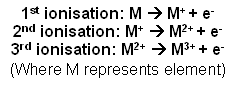
The first ionisation energy is the energy required to remove one electron from each atom in one mole of gaseous atoms of an element to form one mole of gaseous 1+ ions.
Electrons are held in their shells by attraction to the positive nucleus. The first electron will be lost from the highest energy level and will experience the least attraction from the nucleus.
- Three factors affect the attraction between the nucleus and the outer electrons of an atom, and therefore, the ionisation energy:
- Atomic radius - the greater the distance between the nucleus and the outer electrons, the less the nuclear attraction. This will increase as the atom gets larger due to more electrons, and therefore more shielding.
- Nuclear charge - the more protons there are in the nucleus of an atom, the greater the attraction between the nucleus and outer electrons.
- Electron shielding- electrons are negatively charged so inner-shell electrons repel outer shell electrons. This repulsion, called the shielding effect, reduces the attraction between the nucleus and the outer electrons.
- Three factors affect the attraction between the nucleus and the outer electrons of an atom, and therefore, the ionisation energy:
The second ionisation energy is greater than the first. E.g. in a helium atom, there are 2 protons attracting 2 electrons in the 1s sub-shell. After the first electron is lost, the econd is pulled closer to the nucleus. The nuclear attraction on the remaining electron increases and more ionisation energy will be needed to remove this second electron.
- The second ionisation energy is the energy required to remove one electron from each atom of one mole of gaseous 1+ ions of an element to form one mole of gaseous 2+ atoms.
Trend going down a group:
- -atomic radius increases
- -more inner shells so shielding increases
- -nuclear attraction on outer electrons decreases
- -first ionisation energy decreases
- -nuclear attraction on outer electrons decreases
- -more inner shells so shielding increases
- -atomic radius increases
Trend going across a period:
- Nuclear charge increases
- Same shell: similar shielding
- Nuclear attraction increases
- Atomic radius decreases
- First ionisation energy increases
- Atomic radius decreases
- Nuclear attraction increases
- Same shell: similar shielding
- Nuclear charge increases
Images and files in the map
Information
- Description
- AS - Level Chemistry (Chapter 7) Mind Map on Ionisation energies, created by Lucy Garland on 17/04/2016.
- Created by
- Lucy Garland
- Views
- 0
- Rating