
Mind map
Shakespeare's Techniques
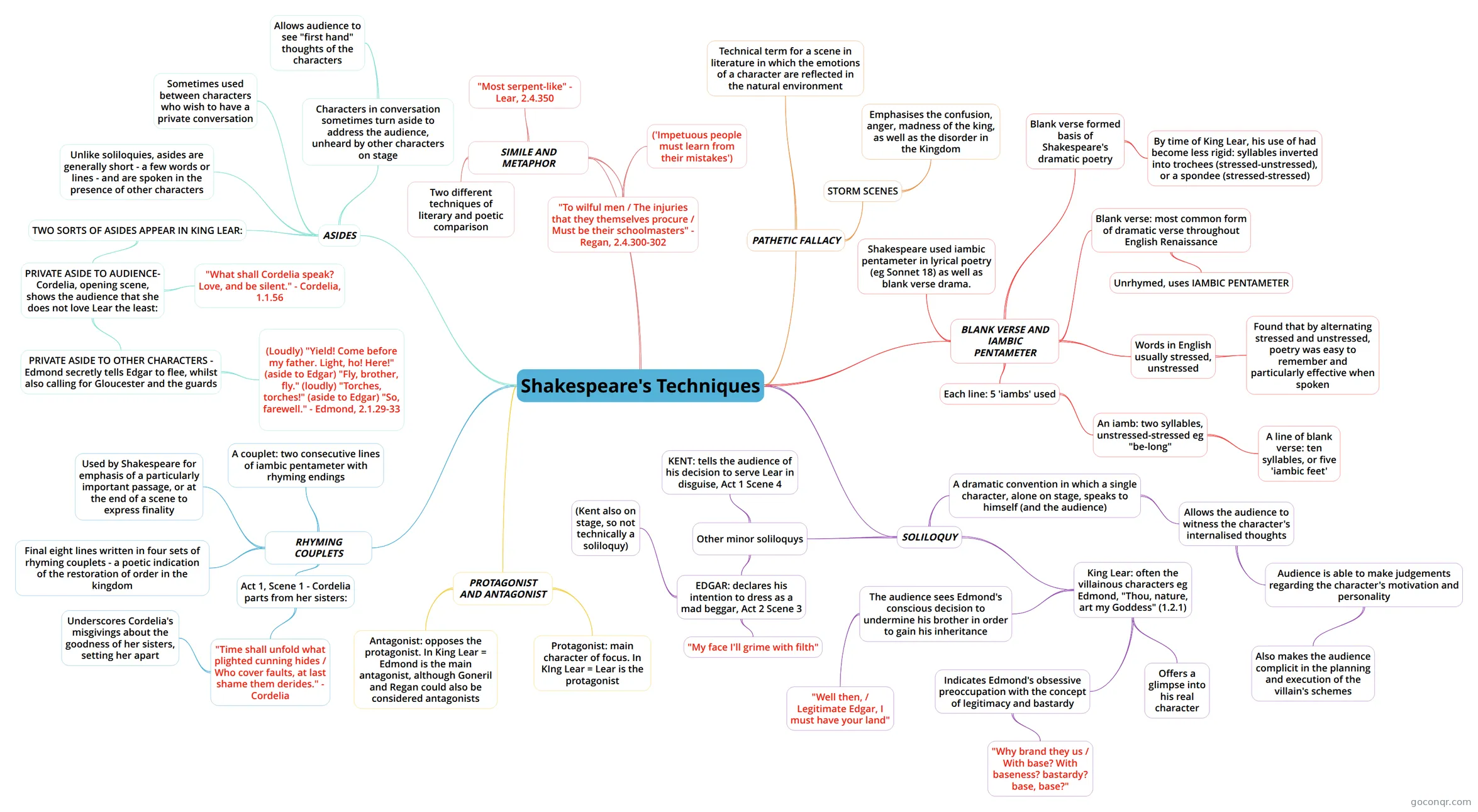
Mind map: Shakespeare's techniques
Map content
Shakespeare's Techniques
BLANK VERSE AND IAMBIC PENTAMETER
- Blank verse: most common form of dramatic verse throughout English Renaissance
- Unrhymed, uses IAMBIC PENTAMETER
- Words in English usually stressed, unstressed
- Found that by alternating stressed and unstressed, poetry was easy to remember and particularly effective when spoken
- Each line: 5 'iambs' used
- An iamb: two syllables, unstressed-stressed eg "be-long"
- A line of blank verse: ten syllables, or five 'iambic feet'
- An iamb: two syllables, unstressed-stressed eg "be-long"
- Shakespeare used iambic pentameter in lyrical poetry (eg Sonnet 18) as well as blank verse drama.
- Blank verse formed basis of Shakespeare's dramatic poetry
- By time of King Lear, his use of had become less rigid: syllables inverted into trochees (stressed-unstressed), or a spondee (stressed-stressed)
- Blank verse: most common form of dramatic verse throughout English Renaissance
SOLILOQUY
- A dramatic convention in which a single character, alone on stage, speaks to himself (and the audience)
- Allows the audience to witness the character's internalised thoughts
- Audience is able to make judgements regarding the character's motivation and personality
- Also makes the audience complicit in the planning and execution of the villain's schemes
- Audience is able to make judgements regarding the character's motivation and personality
- Allows the audience to witness the character's internalised thoughts
- King Lear: often the villainous characters eg Edmond, "Thou, nature, art my Goddess" (1.2.1)
- Offers a glimpse into his real character
- The audience sees Edmond's conscious decision to undermine his brother in order to gain his inheritance
- "Well then, / Legitimate Edgar, I must have your land"
- Indicates Edmond's obsessive preoccupation with the concept of legitimacy and bastardy
- "Why brand they us / With base? With baseness? bastardy? base, base?"
- Other minor soliloquys
- KENT: tells the audience of his decision to serve Lear in disguise, Act 1 Scene 4
- EDGAR: declares his intention to dress as a mad beggar, Act 2 Scene 3
- "My face I'll grime with filth"
- (Kent also on stage, so not technically a soliloquy)
- A dramatic convention in which a single character, alone on stage, speaks to himself (and the audience)
ASIDES
- Characters in conversation sometimes turn aside to address the audience, unheard by other characters on stage
- Allows audience to see "first hand" thoughts of the characters
- Unlike soliloquies, asides are generally short - a few words or lines - and are spoken in the presence of other characters
- Sometimes used between characters who wish to have a private conversation
- TWO SORTS OF ASIDES APPEAR IN KING LEAR:
- PRIVATE ASIDE TO AUDIENCE- Cordelia, opening scene, shows the audience that she does not love Lear the least:
- "What shall Cordelia speak? Love, and be silent." - Cordelia, 1.1.56
- PRIVATE ASIDE TO OTHER CHARACTERS - Edmond secretly tells Edgar to flee, whilst also calling for Gloucester and the guards
- (Loudly) "Yield! Come before my father. Light, ho! Here!" (aside to Edgar) "Fly, brother, fly." (loudly) "Torches, torches!" (aside to Edgar) "So, farewell." - Edmond, 2.1.29-33
- PRIVATE ASIDE TO AUDIENCE- Cordelia, opening scene, shows the audience that she does not love Lear the least:
- Characters in conversation sometimes turn aside to address the audience, unheard by other characters on stage
RHYMING COUPLETS
- A couplet: two consecutive lines of iambic pentameter with rhyming endings
- Used by Shakespeare for emphasis of a particularly important passage, or at the end of a scene to express finality
- Act 1, Scene 1 - Cordelia parts from her sisters:
- "Time shall unfold what plighted cunning hides / Who cover faults, at last shame them derides." - Cordelia
- Underscores Cordelia's misgivings about the goodness of her sisters, setting her apart
- "Time shall unfold what plighted cunning hides / Who cover faults, at last shame them derides." - Cordelia
- Final eight lines written in four sets of rhyming couplets - a poetic indication of the restoration of order in the kingdom
PATHETIC FALLACY
- Technical term for a scene in literature in which the emotions of a character are reflected in the natural environment
- STORM SCENES
- Emphasises the confusion, anger, madness of the king, as well as the disorder in the Kingdom
SIMILE AND METAPHOR
- Two different techniques of literary and poetic comparison
- "Most serpent-like" - Lear, 2.4.350
- "To wilful men / The injuries that they themselves procure / Must be their schoolmasters" - Regan, 2.4.300-302
- ('Impetuous people must learn from their mistakes')
PROTAGONIST AND ANTAGONIST
- Protagonist: main character of focus. In KIng Lear = Lear is the protagonist
- Antagonist: opposes the protagonist. In King Lear = Edmond is the main antagonist, although Goneril and Regan could also be considered antagonists