
Mind map
Creativity and Innovation W4
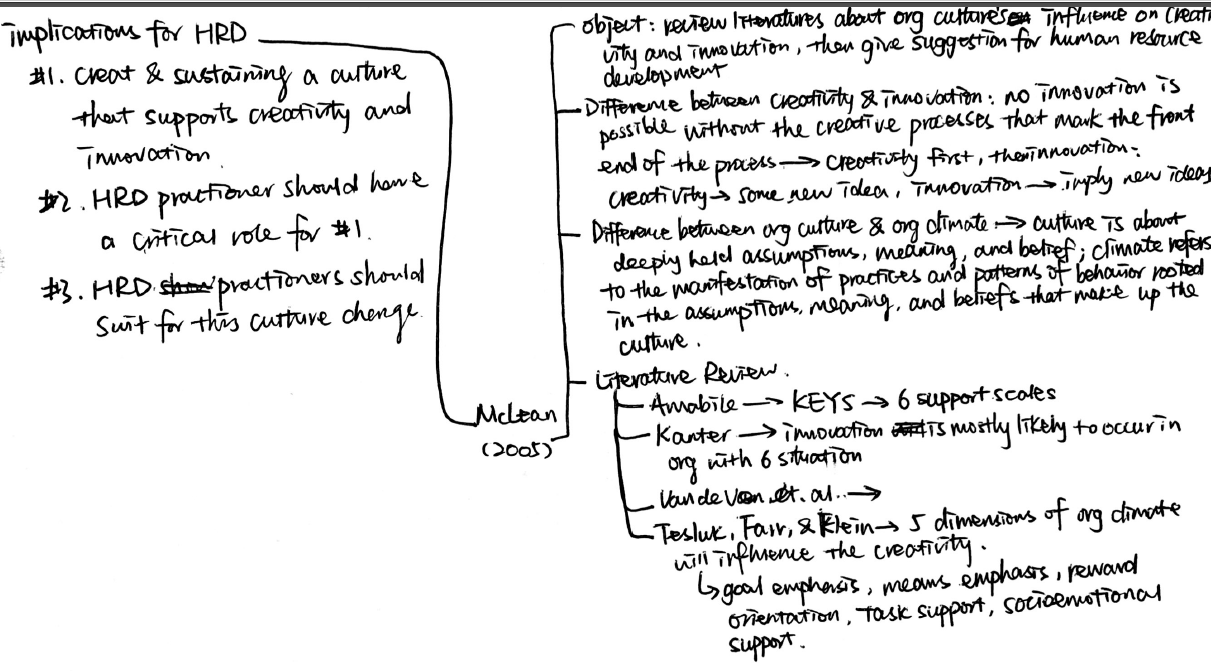
Map content
Creativity and Innovation W4
Amabille (1998) is looking at how creativity can be destroyed among extrinsically or intrinsically motivated people. It is possible to have business imperatives that work and creativity flourishing in the same organisation. Conducted qualitative survey using KEYS (78 questions). Creativity has 3 components: expertise (broader expertise leads to larger intellectual space to explore problems), creative-thinking skills (individual personality determines how flexible and imaginative at problem solving) and motivation (determines what person will actually do). Extrinsic motivation doesn’t boost creativity, au contraire leads to feelings of bribed and controlled. Intrinsic motivation can be most creative when intrinsically motivated. To enhance intrinsic motivation: challenge, freedom, resources, work group features, supervisory encouragement and organisational support. Business creativity is about coming up useful and actionable ideas and improving a product.
- 6 categories emerged from research to enhance creativity and how they can fail: Challenge: matching people with right assignment, but sometimes most eligible employee matched to most urgent task, not enough info necessary to make good connections. Freedom: give people autonomy heightening intrinsic motivation and sense of ownership, but managers end up changing goals quickly or fail to define them. Resources: time and money, managers come up with fake deadlines or impossibly tight ones creating mistrust. Work group features: create mutually supportive groups with diverse perspectives and backgrounds but must share excitement, willing to help teammates and recognise unique knowledge others bring. Failure by assembling homogenous teams with less friction. Supervisory encouragement: show their work matters to org and support creativity by serving as role model to encourage collaboration, but fail to acknowledge and greet employees with scepticism and harsh criticism.
- Organisational support: rewarding creativity through information sharing and collaboration, but fails when gossip and politics in org.
- Expertise and creativity thinking are raw materials, if add motivation it will determine what people will actually do. When people intrinsically motivated, they do things for challenge and enjoyment rather than feeling pressured – motivational principal of creativity. Research showed people believe they will appear smarter if more critical, this negativity bias can have severe consequences for creativity since they focus on external rewards/punishments and affect intrinsic negatively. Creativity often requires managers radically change ways of building and interacting with work group -> conscious culture change. When creativity is killed an organisation loses a potent competitive weapon: new ideas. It can also lose energy and commitment of its people.
- 6 categories emerged from research to enhance creativity and how they can fail: Challenge: matching people with right assignment, but sometimes most eligible employee matched to most urgent task, not enough info necessary to make good connections. Freedom: give people autonomy heightening intrinsic motivation and sense of ownership, but managers end up changing goals quickly or fail to define them. Resources: time and money, managers come up with fake deadlines or impossibly tight ones creating mistrust. Work group features: create mutually supportive groups with diverse perspectives and backgrounds but must share excitement, willing to help teammates and recognise unique knowledge others bring. Failure by assembling homogenous teams with less friction. Supervisory encouragement: show their work matters to org and support creativity by serving as role model to encourage collaboration, but fail to acknowledge and greet employees with scepticism and harsh criticism.
Hulsheger et al (2009) conduct a meta-analyses of creativity and innovation using Hackman’s (1987) input-process-output model examining 15 variables previous studies looked at over last 30 years. They look at previously un-investigated moderators: measurement level and measurement method. Hackman’s IPO is only used to classify team-level variables into input and process factors. Researches have undertook strategies to prevent any bias in research.
- RESULTS. Team input variables: could not be concluded that job-relevant diversity/background diversity had a +ve/-ve relationship with innovation, Task +vely related to innovation, team size/longevity is +ve/-ve related to innovation. Could be established goal interdepended is significantly positively related to innovation. For team process variables: strongly (+ve) linked to innovation, strongest for vision, external communication, support for innovation and task orientation. Internal communication and cohesion also displayed considerable +ve relation with innovation. Hypothesis stating participative safety/task conflict has positive relation to innovation and relationship conflict has negative could not be supported.
- Results confirmed measurement level moderates relation b/w team input and process variables and innovation. For all process factors except support for innovations, relations were stronger if self-report measures used relative to independent ratings. Relationships between team process variables and innovation are stronger for team than individual innovation. To ensure that team members cooperate and collaborate in working on those superordinate goals, team members should be interdependent in reaching their personal goals. This can be achieved by linking the provision of feedback and personal incentives to the accomplishment of group rather than individual goals
- RESULTS. Team input variables: could not be concluded that job-relevant diversity/background diversity had a +ve/-ve relationship with innovation, Task +vely related to innovation, team size/longevity is +ve/-ve related to innovation. Could be established goal interdepended is significantly positively related to innovation. For team process variables: strongly (+ve) linked to innovation, strongest for vision, external communication, support for innovation and task orientation. Internal communication and cohesion also displayed considerable +ve relation with innovation. Hypothesis stating participative safety/task conflict has positive relation to innovation and relationship conflict has negative could not be supported.
Amabile, Regina (1999) examine the work environment for creativity at large high-tech firm before (baseline), mid (wave 1), official end (wave 2), and after (wave 3) a major downsizing of 12-15%. Baseline 455 respondents (45.5% response); 102 at wave 1 (34%); 87 at wave 2 (29%); and 110 at wave 3 (37%). Creativity and most creativity- supporting aspects of the work environment declined significantly during downsizing but increased modestly later; opposite pattern was observed for creativity-undermining aspects. Stimulants and obstacles to creativity in the work environment mediated the effects of downsizing. Downsizing was defined through three measures: recently experienced downsizing in one's own department (downsizing experienced), anticipation of future downsizing in one's own department (anticipated downsizing), and recent disruption of the stability of one's own work group (work group stability).
- Work environment survey KEYS (KEYS: Assessing the Climate for Creativity) includes (six stimulants to creativity and two obstacles to creativity): (1) organizational encouragement; (2) sufficient ; (3) freedom; (4) challenging work; (5) supervisory encouragement; (6) work group supports. The two KEYS obstacles to creativity are: (1) organizational impediments; (2) workload pressure. RESULTS: confirmed large downsizing was experienced by respondents b/w baseline and wave 1 and stability increased after. Creativity was significantly below baseline levels at all three later time points. Productivity was significantly below baseline at waves 1 and 2, but not at wave 3. H1: Creativity will decrease as a function of downsizing was supported. Changes in creativity much greater and enduring than productivity changes.
- The relationship between creativity and downsizing was accounted for by decreases in work environment stimulants to creativity and increases in work environment obstacles to creativity. The 6 KEYS environmental stimulants to creativity declined notably from baseline to wave 1 whereas the KEYS obstacle measure, organizational impediments, increased so during downsizing, work environment stimulants to creativity will decrease and work environment obstacles will increase. Organizational downsizing is accompanied by negative changes in the work environment for creativity. The relationship between downsizing and creativity can be largely accounted for by negative changes in an organization's work environment. Although productivity and the perceived work environment improved on many dimensions, creativity appeared to have still suffered considerably.
- . It is particularly interesting that actually experienced downsizing was a much weaker predictor of perceived work environment than was work group stability or anticipated downsizing. The work group stability results are largely consistent with the theory of the need to belong (Baumeister & Leary, 1995), which suggests ongoing relational human bonds are a powerful, fundamental, and pervasive motive, having strong positive effects on emotional patterns and cognitive processes.
- Limitations: This study identified relationships, not causes. It is possible that something else was going on however it most likely holds since results are consistent with previous research. Only conducted in one company and low response rate for wave 2, results on the levels of downsizing and work group must be interpreted cautiously, because obtained from self-reported measures. Threat-rigidity theory: organizations undergo a “mechanistic shift” under threatening circumstances – centralizing control, conserve resources, restrict information flow, and rely on familiar well-practiced routines. However, threat-rigidity theory implies that, under the types of radical changes that are likely to precede or accompany downsizing, the resulting effects will be dysfunctional. This position has received considerable empirical support
- . It is particularly interesting that actually experienced downsizing was a much weaker predictor of perceived work environment than was work group stability or anticipated downsizing. The work group stability results are largely consistent with the theory of the need to belong (Baumeister & Leary, 1995), which suggests ongoing relational human bonds are a powerful, fundamental, and pervasive motive, having strong positive effects on emotional patterns and cognitive processes.
- The relationship between creativity and downsizing was accounted for by decreases in work environment stimulants to creativity and increases in work environment obstacles to creativity. The 6 KEYS environmental stimulants to creativity declined notably from baseline to wave 1 whereas the KEYS obstacle measure, organizational impediments, increased so during downsizing, work environment stimulants to creativity will decrease and work environment obstacles will increase. Organizational downsizing is accompanied by negative changes in the work environment for creativity. The relationship between downsizing and creativity can be largely accounted for by negative changes in an organization's work environment. Although productivity and the perceived work environment improved on many dimensions, creativity appeared to have still suffered considerably.
- Work environment survey KEYS (KEYS: Assessing the Climate for Creativity) includes (six stimulants to creativity and two obstacles to creativity): (1) organizational encouragement; (2) sufficient ; (3) freedom; (4) challenging work; (5) supervisory encouragement; (6) work group supports. The two KEYS obstacles to creativity are: (1) organizational impediments; (2) workload pressure. RESULTS: confirmed large downsizing was experienced by respondents b/w baseline and wave 1 and stability increased after. Creativity was significantly below baseline levels at all three later time points. Productivity was significantly below baseline at waves 1 and 2, but not at wave 3. H1: Creativity will decrease as a function of downsizing was supported. Changes in creativity much greater and enduring than productivity changes.
Images and files in the map
Information
- Description
- HR (OB ) Mind Map on Creativity and Innovation W4, created by Fatima Khan on 18/10/2016.
- Created by
- Fatima Khan · Oct 2016
- Updated
- Oct 30, 2016
- Views
- 0
- Rating