
Mind map
Orthmyxovirus
Map content
Orthmyxovirus
Replication
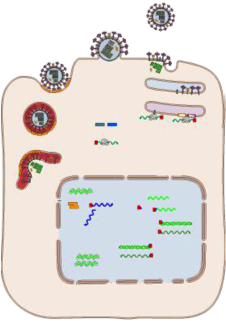
- 1. Virus attachment to plasma membrane
- Adhesion
- 2. Entry to cytoplasm/nucleus
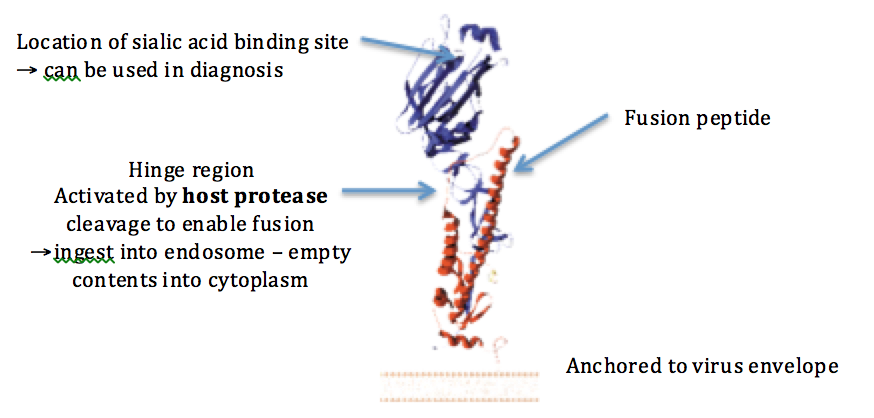
- Cell protease cuts HA
- Cell must possess correct protease
- 3. Un-coating of virus particle
- Endocytosis
- Fusion and release of –ve sense RNA + Pol
- 4. Synthesis of mRNA and protein
- Cap snatching, primer for mRNA synthesis (cytopathic)
- Kills cell
- Binds cap to itself – copy and release
- Cap snatching, primer for mRNA synthesis (cytopathic)
- 5. Replication of nucleic acid
- 6. Virus assembly
- 7. Exit of virus from cell
- Release by Neuraminidase
- Cuts off sialic acid to release it
- Release by Neuraminidase
- Virus organises proteins so buds into lumen – possible on polaroid epithelial cell
- Therefore avoids immune system in doing so
- 1. Virus attachment to plasma membrane
Characteristics
- Genome
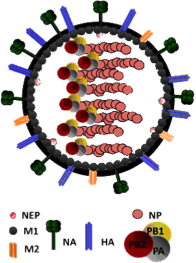
- A: Helical nucleocapsid - 8 segments of –ve sense RNA and nucleoprotein
- B: Each segment binds a copy of the RNA polymerase
- Ready to replicate
- C: Peplomers:-
- HA = Haemagglutinin
- NA = Neuraminidase
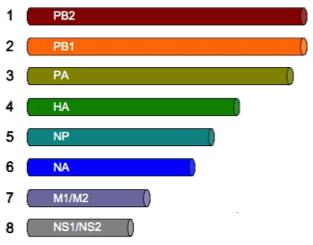
- Organisation
- 1&2 - RNA Polymerase and cap snatching. Biggest – have to arrange a complicated process
- 3 - Haemagglutinin (attachment)
- 4 - Nucleoprotein (CTL target)
- 5 - Neuraminidase (Virus release)
- 6 - Other virus envelope associated proteins
- 7&8 - Non structural proteins Block interferon induction and function. → lots of RNA viruses do this – important for their function
- Structure
- Structure of influenza haemagglutinin
- Mutations can affect host range
- Sialic acid (sugars containing N-acetyl neuraminic acid)
- → can be slightly different in different conformations – different in different species
- Galactosea-2-6 N acetyl neuraminic acid
- Mammalian respiratory tract (mammalian type)
- Galactosea-2-3 N acetyl neuraminic acid
- Wildfowl intestine (avian type)
- Mutation of two amino acids converts from avian to mammalian form
- Governs ability for cross species transmission
- Mutation of one AA gives intermediate form
- Sialic acid (sugars containing N-acetyl neuraminic acid)
- Agglutinates RBCs
- Mutations can affect host range
- Influenza A
- Enveloped pleomorphic virus with prominent peplomers
- Surrounding eight helically symmetrical
- Nucleocapsid segments of –ve sense RNA no cap
- Can’t be directly translated
- Structure of influenza haemagglutinin
- Family: Orthomyxoviridae
- Genus: Influenza A
- Human influenza
- Swine influenza
- Equine influenza
- Avian influenza
- Whale and seal influenza
- Genus: Influenza B
- Humans only
- Genus: Influenza C
- Humans and swine mild disease
- Genus: Togotovirus
- Tick borne virus of humans and livestock in Africa, Asia and Europe.
- Reservoir for new viruses due to mutations from the viruses in this group
- Genus: Influenza A
- Genome
Influenza
- Pathogenesis
- Entry into host
- Medium range: aerosol spread
- (Contagious on or between yards at race meetings events etc.)
- Influenza viruses are spread by aerosol infection / Ingestion
- Long range; indirect contact by people, transport, delivery vehicles
- Able to survive in air for up to 14 days
- Aerosolised virus will tend to impact upon URT
- Medium range: aerosol spread
- Targeted cells
- Normal function
- Mucous secretion and cilliary clearance of particles
- Lining of respiratory tract
- Virus infects cells of the nasal mucosa, trachea, bronchi, and bronchioles in mammals
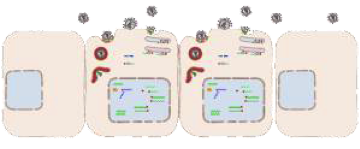
- Virus assembly and budding on luminal side of infected cells (localised spread)
- Budding predominantly on luminal side.
- Change of spread along epithelium due to blocking of interferon response
- Infection is limited to cell types with a protease that can cleave heamagglutinin
- Normal function
- How does the virus alter/interfere with cell function?
- Cytopathic: rapid cell death.
- Death/clumping of cilia
- What effect will this have on the host?
- Inflammation, cytokine and interferon production, sickness behaviour, fever, increased mucous secretion, sensitisation of nocioceptors, pain, sneezing, coughing.
- ↑ goblet cells, ↑ mucous, ↓ ability to clear
- Interferon response drives fever and sickness behaviour
- Monocytes and macrophages endocytose dead cells – recognise infection
- NSP1 mutations alter pathogenicity via interferon blocking actions
- Interferons are quite host species specific
- Entry into host
- Evolution and epidemiology
- All serotypes occur in wildfowl populations (particularly Ducks). They spread in water but cause little disease in these host species.
- Infect enteric system
- Avian strains of influenza are difficult to grow in mammalian tissue and are usually not pathogenic.
- Nevertheless Mammalian disease is thought to have originated by infection with avian virus.
- Can get cross over of viruses
- Influenza viruses accumulate point mutations in genes leading to antigenic drift.
- In turn leads to
- 1. Failure of protection by existing neutralising antibodies
- a. Poorer binding ability to virus due to change
- 2. Altered or enhanced pathogenicity of virus e.g. changes in sensitivity of haemagglutin into host protease. Differences in NS1 ability to block interferon
- Result in differences in severity of disease
- 1. Failure of protection by existing neutralising antibodies
- Antigenic drift occurs rapidly in part because RNA polymerases have no proof function.
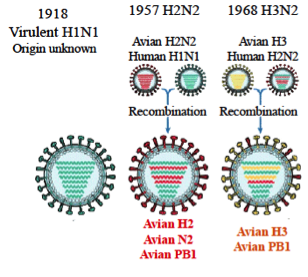
- Genetic re-assortment (Antigenic shift – occurs gradually) and point mutation (Antigenic drift – sudden change) both contribute to the evolution of new variants of influenza virus
- Variants with new H/N genes will no longer be recognised by prevalent neutralising antibodies and may cause pandemic of influenza.
- In turn leads to
- Point mutation in NS1 influence pathogenicity
- NS1 a multifunctional protein that blocks both interferon induction and action
- Haemagglutinin
- Position of amino acid changes that accumulated on A/Hong Kong/(H3N2) between 1968 and 1986
- Mutations that alter the loops to which neutralizing antibody binds, but do not alter the sialic acid binding site itself give a selective advantage and dominate the pattern.
- Connecting loops can vary – non critical to function
- Accumulation of mutations on surface loops
- Human influenza evolution of new pandemic strains
- There are different peplomers on the surface – unrecognised
- Pathogenesis
Species specific
- Avian influenza
- Devastating outbreaks of disease known as Fowl Plague (1878, 2003/4)
- Highly virulent strains (usually H5or H7) virus infection not restricted to respiratory tract all cells are able to cleave the Heamagglitinin and become infected
- Systemic disease → death
- Less virulent strains are also common causing respiratory disease or production losses in chickens and turkeys. (vaccines available)
- New virulent strains may arise following mutation (antigenic drift)
- Pennsylvania outbreak (1983) due to single amino acid change in hinge region of HA in existing poultry virus (altered cell tropism from respiratory tract to all cells)
- Or by antigenic drift: 2003 Dutch outbreak of fowl plague H7N7 strain recombinant wild type waterfowl virus infecting chickens.
- Swine influenza
- Was first seen in USA just after the 1918 pandemic serotype H1N1
- Two variants both H1N1 one circulating in North America and one in Europe. 1979 H1N1 strain with distinct new avian gene sequences occurred in Italy spread through Europe
- H3N2 strains also occur but are less pathogenic
- H1N2 re-assortments between H1N1and H3N2 have been detected in Japan (1996) and UK (1998)
- 2015 H1N1 repeated re-infections of new strains from humans “reverse zoonosis”
- More prevalent in winter
- Introduced with new stock or possibly airborne
- Poor biosecurity
- Outbreak of acute febrile upper respiratory disease secondary pneumonia
- Diagnosis
- Virus isolation in embryonated eggs, haemagglutination.
- Rising antibody titre, haemagglutination inhibition test.
- PCR, Vaccines available
- A lot of pig stock in this country will be vaccinated
- Equine influenze
- Type 1
- Influenza virus A/equine/Prague/1/56(H7/N7)
- Last isolated from a 1979 outbreak
- Uncertain if this virus is still in circulation
- Type 2
- Influenza virus A/equine/ Miami/2/63(H3/N8)
- Recent outbreaks have been of H3N8 type.
- Modest antigenic drift has occurred.
- 1989 – outbreak of equine influenza in Northern China
- Morbidity 80% and mortality 20% in 1st year, less in subsequent years
- Herd immunity builds up
- The virus serotype was H3N8 similar to other equine strains but was shown to contain genes of recent avian origin
- This demonstrates the potential of avian virus to infect horses, which in turn can lead to re-assortment.
- Morbidity 80% and mortality 20% in 1st year, less in subsequent years
- Virus is secreted by infected animals prior to clinical symptoms and is spread by aerosol or contact especially among competition horses.
- Fast acting virus
- Acute upper respiratory disease, fever, depression, cough, nasal discharge severity of infection varies with host age and immune status
- Symptoms are exacerbated by exercise
- Recovery 2-3 weeks
- Yards on which outbreaks occur are quarantined for at least 4 weeks.
- Vaccination record
- Type 1
- Canine influenza
- 2004 Equine influenza H3N8 reported in Dog in USA
- Maintained in kennels and animal shelters in several parts of the USA
- China and Korea avian origin H3N2 strains have been reported in dogs
- UK H3N8 reported in hunt kennels (not currently endemic)
- Hunt kennels – horses and hounds kept in close proximity
- Avian influenza
Treatment
- AMANTADINE (Symmetrel®)
- Block M2 ion channel function and prevent un-coating of virus.
- OSELTAMIVIR (Tamiflu®)
- Stops cutting virus free, therefore slowing the virus
- Neuraminidase inhibitor
- Not generally used - rely on vaccine
- AMANTADINE (Symmetrel®)
Diagnosis
- Typing
- Virus is typed based on serology of antibodies to Heamagglutinin, and Neuraminidase further nomenclature depends on host species, place and year of first isolation.
- 15 Heamagglutinin types
- Surface amino acids differ very slightly – antibodies needed for each
- 9 Neuraminidase types
- All combinations are by reassortment
- Large number of potential combinations, but not all occur in nature.
- 2 viruses in the same cell at the same time creates an opportunity for recombination
- Examples
- Influenza virus A/equine/Prague/1/56(H7/N7)
- Influenza virus A/equine/Miami/2/63(H3/N8)
- Influenza virus A/swine/Iowa/1/30(H1/N1)
- Will often say Newmarket in the name – different strain identified here (on UK vaccination packets in the small print)
- Location – where it was first isolated
- The first number – isolate no. (based on species)
- The second number – year of isolation
- By virus isolation in eggs and serology.
- Haemagglutination inhibition
- Antibodies prevent agglutination
- Acute phase or pre-infection serum
- Top line: no antibodies (early in infection)
- Bottom line: antibodies (late in infection)
- Rapid virus antigen test kit
- 1. Nasal swab.
- 2. Lysis of sample
- 3. Detect nucleoprotein (similar in all strains)
- Recovery phase serum (or sero-typing standard anti-sera e.g. anti influenza H3 or H7)
- Typing
Immunity
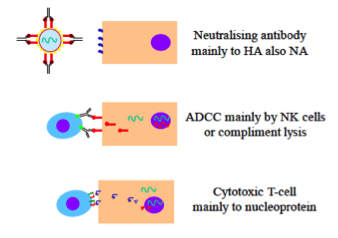
- Immunity (following infection) involves secretory IgA
- Innate immunity, systemic IgG and cytotoxic T-cells
- Vaccination: a number of different inactivated vaccines are available they mostly rely on neutralising IgG antibody to HA therefore it is necessary to update the vaccines to ensure that they are effective for the current virus strain. ISCOM based vaccines are thought to give a more durable response.(ISCOMS induce CTL).
Images and files in the map

Information
- Description
- BVSc3 AD2 (Viruses) Mind Map on Orthmyxovirus, created by Jess Pope on 21/12/2016.
- Created by
- Jess Pope
- Views
- 0
- History
-
- Created by Jess Pope · Dec 21, 2016
- Copied by Jess Pope · Dec 21, 2016
- Copied by Jess Pope · Dec 21, 2016
- Copied by Jess Pope · Dec 21, 2016
- Copied by Jess Pope · Dec 21, 2016
- Rating