
Mind map
Basic Criminal Damage - s.1 (1) CRIMINAL DAMAGE ACT 1971
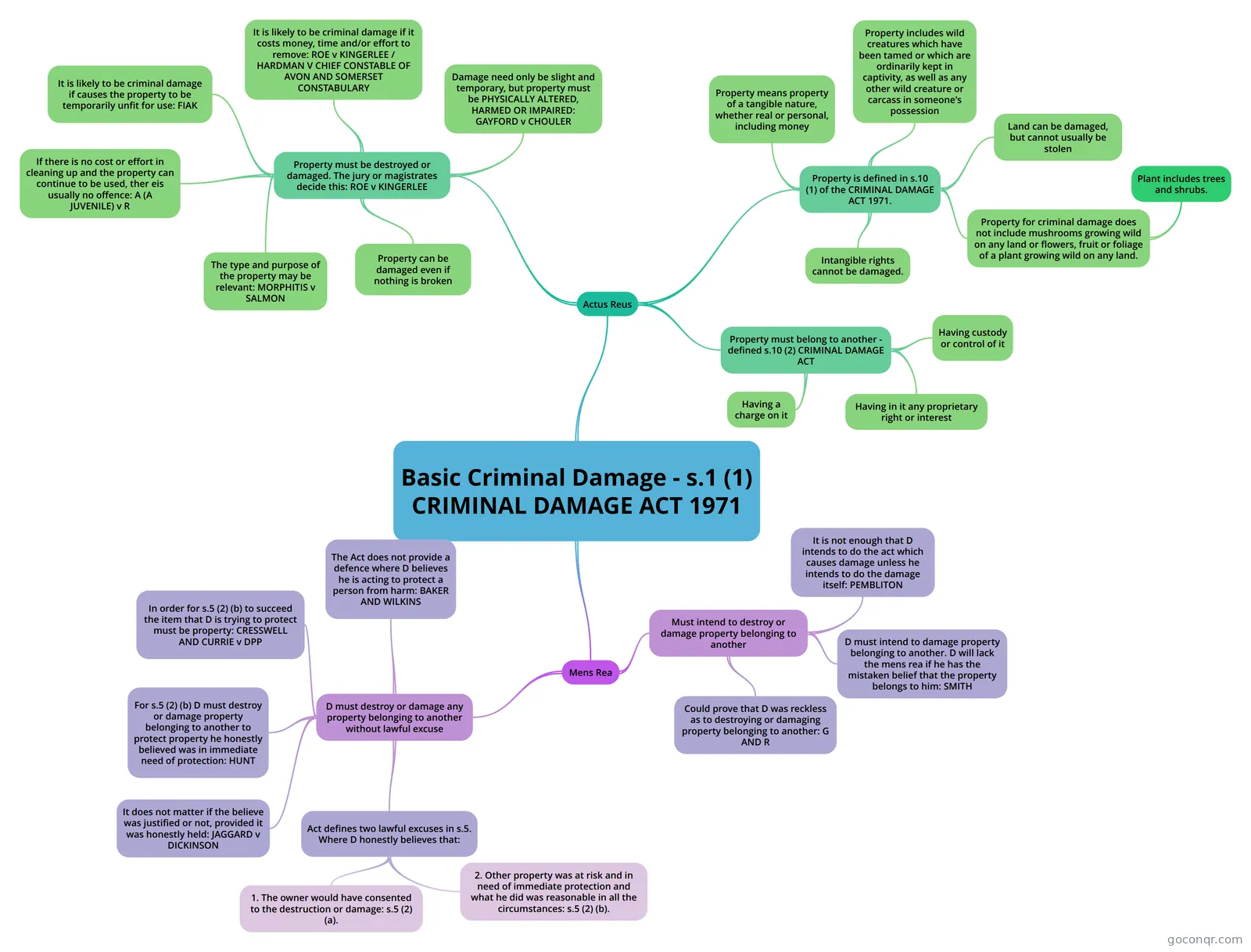
Mind map: Basic criminal damage s.1(1) Criminal Damage Act 1971
Map content
Basic Criminal Damage - s.1 (1) CRIMINAL DAMAGE ACT 1971
Actus Reus
- Property must be destroyed or damaged. The jury or magistrates decide this: ROE v KINGERLEE
- Damage need only be slight and temporary, but property must be PHYSICALLY ALTERED, HARMED OR IMPAIRED: GAYFORD v CHOULER
- Property can be damaged even if nothing is broken
- It is likely to be criminal damage if it costs money, time and/or effort to remove: ROE v KINGERLEE / HARDMAN V CHIEF CONSTABLE OF AVON AND SOMERSET CONSTABULARY
- It is likely to be criminal damage if causes the property to be temporarily unfit for use: FIAK
- If there is no cost or effort in cleaning up and the property can continue to be used, ther eis usually no offence: A (A JUVENILE) v R
- The type and purpose of the property may be relevant: MORPHITIS v SALMON
- Property is defined in s.10 (1) of the CRIMINAL DAMAGE ACT 1971.
- Property means property of a tangible nature, whether real or personal, including money
- Property includes wild creatures which have been tamed or which are ordinarily kept in captivity, as well as any other wild creature or carcass in someone's possession
- Land can be damaged, but cannot usually be stolen
- Property for criminal damage does not include mushrooms growing wild on any land or flowers, fruit or foliage of a plant growing wild on any land.
- Plant includes trees and shrubs.
- Intangible rights cannot be damaged.
- Property must belong to another - defined s.10 (2) CRIMINAL DAMAGE ACT
- Having custody or control of it
- Having in it any proprietary right or interest
- Having a charge on it
- Property must be destroyed or damaged. The jury or magistrates decide this: ROE v KINGERLEE
Mens Rea
- Must intend to destroy or damage property belonging to another
- It is not enough that D intends to do the act which causes damage unless he intends to do the damage itself: PEMBLITON
- D must intend to damage property belonging to another. D will lack the mens rea if he has the mistaken belief that the property belongs to him: SMITH
- Could prove that D was reckless as to destroying or damaging property belonging to another: G AND R
- D must destroy or damage any property belonging to another without lawful excuse
- Act defines two lawful excuses in s.5. Where D honestly believes that:
- 1. The owner would have consented to the destruction or damage: s.5 (2) (a).
- 2. Other property was at risk and in need of immediate protection and what he did was reasonable in all the circumstances: s.5 (2) (b).
- It does not matter if the believe was justified or not, provided it was honestly held: JAGGARD v DICKINSON
- For s.5 (2) (b) D must destroy or damage property belonging to another to protect property he honestly believed was in immediate need of protection: HUNT
- In order for s.5 (2) (b) to succeed the item that D is trying to protect must be property: CRESSWELL AND CURRIE v DPP
- The Act does not provide a defence where D believes he is acting to protect a person from harm: BAKER AND WILKINS
- Act defines two lawful excuses in s.5. Where D honestly believes that:
- Must intend to destroy or damage property belonging to another
Information
- Description
- A2 Law (Offences Against Property ) Mind Map on Basic Criminal Damage - s.1 (1) CRIMINAL DAMAGE ACT 1971, created by Lucy Nove on 07/02/2017.
- Created by
- Lucy Nove
- Views
- 27
- Rating