
Mind map
Societies in the 11th Century
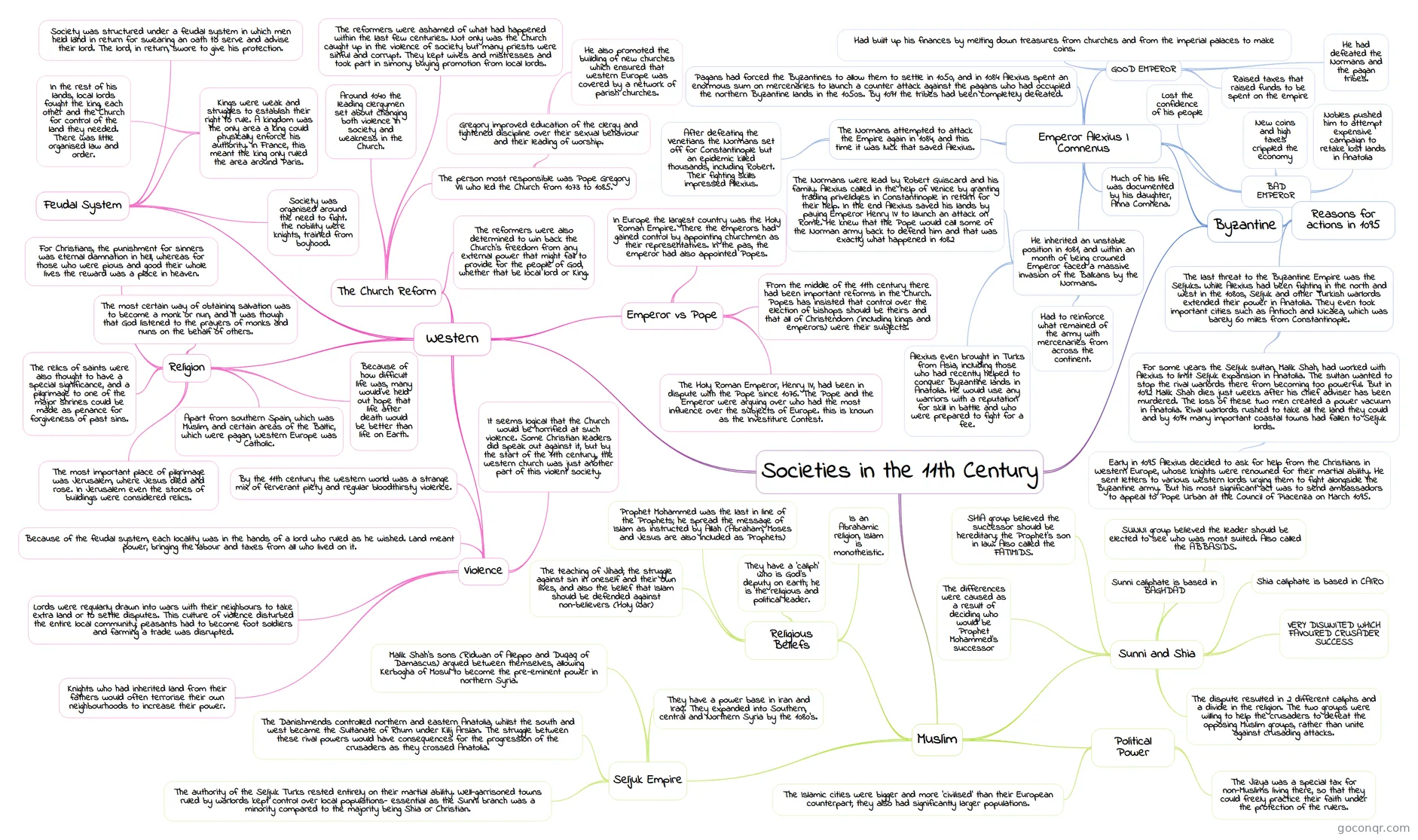
Mind map: Societies in the 11th century
Map content
Societies in the 11th Century
Western
- Feudal System
- Society was organised around the need to fight. the nobility were knights, trained from boyhood.
- Society was structured under a feudal system in which men held land in return for swearing an oath to serve and advise their lord. The lord, in return, swore to give his protection.
- Kings were weak and struggles to establish their right to rule. A kingdom was the only area a king could physically enforce his authority. In France, this meant the king only ruled the area around Paris.
- In the rest of his lands, local lords fought the king, each other and the Church for control of the land they needed. There was little organised law and order.
- Religion
- Because of how difficult life was, many would've held out hope that life after death would be better than life on Earth.
- For Christians, the punishment for sinners was eternal damnation in hell, whereas for those who were pious and good their whole lives the reward was a place in heaven.
- The most certain way of obtaining salvation was to become a monk or nun, and it was though that God listened to the prayers of monks and nuns on the behalf of others.
- The relics of saints were also thought to have a special significance, and a pilgrimage to one of the major shrines could be made as penance for forgiveness of past sins.
- The most important place of pilgrimage was Jerusalem, where Jesus died and rose. In Jerusalem even the stones of buildings were considered relics.
- Apart from southern Spain, which was Muslim, and certain areas of the Baltic, which were pagan, Western Europe was Catholic.
- Violence
- By the 11th century the western world was a strange mix of ferverant piety and regular bloodthirsty violence.
- Because of the feudal system, each locality was in the hands of a lord who ruled as he wished. Land meant power, bringing the labour and taxes from all who lived on it.
- Lords were regularly drawn into wars with their neighbours to take extra land or to settle disputes. This culture of violence disturbed the entire local community; peasants had to become foot soldiers and farming a trade was disrupted.
- Knights who had inherited land from their fathers would often terrorise their own neighbourhoods to increase their power.
- It seems logical that the Church would be horrified at such violence. Some Christian leaders did speak out against it, but by the start of the 11th century,, the western church was just another part of this violent society.
- Emperor vs Pope
- In Europe the largest country was the Holy Roman Empire. There the emperors had gained control by appointing churchmen as their representatives. In the pas, the emperor had also appointed Popes.
- From the middle of the 11th century there had been important reforms in the Church. Popes has insisted that control over the election of bishops should be theirs and that all of Christendom (including kings and emperors) were their subjects.
- The Holy Roman Emperor, Henry IV, had been in dispute with the Pope since 1076. The Pope and the Emperor were arguing over who had the most influence over the subjects of Europe. this is known as the Investiture Contest.
- The Church Reform
- Around 1040 the leading clergymen set about changing both violence in society and weakness in the Church.
- The reformers were ashamed of what had happened within the last few centuries. Not only was the Church caught up in the violence of society but many priests were sinful and corrupt. They kept wives and mistresses and took part in simony; buying promotion from local lords.
- The reformers were also determined to win back the Church's freedom from any external power that might fail to provide for the people of God, whether that be local lord or King.
- The person most responsible was Pope Gregory VII who led the Church from 1073 to 1085.
- Gregory improved education of the clergy and tightened discipline over their sexual behaviour and their leading of worship.
- He also promoted the building of new churches which ensured that western Europe was covered by a network of parish churches.
- Gregory improved education of the clergy and tightened discipline over their sexual behaviour and their leading of worship.
- Feudal System
Byzantine
- Emperor Alexius I Comnenus
- Much of his life was documented by his daughter, Anna Comnena.
- He inherited an unstable position in 1081, and within an month of being crowned Emperor faced a massive invasion of the Balkans by the Normans.
- Had to reinforce what remained of the army with mercenaries from across the continent.
- Alexius even brought in Turks from Asia, including those who had recently helped to conquer Byzantine lands in Anatolia. He would use any warriors with a reputation for skill in battle and who were prepared to fight for a fee.
- The Normans were lead by Robert Guiscard and his family. Alexius called in the help of Venice by granting trading privelidges in Constantinople in return for their help. In the end Alexius saved his lands by paying Emperor Henry IV to launch an attack on Rome. He knew that the Pope would call some of the Norman army back to defend him and that was exactly what happened in 1082
- The Normans attempted to attack the Empire again in 1084, and this time it was luck that saved Alexius.
- After defeating the Venetians the Normans set off for Constantinople but an epidemic killed thousands, including Robert. Their fighting skills impressed Alexius.
- Pagans had forced the Byzantines to allow them to settle in 1050, and in 1084 Alexius spent an enormous sum on mercenaries to launch a counter attack against the pagans who had occupied the northern Byzantine lands in the 1050s. By 1091 the tribes had been completely defeated.
- GOOD EMPEROR
- He had defeated the Normans and the pagan tribes.
- Had built up his finances by melting down treasures from churches and from the imperial palaces to make coins.
- Raised taxes that raised funds to be spent on the empire
- BAD EMPEROR
- New coins and high taxes crippled the economy
- Lost the confidence of his people
- Nobles pushed him to attempt expensive campaign to retake lost lands in Anatolia
- Reasons for actions in 1095
- The last threat to the Byzantine Empire was the Seljuks. While Alexius had been fighting in the north and west in the 1080s, Seljuk and other Turkish warlords extended their power in Anatolia. They even took important cities such as Antioch and Nicaea, which was barely 60 miles from Constantinople.
- For some years the Seljuk sultan, Malik Shah, had worked with Alexius to limit Seljuk expansion in Anatolia. The sultan wanted to stop the rival warlords there from becoming too powerful. But in 1092 Malik Shah dies just weeks after his chief adviser has been murdered. The loss of these two men created a power vacuum in Anatolia. Rival warlords rushed to take all the land they could and by 1094 many important coastal towns had fallen to Seljuk lords.
- Early in 1095 Alexius decided to ask for help from the Christians in Western Europe, whose knights were renowned for their martial ability. He sent letters to various western lords urging them to fight alongside the Byzantine army. But his most significant act was to send ambassadors to appeal to Pope Urban at the Council of Piacenza on March 1095.
- For some years the Seljuk sultan, Malik Shah, had worked with Alexius to limit Seljuk expansion in Anatolia. The sultan wanted to stop the rival warlords there from becoming too powerful. But in 1092 Malik Shah dies just weeks after his chief adviser has been murdered. The loss of these two men created a power vacuum in Anatolia. Rival warlords rushed to take all the land they could and by 1094 many important coastal towns had fallen to Seljuk lords.
- The last threat to the Byzantine Empire was the Seljuks. While Alexius had been fighting in the north and west in the 1080s, Seljuk and other Turkish warlords extended their power in Anatolia. They even took important cities such as Antioch and Nicaea, which was barely 60 miles from Constantinople.
- Emperor Alexius I Comnenus
Muslim
- Religious Beliefs
- Is an Abrahamic religion, Islam is monotheistic.
- Prophet Mohammed was the last in line of the Prophets; he spread the message of Islam as instructed by Allah (Abraham, Moses and Jesus are also included as Prophets)
- They have a 'caliph' who is God's deputy on earth; he is the religious and political leader.
- The teaching of Jihad; the struggle against sin in oneself and their own lives, and also the belief that Islam should be defended against non-believers (Holy War)
- Political Power
- The Islamic cities were bigger and more 'civilised' than their European counterpart; they also had significantly larger populations.
- The Jizya was a special tax for non-Muslims living there, so that they could freely practice their faith under the protection of the rulers.
- Sunni and Shia
- The differences were caused as a result of deciding who would be Prophet Mohammed's successor
- SHIA group believed the successor should be hereditary; the Prophet's son in law. Also called the FATIMIDS.
- SUNNI group believed the leader should be elected to see who was most suited. Also called the ABBASIDS.
- The dispute resulted in 2 different caliphs and a divide in the religion. The two groups were willing to help the crusaders to defeat the opposing Muslim groups, rather than unite against crusading attacks.
- Sunni caliphate is based in BAGHDAD
- Shia caliphate is based in CAIRO
- VERY DISUNITED WHICH FAVOURED CRUSADER SUCCESS
- Seljuk Empire
- They have a power base in iran and Iraq. They expanded into Southern, central and Northern Syria by the 1080's.
- Malik Shah's sons (Ridwan of Aleppo and Duqaq of Damascus) argued between themselves, allowing Kerbogha of Mosul to become the pre-eminent power in northern Syria.
- The Danishmends controlled northern and eastern Anatolia, whilst the south and west became the Sultanate of Rhum under Kilij Arslan. The struggle between these rival powers would have consequences for the progression of the crusaders as they crossed Anatolia.
- The authority of the Seljuk Turks rested entirely on their martial ability. Well-garrisoned towns ruled by warlords kept control over local populations- essential as the Sunni branch was a minority compared to the majority being Shia or Christian.
- Religious Beliefs
Information
- Description
- A - Level Medieval History Mind Map on Societies in the 11th Century, created by El GB on 09/02/2017.
- Created by
- El GB
- Views
- 1
- Rating