
Mind map
1.3 Government Intervention
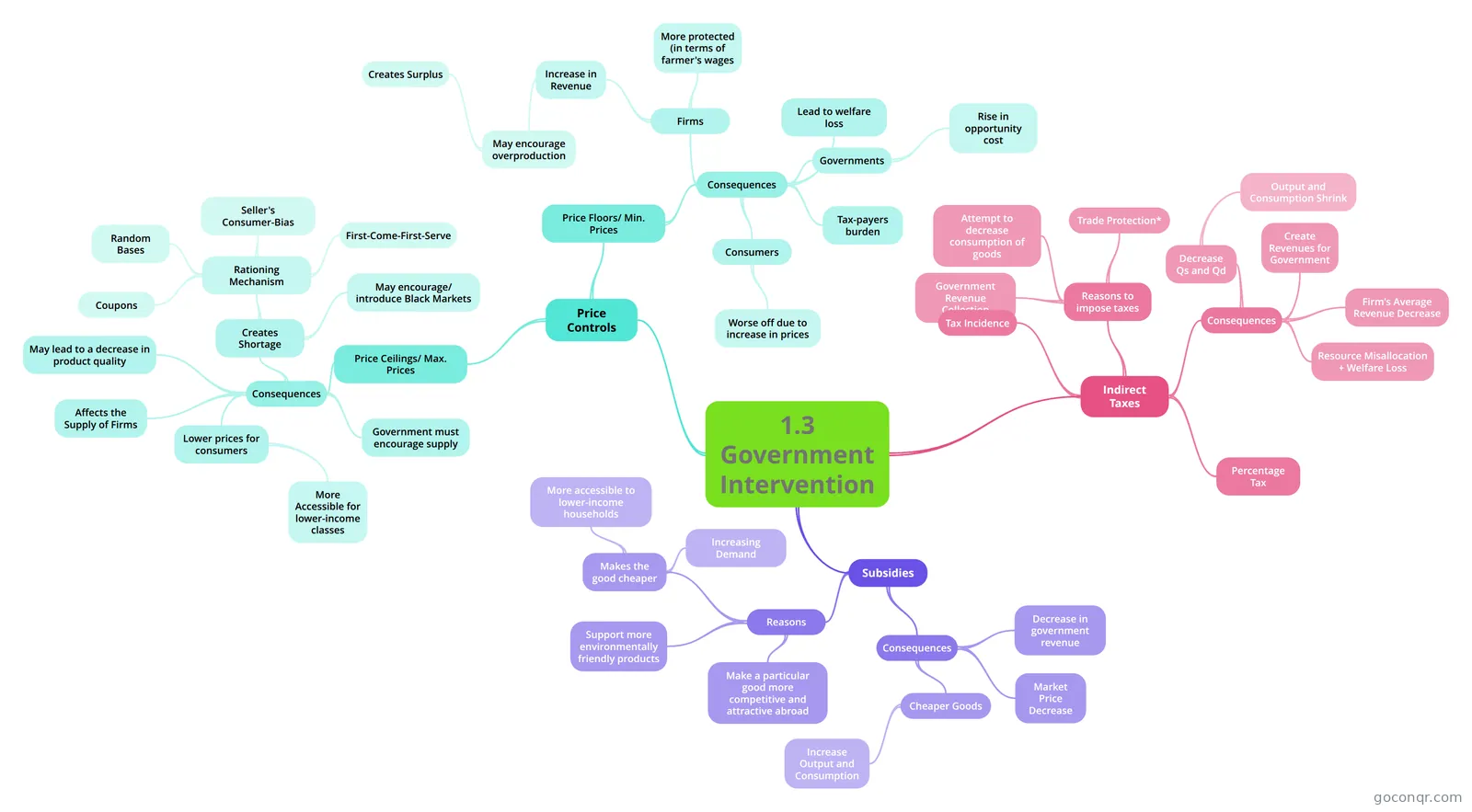
Mind map: Government intervention economics
Map content
1.3 Government Intervention
Indirect Taxes
- Can be treated as an additional cost of production
- Reasons to impose taxes
- Government Revenue Collection
- Attempt to decrease consumption of goods
- e.g. cigarettes, alcoholic drinks, etc.
- Trade Protection*
- * See more in International Trade section
- Consequences
- Decrease Qs and Qd
- Output and Consumption Shrink
- Create Revenues for Government
- Firm's Average Revenue Decrease
- Resource Misallocation + Welfare Loss
- Decrease Qs and Qd
- Tax Incidence
- Percentage Tax
Subsidies
- Reasons
- Makes the good cheaper
- More accessible to lower-income households
- Increasing Demand
- Support more environmentally friendly products
- Make a particular good more competitive and attractive abroad
- Makes the good cheaper
- Consequences
- Decrease in government revenue
- Cheaper Goods
- Increase Output and Consumption
- Market Price Decrease
- Reasons
Price Controls
- Where government attempt to set a price above or below an equilibrium price when the market price is unsatisfactory
- Price Ceilings/ Max. Prices
- Example: - Food price control - Rent control
- Consequences
- Creates Shortage
- May encourage/ introduce Black Markets
- Since there is a shortage caused by price ceilings, those who cannot access these goods in the legal goods may access them in the Black Markets
- Rationing Mechanism
- Mitigate the shortage problem for consumers
- First-Come-First-Serve
- Seller's Consumer-Bias
- Products may be allocated on the basis of who the consumer is (e.g. regular consumer?)
- Random Bases
- Coupons
- May encourage/ introduce Black Markets
- Lower prices for consumers
- More Accessible for lower-income classes
- Government must encourage supply
- Decrease the shortage issue
- Affects the Supply of Firms
- May lead to a decrease in product quality
- Creates Shortage
- Price Floors/ Min. Prices
- Examples: - Price support for farmers - Minimum Wage Policy
- Consequences
- Firms
- Increase in Revenue
- May encourage overproduction
- Which means resource misallocation
- Creates Surplus
- May encourage overproduction
- More protected (in terms of farmer's wages
- Increase in Revenue
- Consumers
- Worse off due to increase in prices
- Takes a larger % of income spent on these goods
- Worse off due to increase in prices
- Tax-payers burden
- Lead to welfare loss
- Governments
- Rise in opportunity cost
- Firms
Information
- Description
- IB Economics (1: Microeconomics) Mind Map on 1.3 Government Intervention, created by IBMichelle on 17/04/2014.
- Created by
- IBMichelle
- Views
- 524
- Tags
- Rating