
Mind map
Polymers
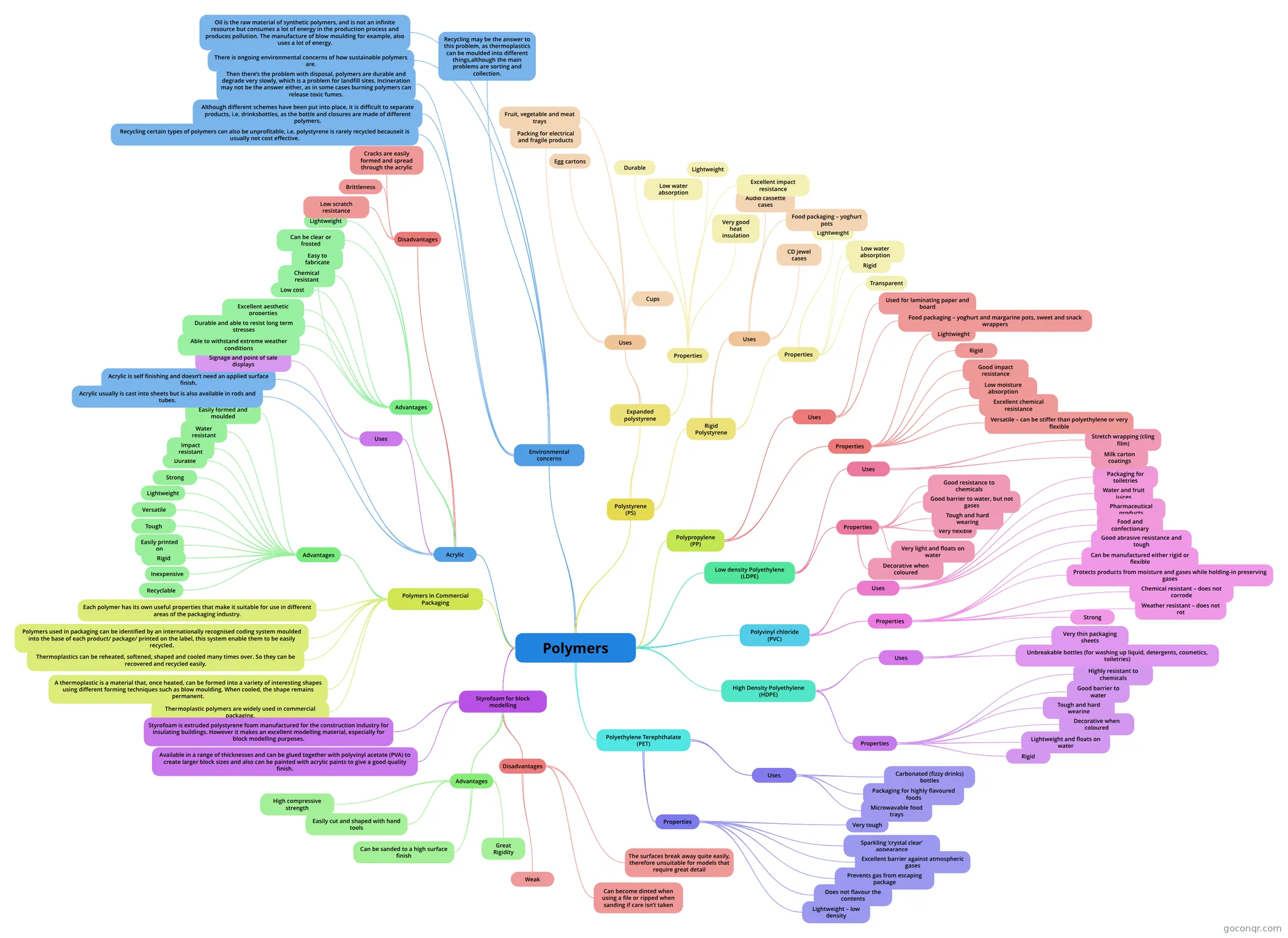
Mind map: Polymers in packaging
Map content
Polymers
Polymers in Commercial Packaging
- Thermoplastic polymers are widely used in commercial packaging.
- A thermoplastic is a material that, once heated, can be formed into a variety of interesting shapes using different forming techniques such as blow moulding. When cooled, the shape remains permanent.
- Thermoplastics can be reheated, softened, shaped and cooled many times over. So they can be recovered and recycled easily.
- Polymers used in packaging can be identified by an internationally recognised coding system moulded into the base of each product/ package/ printed on the label, this system enable them to be easily recycled.
- Each polymer has its own useful properties that make it suitable for use in different areas of the packaging industry.
- Advantages
- Easily printed on
- Inexpensive
- Recyclable
- Rigid
- Versatile
- Tough
- Strong
- Durable
- Water resistant
- Easily formed and moulded
- Impact resistant
- Lightweight
Styrofoam for block modelling
- Styrofoam is extruded polystyrene foam manufactured for the construction industry for insulating buildings. However it makes an excellent modelling material, especially for block modelling purposes.
- Available in a range of thicknesses and can be glued together with polyvinyl acetate (PVA) to create larger block sizes and also can be painted with acrylic paints to give a good quality finish.
- Advantages
- High compressive strength
- Can be sanded to a high surface finish
- Easily cut and shaped with hand tools
- Great Rigidity
- Disadvantages
- Can become dinted when using a file or ripped when sanding if care isn’t taken
- The surfaces break away quite easily, therefore unsuitable for models that require great detail
- Weak
Polyethylene Terephthalate (PET)
- Properties
- Sparkling ‘crystal clear’ appearance
- Very tough
- Lightweight – low density
- Does not flavour the contents
- Prevents gas from escaping package
- Excellent barrier against atmospheric gases
- Uses
- Carbonated (fizzy drinks) bottles
- Packaging for highly flavoured foods
- Microwavable food trays
- Properties
High Density Polyethylene (HDPE)
- Properties
- Highly resistant to chemicals
- Tough and hard wearing
- Lightweight and floats on water
- Good barrier to water
- Decorative when coloured
- Rigid
- Uses
- Unbreakable bottles (for washing up liquid, detergents, cosmetics, toiletries)
- Very thin packaging sheets
- Properties
Polyvinyl chloride (PVC)
- Properties
- Weather resistant – does not rot
- Chemical resistant – does not corrode
- Protects products from moisture and gases while holding-in preserving gases
- Can be manufactured either rigid or flexible
- Good abrasive resistance and tough
- Strong
- Uses
- Water and fruit juices
- Pharmaceutical products
- Food and confectionary
- Packaging for toiletries
- Properties
Low density Polyethylene (LDPE)
- Properties
- Decorative when coloured
- Very light and floats on water
- Very flexible
- Tough and hard wearing
- Good barrier to water, but not gases
- Good resistance to chemicals
- Uses
- Stretch wrapping (cling film)
- Milk carton coatings
- Properties
Polypropylene (PP)
- Properties
- Rigid
- Lightwieght
- Excellent chemical resistance
- Versatile – can be stiffer than polyethylene or very flexible
- Low moisture absorption
- Good impact resistance
- Uses
- Food packaging – yoghurt and margarine pots, sweet and snack wrappers
- Used for laminating paper and board
- Properties
Polystyrene (PS)
- Rigid Polystyrene
- Properties
- Rigid
- Lightweight
- Low water absorption
- Transparent
- Uses
- Food packaging – yoghurt pots
- CD jewel cases
- Audio cassette cases
- Properties
- Expanded polystyrene
- Properties
- Very good heat insulation
- Durable
- Low water absorption
- Lightweight
- Excellent impact resistance
- Uses
- Egg cartons
- Cups
- Packing for electrical and fragile products
- Fruit, vegetable and meat trays
- Properties
- Rigid Polystyrene
Acrylic
- Acrylic usually is cast into sheets but is also available in rods and tubes.
- Acrylic is self finishing and doesn’t need an applied surface finish.
- Uses
- Signage and point of sale displays
- Advantages
- Able to withstand extreme weather conditions
- Low cost
- Can be clear or frosted
- Easy to fabricate
- Lightweight
- Chemical resistant
- Excellent aesthetic properties
- Durable and able to resist long term stresses
- Disadvantages
- Cracks are easily formed and spread through the acrylic
- Low scratch resistance
- Brittleness
Environmental concerns
- Recycling certain types of polymers can also be unprofitable, i.e. polystyrene is rarely recycled becauseit is usually not cost effective.
- Although different schemes have been put into place, it is difficult to separate products, i.e. drinksbottles, as the bottle and closures are made of different polymers.
- Recycling may be the answer to this problem, as thermoplastics can be moulded into different things,although the main problems are sorting and collection.
- Then there’s the problem with disposal, polymers are durable and degrade very slowly, which is a problem for landfill sites. Incineration may not be the answer either, as in some cases burning polymers can release toxic fumes.
- Oil is the raw material of synthetic polymers, and is not an infinite resource but consumes a lot of energy in the production process and produces pollution. The manufacture of blow moulding for example, also uses a lot of energy.
- There is ongoing environmental concerns of how sustainable polymers are.
Information
- Description
- A-Levels Graphical Products AS (Polymers) Mind Map on Polymers, created by Poppy Venables on 12/05/2013.
- Created by
- Poppy Venables
- Views
- 112
- Tags
- Rating