
Mind map
The Concept of Liability
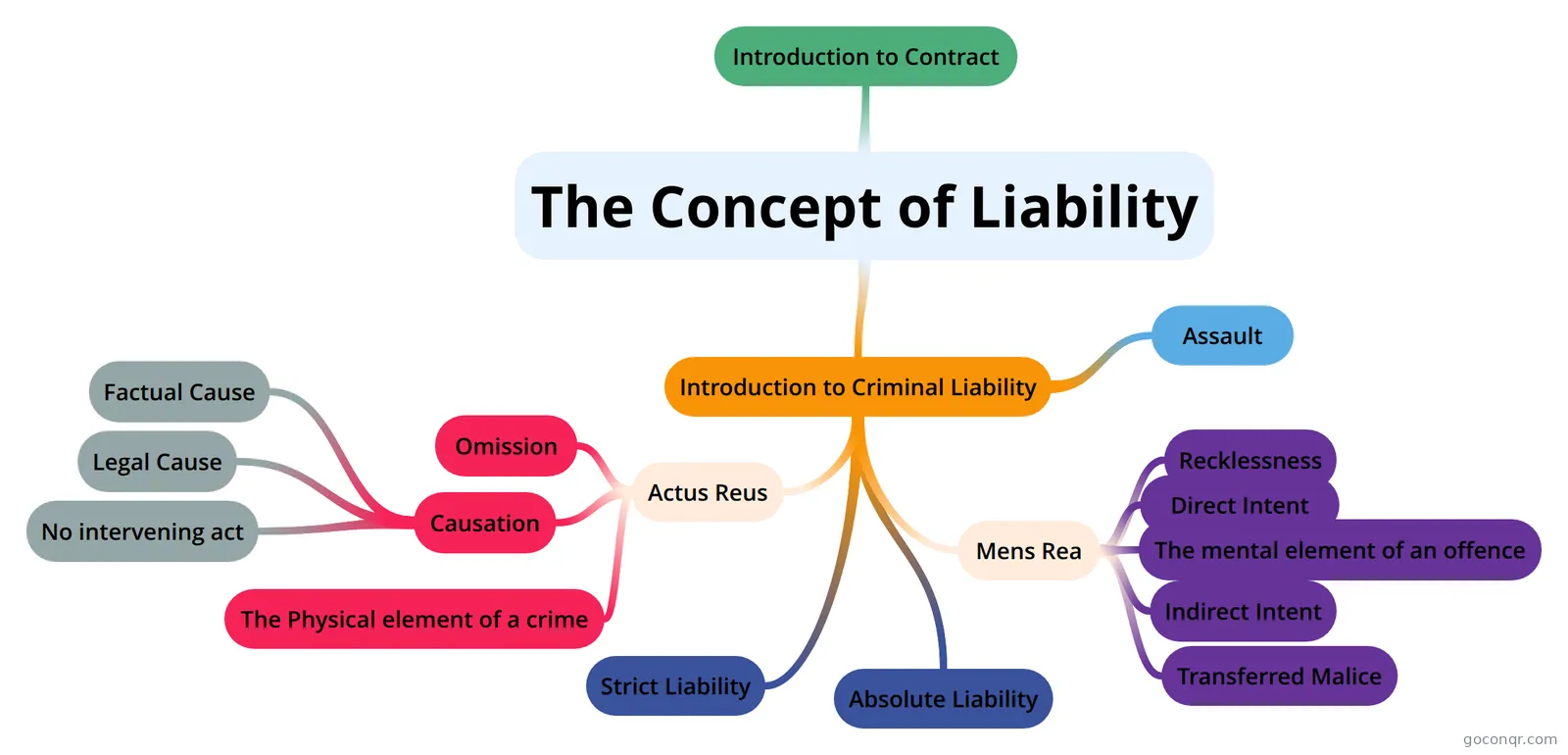
Mind map: The concept of liability
Map content
The Concept of Liability
Introduction to Criminal Liability
- Actus Reus
- The Physical element of a crime
- D's act must be voluntary. If D has no control over his/her actions then they are not at fault and have not committed the actus reus HILL V BAXTER (1958)
- Causation
- The prosecution has to show that: D's conduct was the factual cause of that consequence; and D's conduct was the legal cause of that consequence; and there was no intervening act which broke the chain of causation from D's conduct to that consequence
- Factual Cause
- 'but for' test: D will be the factual cause if the consequence would not have happened 'but for' D's conduct. PAGETT (1983) D used his pregnant girlfriend as a shield while he was shot at by police. the girl was shot by the police and later died. D was convicted of manslaughter
- Legal Cause
- D will be the legal cause if they are more than a minimal cause of the consequence. BENGE (1865) D was a foreman charged with manslaughter when the railway tracks weren't re-laid in time and a train crashed as a result killing many people.
- No intervening act
- Where D's conduct causes reasonably foreseeable actions by a third party, the chain of causation will remain unbroken: PAGETT Medical negligence is unlikely to break the chain of causation CHESHIRE (1991)
- Omission
- The normal rule is that an omission (failure to act) cannot make a person guilty of an offence. However: A statute may require D to act and omitting to do so will satisfy the actus reus e.g driving without insurance
- The Physical element of a crime
- Mens Rea
- The mental element of an offence
- Each offence has its own mens rea to be found guilty the prosecution must prove that D had the relevant mens rea for the offence charged
- Direct Intent
- D directly intends a result where it is his aim or purpose. D actually desires the result that occurs and sets out to achieve it : MOHAN (1976). For example, where D deliberately punches V, he directly intends to use unlawful force on V. Her motive or reason for throwing the punch is not to relevant to whether he has the mens rea or not
- Indirect Intent
- a court may find that D indirectly intends a result where that result is not desired, but was virtually certain to occur and D knows this. : WOOLIN (1998) D 'lost his cool' when his baby started to choke and in a fit of frustration, threw his baby in the direction of his pram. The child missed the pram and fatally struck a wall. The trial judge misdirected the jury on the law. As a result, the House of Lords held on appeal that D should be guilty of manslaughter. The trial judge should have made it clear that D must know that the undesired result was virtually certain to occur, in order that the jury may find that D indirectly intended the death.
- Recklessness
- D will have acted recklessly where he knows there was a risk of the result happening, but takes that risk. CUNNINGHAM: (1957) D tore a gas meter from the wall of an empty house in order to steal the money in it. This caused gas to seep into the house next door, making V ill. D was not liable since he did not know there was a risk of gas escaping into V's house. He had not intended to cause the harm, nor had he taken a risk he knew about.
- Transferred Malice
- Where D's mens rea is directed at one person, but D harms someone else, he can still be guilty. In such cases D's state of mind is transferred to the actual victim. Either intention or recklessness can be transferred. LATIMER (1886) D aimed a blow with a belt at a man in a pub after that man had attacked him. The belt bounced off the man and struck a woman in the face. D was convicted of wounding the woman. His intention to harm the man transferred to the actual victim.
- However, the principle of transferred malice is not available top make D guilty where D's mens rea is for a completely different type of offence. PEMBLITON (1874) D threw a stone intending to hit people with whom he had been fighting. The stone missed them and smashed a pub window. He was not liable for the damage to the property window because his intention to hit people could not be transferred to property
- The mental element of an offence
- Strict Liability
- There are two exceptions to the general rule that crimes require the prosecution to prove both actus resus and mens rea for D to be guilty these are: Crimes of strict liability and crimes of absolute liabilty
- An offence of strict liability means one where the prosecution need not prove mens rea for at least part of the actus reus (or not at all). D must have committed the actus reus voluntarily, but D does not have to be at fault. D can be liable for the offence even though he or she did not have a guilty mind at the time they committed the guilty act. HARROW LONDON BOROUGH COUNCIL V SHAH (1999)
- 1. Strict liability offences help protect society for example protection from unfit food, protection against pollution and protection from unsafe buildings. It makes sure that businesses are run properly. 2. It is easier to enforce satrict liability offences as there is no need for the prosecution to prove mens rea. This would have helped secure conviction of the company in ALPHACELL LTD V WOODWARD 3. It also saves court time as D's are more likely to plead guilty so that no trial is required. The fact that D may not be blameworthy can be taken into account when sentencing.
- Absolute Liability
- Where an offence is one of strict liability, the prosecution must prove D voluntarily committed the actus reus; if D acted involuntarily then there is no actus reus and D is not guilty. On the other hand, if an offence is one of absolute liability, in addition to the mens rea not needing to be proved, the actus reus can be involuntary. Such crimes are rare and the actus reus is a state of affairs. WINZAR V CHIEF CONSTABLE OF KENT (1983) the police removed D, who was drunk from a hospital and took him outside. He was then charged with being found drunk on the highway. The court upheld his conviction because this was an offence of absolute liability, designed to deal with the nuisance of public drunkness. It did not matter that D had been taken to the highway against his will.
- Assault
- D must intentionally or recklessly cause V to apprehend immediate and unlawful force: IRELAND (1996) The actus reus of an assault is where by an act or words D causes V to apprehend immediate and unlawful force.
- Actus Reus
Introduction to Contract
Information
- Description
- A level Law Mind Map on The Concept of Liability, created by Joe Patterson on 05/05/2017.
- Created by
- Joe Patterson
- Views
- 5
- Rating
More on Elements of Criminal Liability